

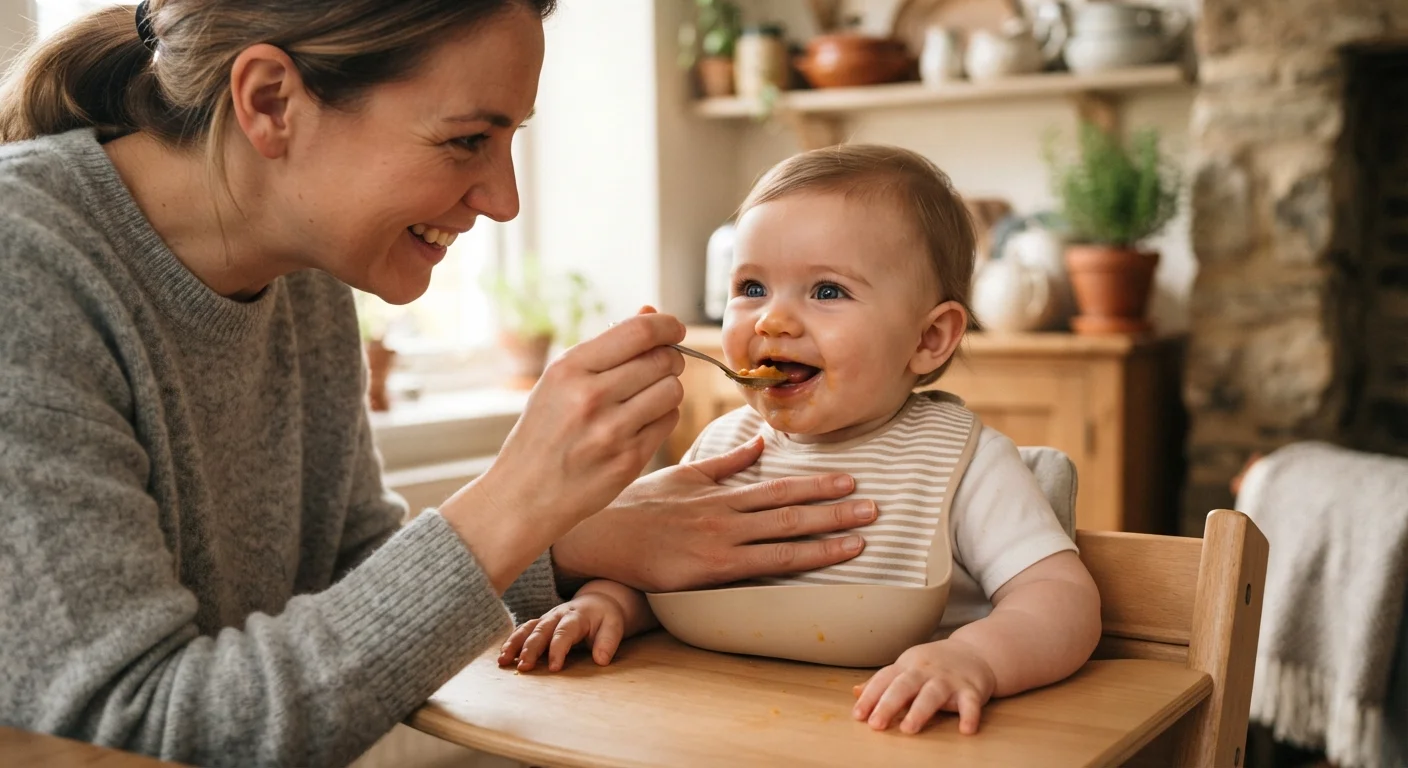
When Is Your Baby Actually Ready?
The American Academy of Pediatrics (AAP) recommends introducing solid foods at around 6 months of age - not at 4 months, and not simply because a grandparent thinks the baby looks hungry. Age alone is not the deciding factor. Developmental readiness is. For a broader picture of what's happening in your baby's first year, see our month-by-month infant development guide.
Look for all three of these physical readiness signs before proceeding:
- Head and neck control: Your baby can hold their head steady and upright without support.
- Sitting with minimal help: They can sit up with only light support and don't slump forward significantly.
- Loss of tongue-thrust reflex: When you put something near their mouth, they don't automatically push it back out with their tongue.
Bonus signals include showing interest in food - watching others eat, reaching toward plates, or opening their mouth when food is near. If you're uncertain, your pediatrician is the right person to make the final call.
What you will need
What You'll Need Before the First Bite
Starting solids doesn't require expensive equipment, but having the right basics in place makes the process safer and more manageable.
Highchair or infant feeding seat
Keeps your baby upright and safely supported during feeding, which is essential for safe swallowing.
Soft-tipped baby spoons
Gentle on developing gums and small enough for a baby's mouth.
Silicone bib with catch pocket
Catches dropped food and reduces cleanup - solids feeding is invariably messy.
Small storage containers or ice cube trays
Useful for batch-preparing and freezing pureed foods in baby-sized portions.
Food thermometer
Confirms that heated food is not too hot before serving - always stir and test temperature.
Beyond equipment, prepare yourself mentally: early feeding sessions are more about exploration than nutrition. Expect mess, funny faces, and a lot of food ending up on the floor. That's normal and developmentally appropriate.
How to Introduce Solids Step by Step
Follow these steps in order. There's no need to rush - the goal for the first several months is exposure and skill-building, not caloric replacement.
Confirm readiness with your pediatrician
Before offering any solid food, bring it up at your baby's 6-month well-child visit. Your pediatrician can confirm developmental readiness, flag any concerns specific to your baby (such as reflux, prematurity, or family allergy history), and give you a starting plan tailored to your child.
Choose an appropriate first food
Good first foods are smooth, easy to swallow, and low in added salt or sugar. Common starting points include:
- Iron-fortified single-grain baby cereal mixed with breast milk or formula
- Pureed cooked vegetables (sweet potato, squash, peas, carrots)
- Pureed ripe fruit (banana, pear, avocado)
- Pureed plain meat or poultry
There is no evidence-based requirement to start with vegetables before fruit or to follow a specific order - variety and iron intake are the priorities. For foundational nutrition principles, our family nutrition basics guide offers helpful context.
Offer a small amount at a calm, unhurried time
Start with 1-2 teaspoons of a single pureed food. Choose a time when your baby is alert and content - not overtired, overhungry, or fussy. Sit them upright in a highchair and maintain eye contact. Offer the spoon gently; never force it into their mouth.
Wait 3-5 days before introducing the next new food
Introducing one food at a time and waiting several days before adding another allows you to identify any adverse reactions - rashes, vomiting, diarrhea, or unusual fussiness - and trace them to a specific food. Keep a simple log of what you've introduced and when.
Gradually increase variety and texture
Over weeks and months, expand the range of foods and slowly shift from smooth purees toward mashed and then soft, small finger foods as your baby's oral motor skills develop. By around 9-10 months, many babies can manage soft, small pieces of food. The goal by 12 months is a varied diet of family foods (appropriately modified in texture) alongside continued breast milk or formula.
Maintain breast milk or formula as the primary drink
Solids supplement, not replace, breast milk or formula during the first year. Continue offering your usual milk feeds - the volume may naturally decrease as solid intake increases, but milk remains the primary source of calories, fat, and nutrients until 12 months.
Eat Together When You Can
Babies learn enormously from watching others eat. Sharing mealtimes - even if your baby is just observing - builds positive associations with food and models eating behaviors. It also makes feeding feel less like a clinical task and more like a shared family moment.
Common Pitfalls and What to Watch For
Even well-prepared parents encounter stumbling blocks. Here are the most frequent ones:
- Starting too early: Introducing solids before 4 months is associated with increased choking risk and potential digestive issues. Before 6 months, most babies aren't neurologically ready.
- Skipping common allergens: Current evidence, including guidance from organizations like the AAP, suggests that early introduction of common allergens - peanut products, egg, fish - may actually lower allergy risk for many infants. Discuss timing with your pediatrician, especially if there's a family history of food allergies.
- Confusing gagging with choking: Gagging is a normal protective reflex as babies learn to move food in their mouths. It looks alarming but usually resolves on its own. Choking is silent, involves no crying or coughing, and requires immediate action. Take an infant CPR and first-aid course before starting solids.
- Offering honey or cow's milk too early: Honey should not be given before 12 months due to the risk of infant botulism. Whole cow's milk as a main drink is not recommended before 12 months.
- Pressuring your baby to eat more: Responsive feeding - following your baby's hunger and fullness cues - lays a healthier foundation than coaxing or pushing. For more on building sound family eating patterns, see our nutrition pitfalls to avoid.
Know the Difference: Gagging vs. Choking
Gagging involves coughing, sputtering, and often watery eyes - it looks scary but is a normal reflex as babies learn to handle food. Choking is silent: the baby cannot cough, cry, or breathe. Every caregiver should complete an infant CPR and first-aid course before starting solids. Contact your local hospital, Red Cross chapter, or pediatrician's office for courses available in your area.
This article provides general educational information only and is not a substitute for personalized medical advice. Always consult your child's pediatrician before starting solid foods or making changes to their feeding routine.
The content provided on our blog site traverses numerous categories, offering readers valuable and practical information. Readers can use the editorial team’s research and data to gain more insights into their topics of interest. However, they are requested not to treat the articles as conclusive. The website team cannot be held responsible for differences in data or inaccuracies found across other platforms. Please also note that the site might also miss out on various schemes and offers available that the readers may find more beneficial than the ones we cover.