

Why These Terms Get Confused
"Therapist," "counselor," and "psychiatrist" are often used interchangeably in everyday conversation - but they describe meaningfully different roles, training backgrounds, and services. For families trying to figure out where to start, the overlap can feel overwhelming. This article cuts through the confusion with plain-language definitions so you can make a more informed decision about the type of support that may suit your situation.
It's worth knowing upfront: there is no single "right" type of mental health professional. The best fit depends on what you're experiencing, how long it's been going on, and what kind of help you're looking for. If you're unsure whether you're dealing with a mental health concern or a general wellness question, our article on what mental wellness actually means offers a helpful starting point.
Licensed Therapist
A mental health professional with a state license - such as an LCSW, LMFT, or LPC - who uses evidence-based talk-based approaches to help clients address emotional, behavioral, or psychological concerns. They cannot prescribe medication in most states.
Counselor
A broadly used term for a professional who provides guidance and support, often in a specific context (school, substance use, career). Credentials and scope vary widely; licensing requirements depend on the state and specialty.
Psychiatrist
A medical doctor (MD or DO) who specializes in mental health. Psychiatrists are qualified to diagnose mental health conditions, prescribe and manage psychiatric medications, and may also provide psychotherapy.
Psychotherapy
A broad term for structured, evidence-based treatment of mental health conditions through conversation and skill-building. Examples include cognitive behavioral therapy (CBT) and dialectical behavior therapy (DBT).
Medication Management
Ongoing psychiatric care focused on evaluating the effectiveness, dosage, and side effects of psychiatric medications. Typically provided by a psychiatrist, and sometimes by a primary care physician or nurse practitioner.
Employee Assistance Program (EAP)
A workplace benefit that typically provides free, short-term counseling sessions and referrals to mental health services. EAPs are confidential and available to eligible employees regardless of health insurance coverage.
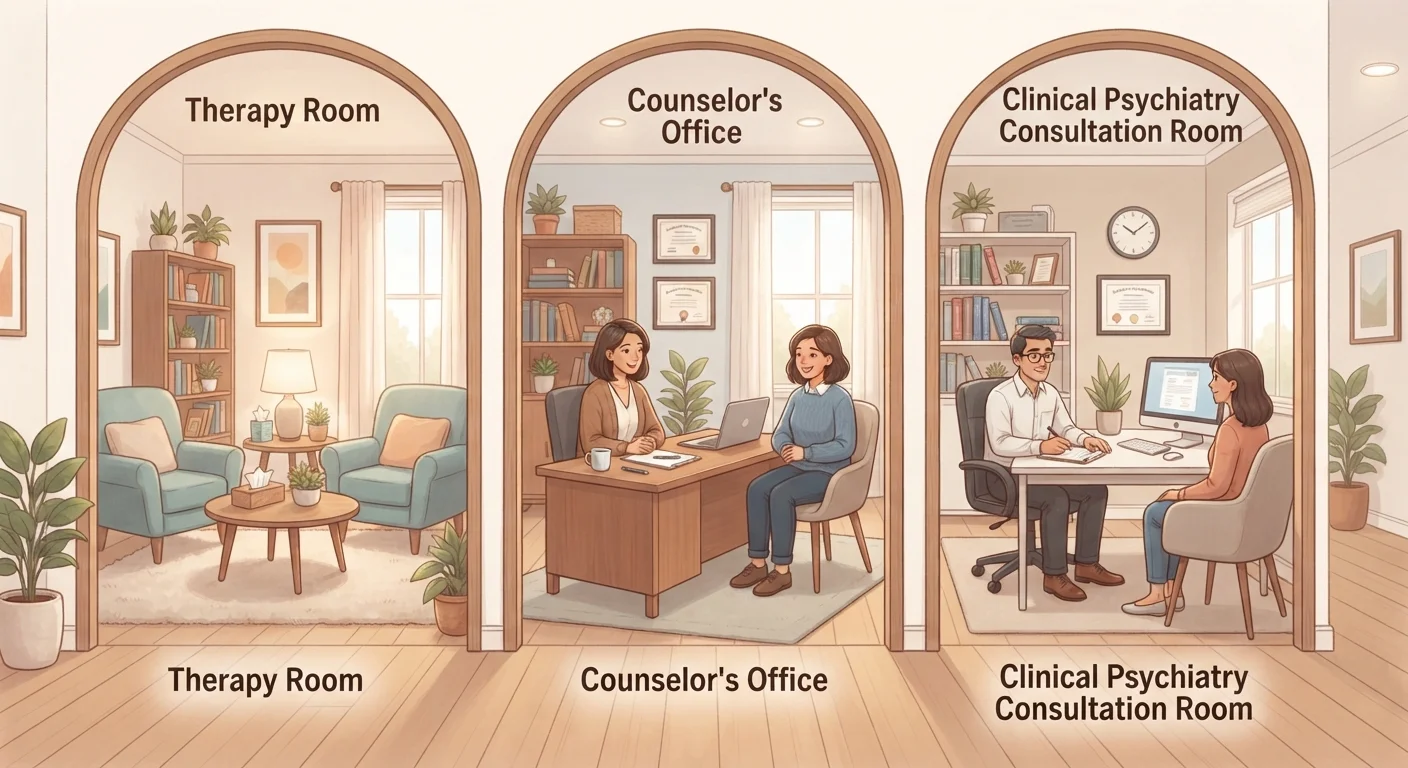
Therapists, Counselors, and Psychiatrists: What Each Role Involves
Therapists are licensed mental health professionals trained to help people work through emotional, behavioral, and psychological challenges using structured, evidence-based talk-based approaches. Common therapy modalities include cognitive behavioral therapy (CBT), dialectical behavior therapy (DBT), and trauma-focused therapies. Therapists typically hold a master's or doctoral degree and are licensed by their state. They do not prescribe medication in most states.
Counselors often work in more specific contexts - schools, substance use recovery programs, career transitions, or grief support, for example. The term "counselor" can cover a wide range of credentials, from licensed professional counselors (LPCs) to school counselors, so it's always worth asking about licensing and training. Counselors generally focus on shorter-term, goal-oriented support rather than deep psychological exploration.
Psychiatrists are medical doctors (MDs or DOs) who specialize in diagnosing and treating mental health conditions. Their most distinctive feature: they can prescribe and manage psychiatric medications. A psychiatry appointment often centers on assessment, diagnosis, and medication management rather than extended talk therapy, though some psychiatrists do offer psychotherapy.
| Can prescribe medication | Psychiatrists (and some nurse practitioners/physician assistants) (American Psychiatric Association) |
| Typical therapy session length | 45-60 minutes |
| Psychiatrist appointment focus | Diagnosis, medication evaluation, and management |
| States where psychologists can prescribe | Currently a small number, including Louisiana and New Mexico (American Psychological Association) |
| Common therapy credentials | LCSW, LMFT, LPC, PhD/PsyD in psychology |
| Free short-term counseling source | Employee Assistance Programs (EAPs) through employers |
Many people work with more than one type of professional simultaneously - for example, seeing a therapist weekly while a psychiatrist manages their medication. This collaborative approach is common and often effective for conditions that benefit from both medication and therapeutic support.
When to Consider Each Type of Support
If you're navigating stress, relationship difficulties, grief, anxiety, or life transitions and you want a structured space to talk through your feelings and develop coping strategies, a therapist is often a natural starting point. Common myths about seeing a therapist - like the idea that it's only for crises - can prevent people from reaching out when they'd genuinely benefit.
If you have a specific, time-limited concern - adjusting to a new job, navigating a loss, or needing support during a difficult season - a counselor with relevant expertise might be a good fit. Schools, community health centers, and employee assistance programs (EAPs) are common access points for counseling services.
If you're experiencing symptoms that may have a biological component - such as persistent depression, significant mood shifts, panic attacks, psychosis, or symptoms that haven't responded to therapy alone - a psychiatric evaluation may be appropriate. A psychiatrist can assess whether medication might be part of an effective treatment plan alongside other support.
If you're new to thinking about your emotional wellbeing at all, our starting point for mental wellbeing walks through how to approach this without feeling overwhelmed.
Your Primary Care Doctor Is Also a Resource
Many people begin conversations about mental health with their primary care physician. A PCP can conduct an initial screening, rule out medical causes for symptoms, prescribe certain psychiatric medications, and provide referrals to appropriate specialists. If you're unsure where to start, your regular doctor's office is a reasonable first call.
This article is for general informational purposes only and is not a substitute for advice from a qualified mental health or medical professional. If you are experiencing a mental health emergency, please contact a crisis line or seek emergency care immediately.
The content provided on our blog site traverses numerous categories, offering readers valuable and practical information. Readers can use the editorial team’s research and data to gain more insights into their topics of interest. However, they are requested not to treat the articles as conclusive. The website team cannot be held responsible for differences in data or inaccuracies found across other platforms. Please also note that the site might also miss out on various schemes and offers available that the readers may find more beneficial than the ones we cover.