

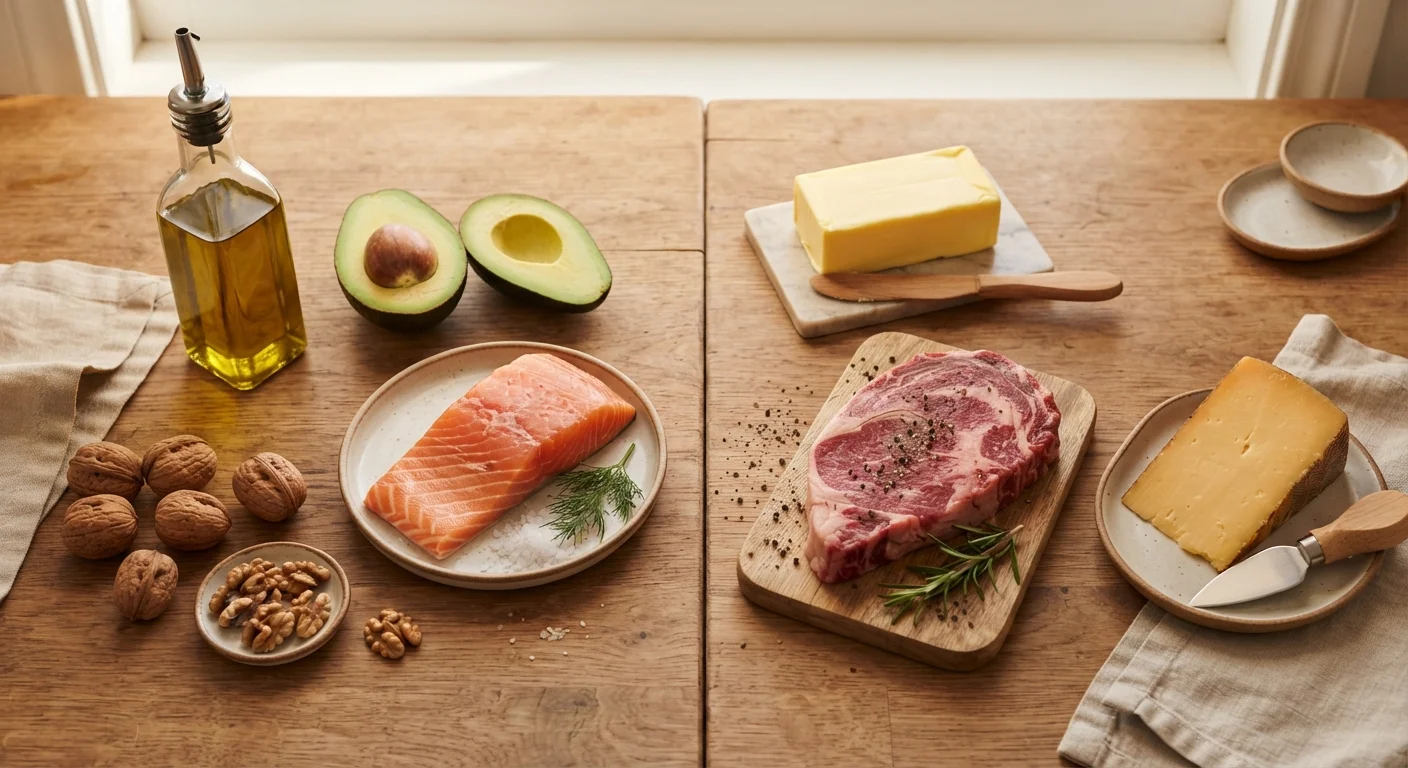
Option A
Saturated Fat
The solid-at-room-temperature fat found mostly in animal foods.
Best for: Understanding which everyday pantry staples to enjoy in moderation, particularly for households watching heart health.
Option B
Unsaturated Fat
The liquid, plant-forward fat widely encouraged by dietary guidelines.
Best for: Home cooks looking to build meals around heart-supportive fats without overhauling their entire grocery list.
What Makes a Fat Saturated or Unsaturated?
At the molecular level, all dietary fats are made of fatty acid chains attached to a glycerol backbone. The word saturated refers to carbon atoms in the chain being fully "saturated" with hydrogen atoms - no double bonds between carbons. Unsaturated fats have one or more double bonds, which creates kinks in the chain and changes how the molecule behaves at room temperature.
That structural difference has real-world consequences in your kitchen. Saturated fats - think butter, lard, and coconut oil - are solid or semi-solid at room temperature. Unsaturated fats - olive oil, canola oil, the fat in walnuts and salmon - stay liquid. Neither form is a sign of purity or danger on its own; they simply behave differently in cooking and in the body.
Unsaturated fats break down further into two families: monounsaturated (one double bond, found in olive oil and avocados) and polyunsaturated (multiple double bonds, found in fatty fish, flaxseed, and most vegetable oils). Omega-3 and omega-6 fatty acids - terms you may have seen on packaging - are types of polyunsaturated fat.
For a broader look at how fat fits alongside carbohydrates and protein, see our plain-language macronutrient guide.
Where Each Fat Type Shows Up in Everyday Foods
Knowing which foods carry which fats makes grocery decisions far less abstract.
Common sources of saturated fat:
- Fatty cuts of beef, pork, and lamb
- Full-fat dairy - butter, cream, whole milk, cheese
- Coconut oil and palm oil
- Many commercially baked goods and fried snacks
Common sources of unsaturated fat:
- Olive oil, avocado oil, canola oil
- Avocados
- Nuts and nut butters (almonds, walnuts, peanuts)
- Seeds (chia, flaxseed, sunflower)
- Fatty fish such as salmon, mackerel, and sardines
| Criterion | Saturated Fat | Unsaturated Fat |
|---|---|---|
| Structure | No double bonds; fully saturated with hydrogen | One or more double bonds in carbon chain |
| State at room temperature | Solid or semi-solid | Liquid |
| Main food sources | Butter, red meat, full-fat dairy, coconut oil | Olive oil, avocados, nuts, seeds, fatty fish |
| Sub-types | Long-chain, medium-chain (e.g., lauric acid) | Monounsaturated, polyunsaturated (omega-3, omega-6) |
| Guideline stance | Limit to under 10% of daily calories | Encouraged as a replacement for saturated fat |
| Effect on LDL cholesterol | Associated with higher LDL in many studies | Associated with more favorable LDL levels |
| Cooking stability | Generally more stable at high heat | Varies; some (e.g., olive oil) handle moderate heat well |
Most whole foods contain a mix of fat types rather than just one. Salmon contains some saturated fat alongside its well-known omega-3s. Even olive oil has a small saturated fat component. Labels reflect this - the "Saturated Fat" and "Total Fat" lines on the Nutrition Facts panel count grams from every source in that food.
What Dietary Guidelines Generally Recommend
The U.S. Dietary Guidelines for Americans advise limiting saturated fat to less than 10 percent of total daily calories, and suggest replacing some saturated fat with unsaturated fat rather than simply cutting fat overall. The American Heart Association recommends an even lower threshold for people managing cardiovascular risk - but personal targets should always be discussed with a healthcare provider, not determined by an article.
<10%
Recommended saturated fat limit (daily calories)
Per the U.S. Dietary Guidelines for Americans, adults are advised to keep saturated fat below 10% of total daily caloric intake.
~70%
Of US adults exceed saturated fat recommendations
According to CDC dietary surveillance data, a majority of American adults consume more saturated fat than current guidelines suggest.
5-6%
AHA's lower saturated fat target for at-risk adults
The American Heart Association suggests a more conservative limit of 5-6% of daily calories for people managing high cholesterol or cardiovascular disease risk.
The reasoning behind these guidelines centers on LDL cholesterol (often called "bad" cholesterol). Research, including large observational studies and controlled trials, has generally found that substituting saturated fat with polyunsaturated fat is associated with more favorable LDL levels. The science is nuanced, however - some researchers argue that the food matrix surrounding the fat (a cheese versus a processed pastry, for example) matters as much as the fat itself.
What most experts agree on: overall diet quality outweighs single-nutrient obsession. A diet rich in vegetables, legumes, whole grains, and a variety of fats - including moderate saturated fat - is a more useful framing than targeting one molecule. This is also why common nutrition myths around "all fat is bad" have largely been retired by mainstream science.
This article is for general informational purposes only and is not a substitute for personalized medical or dietary advice. Please consult a qualified healthcare professional for guidance specific to your health situation.
The content provided on our blog site traverses numerous categories, offering readers valuable and practical information. Readers can use the editorial team’s research and data to gain more insights into their topics of interest. However, they are requested not to treat the articles as conclusive. The website team cannot be held responsible for differences in data or inaccuracies found across other platforms. Please also note that the site might also miss out on various schemes and offers available that the readers may find more beneficial than the ones we cover.