

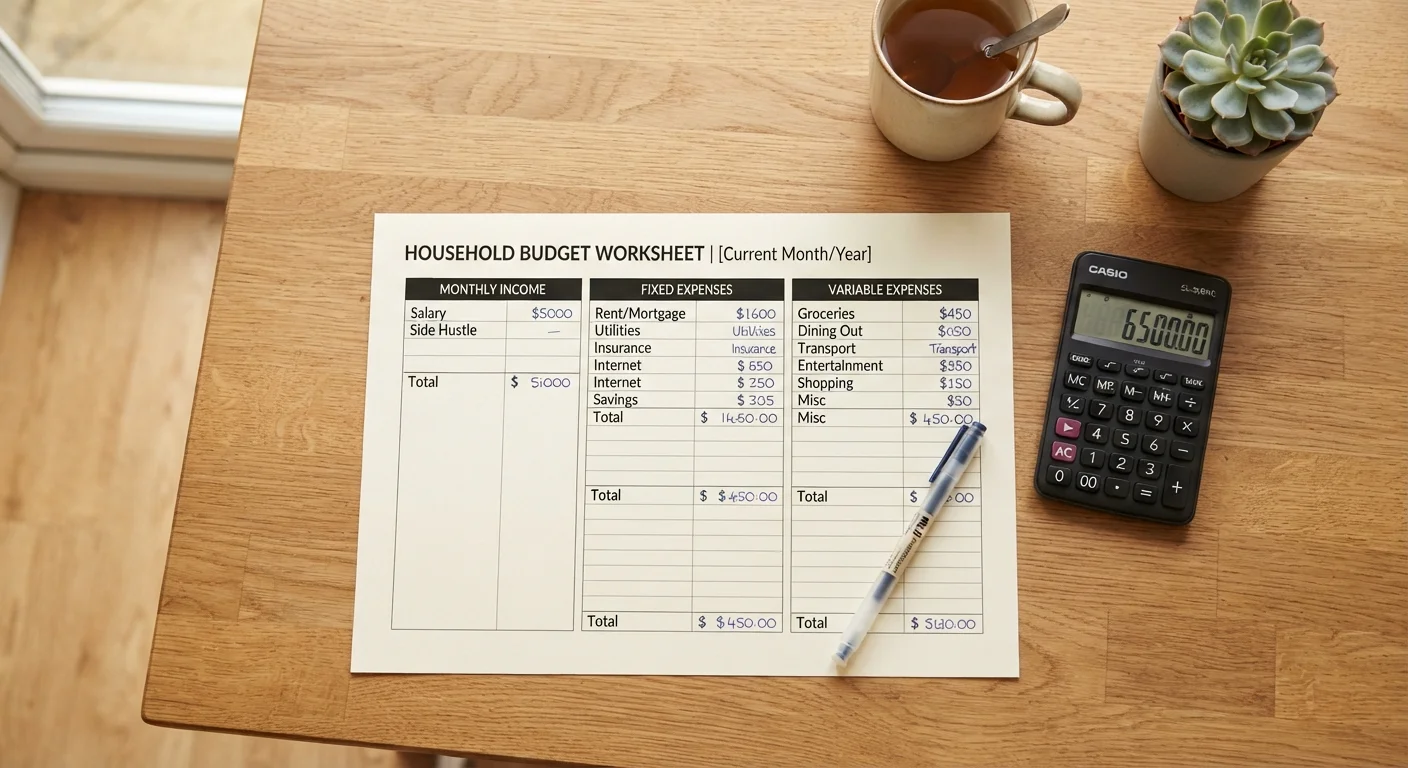
How the Three Categories Actually Work
Before you can apply the 50/30/20 rule, you need a clear picture of what goes in each bucket. Start with your monthly take-home pay - after taxes and any automatic deductions like health insurance premiums through your employer.
Needs (50%): This covers the non-negotiables. Rent or mortgage, utilities, groceries, transportation to work, minimum loan payments, and required insurance all belong here. If you stopped paying for it, there would be a serious consequence - eviction, repossession, or a lapse in coverage.
Wants (30%): These are the expenses that make life enjoyable but that you could cut if you had to. Streaming services, dining out, vacations, concert tickets, and clothing beyond basics fit here. The wants category isn't about guilt - it's about awareness. For a deeper look at how to draw the line honestly, see making honest needs vs. wants decisions.
Savings and Debt Payoff (20%): This is your financial future. Emergency fund contributions, retirement account deposits, and any extra debt payments beyond minimums all live here. Treating this category with the same seriousness as your rent payment is what separates households that build wealth from those that feel like they're always starting over.
~34%
Average share of income spent on housing by US renters
According to U.S. Census Bureau data, many renter households spend well above the traditional 30% housing guideline, making the 50% needs cap a stretch in many markets.
$1,000
Emergency savings many US households lack
Federal Reserve survey data has consistently found that a notable share of US adults would struggle to cover an unexpected $400-$1,000 expense, highlighting why the savings slice matters.
3 buckets
Categories the 50/30/20 rule uses
Compared to line-item budgets that can track 20 or more expense categories, the 50/30/20 framework's simplicity is its primary advantage for households new to budgeting.
Where the Rule Works Well - and Where It Doesn't
The 50/30/20 framework shines for households with relatively stable incomes and living costs that fall within typical national ranges. It's easy to explain, easy to remember, and requires no spreadsheet expertise. For families feeling overwhelmed by complex budgeting systems, it offers a manageable entry point.
That said, it isn't a perfect fit for everyone. Households in high-cost metro areas - where rent alone can consume 40% or more of take-home pay - may find the 50% needs cap impossible to hit. Similarly, families carrying significant high-interest debt may need to temporarily redirect more than 20% toward payoff in order to make meaningful progress.
Adjust the Percentages to Fit Your Reality
There's nothing magic about 50/30/20 specifically - the real value is the habit of intentional allocation. If your needs genuinely run 60% of take-home pay right now, start there and work toward the benchmark over time. A budget that reflects your actual life is far more useful than one that looks correct on paper but can't be followed.
If the standard percentages don't match your reality, treat them as a target direction rather than an immediate destination. Even adjusting to a 60/20/20 split while you work to lower housing or transportation costs puts you further ahead than having no framework at all. The point is intentional allocation, not perfection.
It also helps to know your current numbers before you apply any framework. Building your first household spending snapshot is a practical first step that shows you exactly where your dollars are going each month.
Putting the Rule Into Practice
The mechanics are straightforward. Take your monthly take-home pay, multiply it by 0.50, 0.30, and 0.20, and you have your three spending targets in dollars.
For example, a household bringing home $5,000 per month after taxes would aim for:
- $2,500 for needs
- $1,500 for wants
- $1,000 for savings and extra debt payoff
Once you have those numbers, compare them to what you're actually spending. That gap - between target and reality - tells you where to focus first. Most households find they're over in one or two categories, and that's where the real budgeting work begins.
The 50/30/20 rule fits naturally within a broader personal finance plan. For resources on building savings habits and managing debt alongside your budget, the Saving & Debt hub covers both topics in depth. And for ongoing, practical money habits that complement a simple budget, the Everyday Money Tips hub is a useful ongoing reference.
This article is for general informational and educational purposes only and does not constitute personalized financial advice. Consider consulting a qualified financial professional for guidance specific to your household's situation.
Frequently Asked Questions
It uses your after-tax, take-home income - the amount that actually lands in your bank account each pay period. Using gross income would inflate your budget numbers and lead to unrealistic targets, since taxes, Medicare, and Social Security contributions are already withheld.
Needs are expenses you can't reasonably go without - rent or mortgage payments, basic groceries, utilities, minimum debt payments, and required insurance. Wants are things that add enjoyment or convenience but aren't strictly necessary, like streaming subscriptions, restaurant meals, or gym memberships. The line can get blurry, and that's normal - the related article on <a href="/personal-finance/budgeting-basics/needs-wants-and-the-gray-area-in-between-making-honest-budget-decisions">needs vs. wants in real household budgets</a> walks through common gray areas.
That's a real challenge in high-cost areas, and the 50/30/20 rule isn't designed to magically fix a housing cost problem. In that situation, you may need to temporarily shrink the 'wants' category, aggressively look for ways to reduce other needs-category costs, or consider a longer-term plan to increase income. The percentages are guidelines, not guarantees.
Minimum required payments on debt (like a car loan or credit card minimum) count as needs because skipping them has serious consequences. Any amount you pay above and beyond the minimum - accelerated debt payoff - belongs in the 20% savings and debt category.
For households where most or all of take-home pay is consumed by basic living costs, the standard split may not be achievable right away. The framework is still useful as a goal and a diagnostic tool - it can highlight the gap between where you are and where you want to be, even if 20% savings isn't realistic today.
The 50/30/20 rule is a high-level percentage framework - it doesn't require assigning every dollar to a specific expense category. Envelope budgeting physically separates cash into spending categories, while zero-based budgeting assigns every dollar a specific job each month. The 50/30/20 approach is generally less granular and easier to maintain for households that want simplicity over precision.
The content provided on our blog site traverses numerous categories, offering readers valuable and practical information. Readers can use the editorial team’s research and data to gain more insights into their topics of interest. However, they are requested not to treat the articles as conclusive. The website team cannot be held responsible for differences in data or inaccuracies found across other platforms. Please also note that the site might also miss out on various schemes and offers available that the readers may find more beneficial than the ones we cover.