

Why These Three Mechanics Matter
Most pet owners focus on what to teach — sit, stay, come, leave it. Far fewer pay attention to how learning actually happens in an animal's brain. Three mechanics — reward timing, luring, and fading — sit at the heart of almost every positive-reinforcement training method. Understanding them doesn't require a background in animal behavior; it just requires knowing what your pet's nervous system is actually doing when it learns.
These aren't stylistic preferences. They reflect how associations form between a behavior and its consequence. Get them right and training accelerates. Get them wrong — particularly timing — and you can accidentally reinforce behaviors you didn't intend to. For a grounding in why reward-based approaches work at a biological level, see our guide to the science of positive reinforcement.
Reward Timing: The Half-Second Window
When an animal performs a behavior, a brief window opens — roughly half a second — during which a reward will be reliably associated with that behavior. Deliver the reward inside that window and the animal learns: that action caused something good. Deliver it three seconds later and the animal is learning from whatever it did in those three seconds — which might be sniffing the floor, glancing away, or shifting its weight.
This is why trainers use a marker signal — a clicker or a short verbal cue like "yes" — to bridge the gap between the behavior and the treat. The marker itself becomes a conditioned signal meaning "that's exactly it, reward is coming." The treat can then follow over the next few seconds without losing precision.
Load your marker before you need it. Spend two minutes pairing a clicker or the word 'yes' with treats before starting a new behavior — ten to fifteen pairings is usually enough for the marker to carry predictive value.
A marker that hasn't been conditioned functions as meaningless noise. Pre-loading it means the signal reliably predicts reward from the first repetition of a new skill.
When fading a lure, change the position of the reward before changing the gesture. Reward from a treat pouch or your non-luring hand first — the pet stops tracking the lure hand and starts responding to your movement pattern instead.
Pets that watch the lure hand are responding to food location, not the cue. Shifting reward delivery location breaks that fixation gradually without stalling progress.
Timing errors are cumulative. A small delay repeated across dozens of repetitions teaches a subtly different behavior than the one intended. If you find your pet is learning a variation of what you wanted — sitting crooked, downing with the hindquarters off to one side — delayed or inconsistent marking is usually the first thing to examine.
Practice marking without a pet first. Use a dropped ball or a friend's taps on a table as the "behavior," and work on clicking or saying "yes" at the precise moment of contact. This kind of isolated practice measurably improves timing before it counts.
Luring: How to Guide Without Forcing
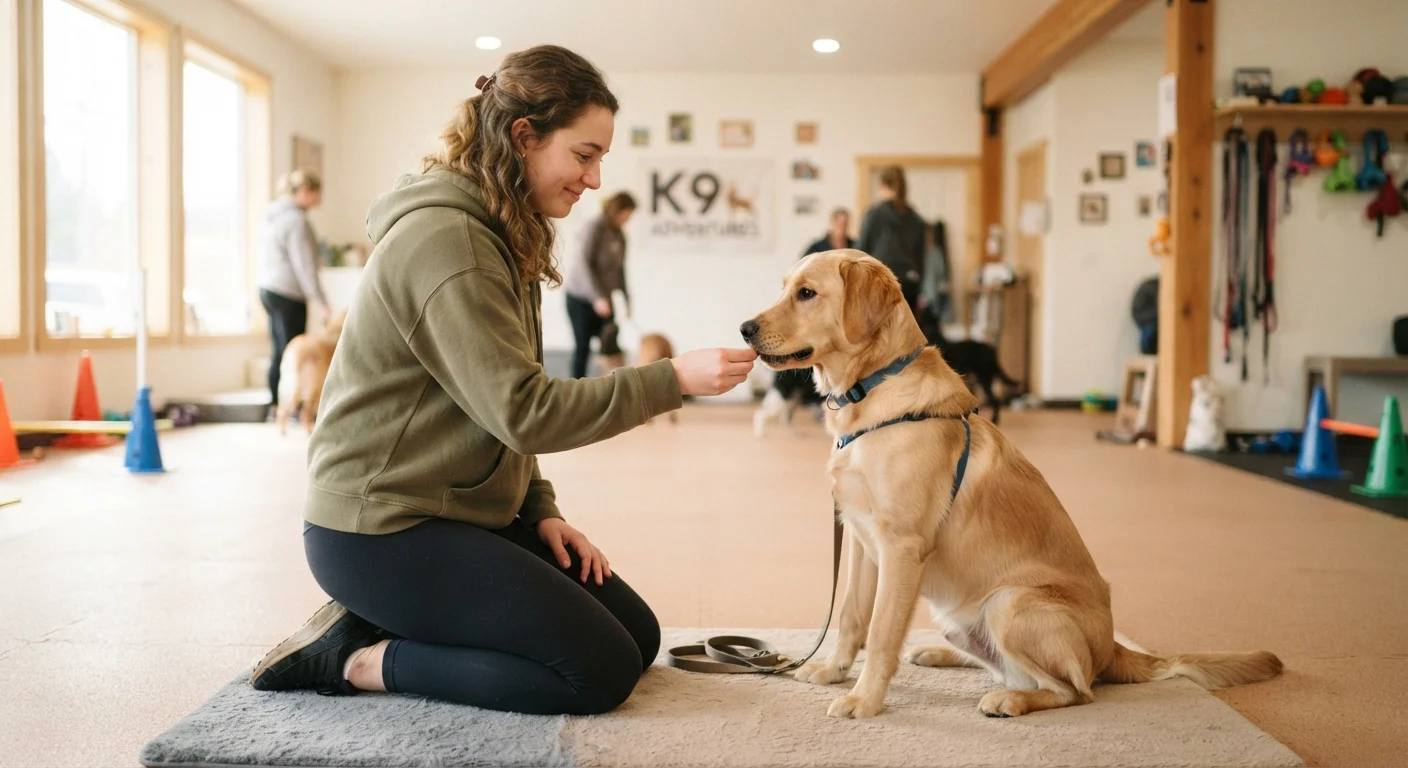
A lure is anything — almost always food — held in a way that guides a pet into a target position. To teach a sit, you hold a treat at your dog's nose and arc it slowly back over the head; the nose follows the treat, the hindquarters drop, and the sit happens. No pressure, no pushing. The pet chooses to follow because following is immediately rewarding.
Luring is effective precisely because it produces fast results with minimal frustration. A new behavior can often be prompted within the first session. That speed, however, comes with a responsibility: luring is a teaching tool, not a finished cue. The goal is always to reach a point where the pet performs without the lure present.
Visible Treats Before the Cue Is a Common Trap
Showing a treat before giving a verbal cue teaches the pet to wait for food to appear rather than respond to the word. Once this pattern forms it can take significant effort to reverse. Always give the cue first, mark the behavior, then deliver the reward.
Keep lure sessions short and purposeful. Use the lure for two to five repetitions to establish the movement pattern, then begin reducing it. Using a lure for extended periods without reducing it trains the pet to only respond when food is visible — which most owners discover the hard way in real-world situations.
Fading: Removing the Prompt Without Losing the Behavior
Fading is the process of systematically withdrawing the lure or prompt so the behavior becomes independent of it. Done gradually, the pet barely notices the change. Done abruptly, the behavior often falls apart — which is why so many owners say their pet "knows" a command at home but not elsewhere, or only responds when treats are visible.
A simple fading sequence for a lured behavior looks like this:
- Lure the full movement, reward from the lure hand.
- Lure the full movement, reward from the opposite hand.
- Use an empty lure hand (same gesture), reward from the opposite hand.
- Reduce the gesture to a smaller hand movement, reward from elsewhere.
- Introduce a verbal cue paired with the reduced gesture.
- Use only the verbal cue.
Each step should be practiced until reliable before advancing. Rushing the sequence is the single most common reason behaviors seem to "disappear" after initial training. For a practical overview of how to build these habits from the very first days with a pet, see our first 30-day training roadmap.
How the Three Mechanics Work Together
Reward timing, luring, and fading aren't separate skills — they're a sequence. Luring gets the behavior to happen. Precise timing marks and rewards it accurately. Fading turns it into something the pet offers reliably on cue, without a prompt. Weak execution at any stage undermines the others.
Consider a recall: you lure the dog toward you with a treat. A well-timed marker the moment the dog arrives reinforces coming close, not the moment just before it. As you fade the lure, the dog learns that moving toward you — not following visible food — is the behavior that earns the reward. Eventually the verbal cue alone is enough.
< 0.5 sec
Effective reward delivery window
Animal learning research consistently identifies a sub-half-second window as optimal for associating a consequence with the immediately preceding behavior.
2–5 reps
Recommended lure uses before starting to fade
Professional trainers generally recommend limiting lure-assisted repetitions per session to prevent prompt dependency from becoming established.
Setting up sessions thoughtfully before you begin also matters. Hungry but not starving, short duration, low distraction — these conditions let the mechanics do their work. Our pre-session readiness checklist walks through the variables worth controlling.
Common Mistakes and How to Avoid Them
Even experienced trainers return to these basics when a behavior starts breaking down. The most frequent errors are:
- Late marking: The marker arrives after the pet has moved on. Use a physical bridge — a clicker, for precision — until verbal timing is sharp.
- Lure dependence: The owner shows the treat before giving the cue rather than after. The pet is responding to the food, not the cue. Keep the treat hidden until after the behavior and marker.
- Premature fading: Removing the lure too fast before the behavior is fluent. Return one step and build more repetitions before advancing.
- Skipping the variable reward schedule: Once a behavior is solid, rewarding every single repetition can reduce motivation. Moving to an intermittent reward schedule — rewarding some repetitions, not all — typically strengthens persistence.
If a behavior that seemed solid starts falling apart, check these four areas before assuming the pet has "forgotten" or is being stubborn. Behavior problems in training are almost always mechanics problems. For a broader look at misconceptions that derail training, see our breakdown of persistent training myths.
The content provided on our blog site traverses numerous categories, offering readers valuable and practical information. Readers can use the editorial team’s research and data to gain more insights into their topics of interest. However, they are requested not to treat the articles as conclusive. The website team cannot be held responsible for differences in data or inaccuracies found across other platforms. Please also note that the site might also miss out on various schemes and offers available that the readers may find more beneficial than the ones we cover.