

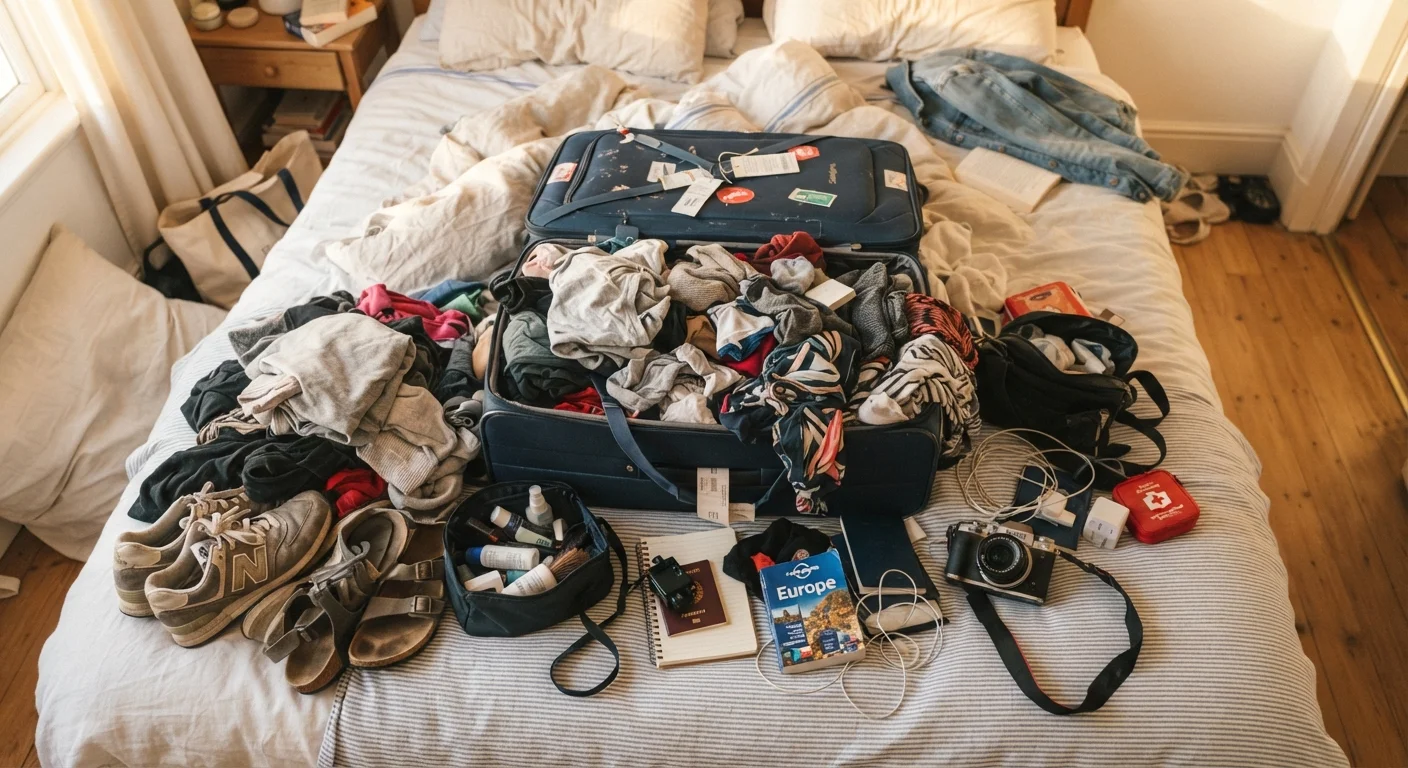
The Overpacking Safety Paradox
Travel anxiety often expresses itself through stuff. The more uncertain we feel about a destination, the more we pack — as if an extra layer of gear can insulate us from the unknown. It's an intuitive response, but it's frequently counterproductive. Overpacking introduces a distinct set of vulnerabilities that many travelers don't consider until they're already abroad and struggling.
The core issue is that safety abroad is primarily about awareness, mobility, and decision-making — not inventory. A traveler who moves confidently through a busy train station with a single manageable bag is generally safer than one distracted by multiple heavy bags and constantly anxious about what they might have forgotten. This article examines the specific myths that drive overpacking in the name of safety, and what the evidence-based alternative actually looks like.
Myth
Bringing more gear and supplies means you're better prepared for emergencies.
Fact
Excess gear adds physical burden and creates logistical problems without meaningfully covering most real travel risks.
The appeal of stuffing your bag with every conceivable backup item is understandable — what if the power goes out, what if there's no pharmacy nearby? But real travel emergencies rarely unfold the way we imagine. Most common incidents abroad involve lost documents, minor illness, missed flights, or petty theft — situations where your insurance coverage, a photocopy of your passport, or a local pharmacist are far more useful than a 10-pound first-aid kit. Heavy bags also slow you down physically and mentally, making it harder to stay alert and responsive to your actual surroundings.
Myth
Carrying extra cash in multiple currencies keeps you covered if something goes wrong.
Fact
Large amounts of cash are harder to replace than card funds and make you a more valuable target if stolen.
Many travelers pack thick envelopes of foreign currency as a 'safety net,' but cash lost to theft or misplacement is typically unrecoverable. Cards tied to accounts with fraud protection offer a meaningful layer of financial recourse that cash simply doesn't. A reasonable amount of local currency for small purchases and tips is practical; stashing wads of bills across your bags is not a strategy — it's a liability. Before departure, check whether your bank accounts have international fee waivers and notify your institution of your travel dates so cards work reliably.
Myth
A bulky, well-stocked bag makes you look like a prepared, serious traveler.
Fact
Visibly oversized luggage and high-end gear can mark you as a wealthy tourist, which may attract unwanted attention.
Street-smart travel often comes down to blending in. Travelers hauling enormous bags or wearing gear that signals expensive equipment are easier to identify as outsiders with valuables. This isn't about dressing down to the point of discomfort — it's about not broadcasting wealth unnecessarily. Neutral, practical clothing and a manageable bag allow you to move through stations, markets, and neighborhoods with far less friction. See our guide to reading a destination's safety landscape for context on how environment shapes actual risk.
Myth
Duplicate items — two of everything — guarantee you're never caught without what you need.
Fact
Doubling up on most items adds weight that compounds fatigue and physical strain over a trip.
There's a short list of things worth duplicating: a backup copy of your passport photo page, a spare debit card kept separately from your wallet, and perhaps an extra phone charger. Beyond that, doubling up on clothing, toiletries, or tech accessories rarely pays off. Fatigue from carrying unnecessary weight is a real safety issue — tired travelers make worse decisions, are less situationally aware, and are more prone to slips, strains, and mishaps. Our article on what families actually need to travel carry-on only offers a practical framework for deciding what earns a spot in your bag.
Myth
Children need a dedicated bag of supplies for every possible scenario.
Fact
Kids' needs abroad are largely the same as at home — most destinations have pharmacies, grocery stores, and basic supplies readily available.
Parents understandably want to be ready for anything when traveling with children, but the urge to pack every contingency can backfire. Most cities and resort areas around the world stock children's medications, diapers, snacks, and basic clothing. Packing a reasonable, targeted kit — prescription medications, a comfort item, a change of clothes per child — is smart. Trying to anticipate every possible need often means carrying 20 pounds of items you never open. For a balanced approach to keeping kids safe without letting preparation become its own burden, see our piece on keeping kids safe in unfamiliar places.
What Strategic Minimalism Actually Looks Like
Packing smart doesn't mean packing next to nothing — it means packing with intention. The travelers who navigate unfamiliar places most confidently tend to carry: documentation backups (digital and physical), a small amount of local currency for cash-only situations, versatile clothing suited to the destination's climate, and a focused medical kit covering prescriptions plus common needs like pain relief and stomach remedies.
Mobility Is a Safety Asset
In genuine emergency situations abroad — a sudden evacuation, a missed connection, a fast-moving crowd — being able to move quickly matters. A traveler carrying a single manageable bag can navigate stairs, board transport, and change plans in minutes. One wrestling with oversized luggage may not have that option. Packing light isn't just convenient; it's a practical form of preparedness.
This approach pairs naturally with smart trip structure. Just as building breathing room into your itinerary prevents schedule overload, building breathing room into your bag prevents logistical overload. For broader perspective on the assumptions that shape how we plan and prepare to travel, our piece on things travelers assume about popular destinations is a useful read before your next trip.
23 kg
Average checked bag weight for US leisure travelers
Industry luggage surveys consistently find US leisure travelers checking bags well above what airlines consider optimal for ease of handling and mobility.
~50%
Packed items travelers report never using
Post-trip traveler surveys frequently find that roughly half of packed items go unused, suggesting systematic over-preparation is common among American vacationers.
The content provided on our blog site traverses numerous categories, offering readers valuable and practical information. Readers can use the editorial team’s research and data to gain more insights into their topics of interest. However, they are requested not to treat the articles as conclusive. The website team cannot be held responsible for differences in data or inaccuracies found across other platforms. Please also note that the site might also miss out on various schemes and offers available that the readers may find more beneficial than the ones we cover.