

Start here
Why the Sidewall Markings Matter
Core skill
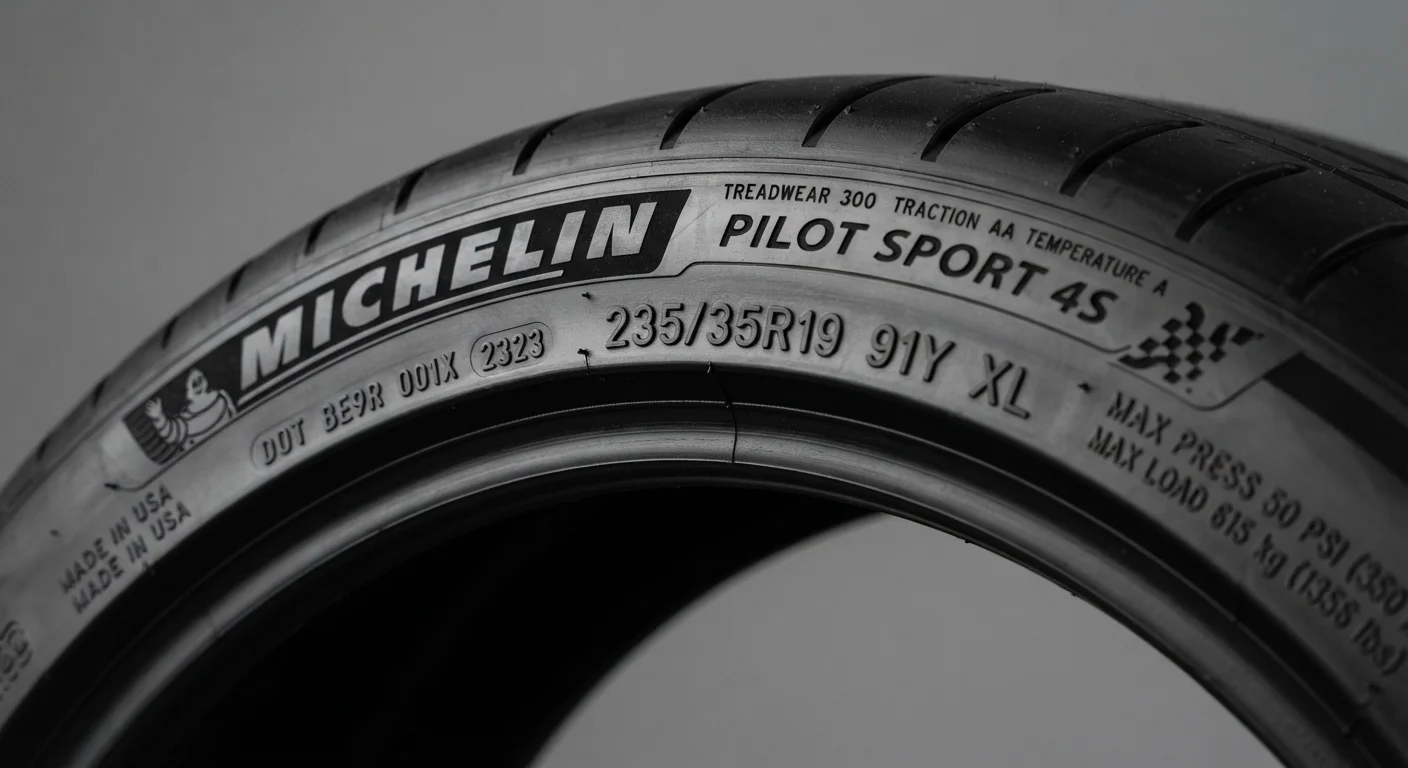
Decoding the Tire Size String
Go deeper
Load Index and Speed Rating Explained
Safety check
DOT Code and Tire Age
Apply it
Putting It All Together at the Shop
Why the Sidewall Markings Matter
That wall of molded letters and numbers running around your tire isn't decoration or legal boilerplate. It's a precise technical specification - one that directly affects how safely your vehicle handles, stops, and carries weight. Buying or installing the wrong tire because you ignored the sidewall code is one of the most common and avoidable mistakes drivers make.
Your door jamb sticker (found on the driver's side door frame) lists the tire size and inflation pressure your vehicle's engineers specified. The sidewall markings on any replacement tire must align with that spec. Think of the sidewall as a label you actually need to read - like the dashboard warning lights that tell you when something's off.
Aspect Ratio
The tire sidewall height expressed as a percentage of the tire's section width. A lower number means a shorter sidewall.
Load Index
A number code that maps to the maximum weight a single tire can safely support. Your vehicle requires a minimum load index - never go below it.
Speed Rating
A letter code indicating the maximum sustained speed a tire is engineered to handle under controlled test conditions.
DOT Date Code
The last four digits of the DOT code on a tire sidewall. They show the week and year the tire was manufactured.
Radial Construction
The standard tire design where internal cords run perpendicular to the direction of travel, providing flexibility, durability, and fuel efficiency.
Section Width
The widest measurement of a tire from sidewall to sidewall, expressed in millimeters in the size string.
Decoding the Tire Size String
Most passenger tires use a format like P215/65R16. Here's what each part means:
- P - Service type. "P" stands for passenger vehicle. "LT" indicates light truck. Some tires have no prefix, which signals a European metric standard with slightly different load conventions.
- 215 - Section width in millimeters. This is the tire's widest point measured across the tread from sidewall to sidewall.
- 65 - Aspect ratio. The sidewall height is 65% of the section width. Lower numbers (like 45 or 50) mean a shorter, stiffer sidewall - common on performance vehicles.
- R - Construction type. "R" means radial, which is the standard for virtually all modern passenger tires. Radial tires have cords running perpendicular to the direction of travel.
- 16 - Rim diameter in inches. This must match your wheel exactly.
After this string, you'll typically see two more numbers - the load index and speed rating. Those get their own section because they matter differently.
Load Index and Speed Rating Explained
Following the size string, you'll see something like 95H. The number is the load index; the letter is the speed rating.
Load Index
The load index is a standardized code that maps to a specific maximum weight capacity per tire. A load index of 95 corresponds to 1,521 lbs per tire. Multiply by four and you get the total load capacity for the vehicle. Never install tires with a lower load index than your vehicle requires - doing so risks structural failure under normal driving loads.
Speed Rating
The speed rating letter indicates the maximum sustained speed the tire is designed to handle under controlled test conditions. Common ratings include S (112 mph), H (130 mph), V (149 mph), and W (168 mph). This isn't a recommendation to drive at those speeds - it reflects the tire's heat-management capability. Always match or exceed your vehicle's required speed rating when replacing tires.
Match or Exceed - Never Go Below
When replacing tires, it's acceptable to use a tire with a higher load index or speed rating than specified - that simply means more capacity. What you must never do is install a tire with a lower load index or speed rating than your vehicle requires. That's where safety margins disappear.
DOT Code and Tire Age
Somewhere on the sidewall you'll find a string beginning with DOT. This is the Department of Transportation compliance code, and the last four digits are the most useful part for everyday drivers.
Those four digits are a date code. The first two digits represent the week of manufacture; the last two represent the year. DOT ×× ×× 2318 means the 23rd week of 2018. Tires degrade chemically over time - the rubber oxidizes and loses flexibility even if the tread looks fine.
Many tire manufacturers recommend replacement at six years from the manufacture date, with ten years being an absolute maximum regardless of appearance. If you're buying used tires or inheriting a vehicle, check this code before assuming the tires are safe. This pairs well with understanding your tire rotation and alignment schedule - knowing when tires were made helps you plan maintenance properly.
Putting It All Together at the Shop
Armed with this knowledge, you can walk into any tire shop with confidence. Before you go:
- Check your door jamb sticker for the manufacturer-specified size, load index, and speed rating.
- Note the DOT date code on your current tires so you can explain their age.
- Cross-reference the sidewall markings on any replacement options the shop suggests against your vehicle's requirements.
A qualified tire professional can help you navigate approved size alternatives if they're needed, but you'll now understand what they're telling you. If a TPMS (Tire Pressure Monitoring System) light appears after a replacement, that's a signal worth investigating - see our guide on what your warning lights mean for context.
Tire sidewalls are dense, but once you break the code into its parts - size string, load index, speed rating, and DOT date - it becomes a straightforward label. Reading it correctly is a basic, practical skill every driver should have before the next set of tires goes on.
Frequently Asked Questions
It's a standardized size code. For example, in P215/65R16, the 215 is the tread width in millimeters, 65 is the aspect ratio (sidewall height as a percentage of width), R means radial construction, and 16 is the rim diameter in inches.
Minor approved variations exist, but you should always consult your owner's manual or a qualified tire professional before deviating. The wrong size can affect speedometer accuracy, handling, and clearance.
Look for the DOT code on the sidewall. The last four digits are the key - the first two are the week and the last two are the year of manufacture. For example, 2319 means the 23rd week of 2019.
Never go below the load index listed in your owner's manual or on the door jamb sticker. You can use a higher load index safely, but a lower one puts you at risk of tire failure under the vehicle's weight.
Not necessarily. Speed ratings reflect a tire's maximum sustained speed capacity under controlled conditions. A higher rating often correlates with performance-oriented compounds, but the right rating is simply the one your vehicle requires.
Many tire manufacturers and safety organizations recommend replacing tires that are six to ten years old regardless of tread depth, because rubber degrades over time. Check your manufacturer's guidance and have older tires inspected by a professional.
The content provided on our blog site traverses numerous categories, offering readers valuable and practical information. Readers can use the editorial team’s research and data to gain more insights into their topics of interest. However, they are requested not to treat the articles as conclusive. The website team cannot be held responsible for differences in data or inaccuracies found across other platforms. Please also note that the site might also miss out on various schemes and offers available that the readers may find more beneficial than the ones we cover.