

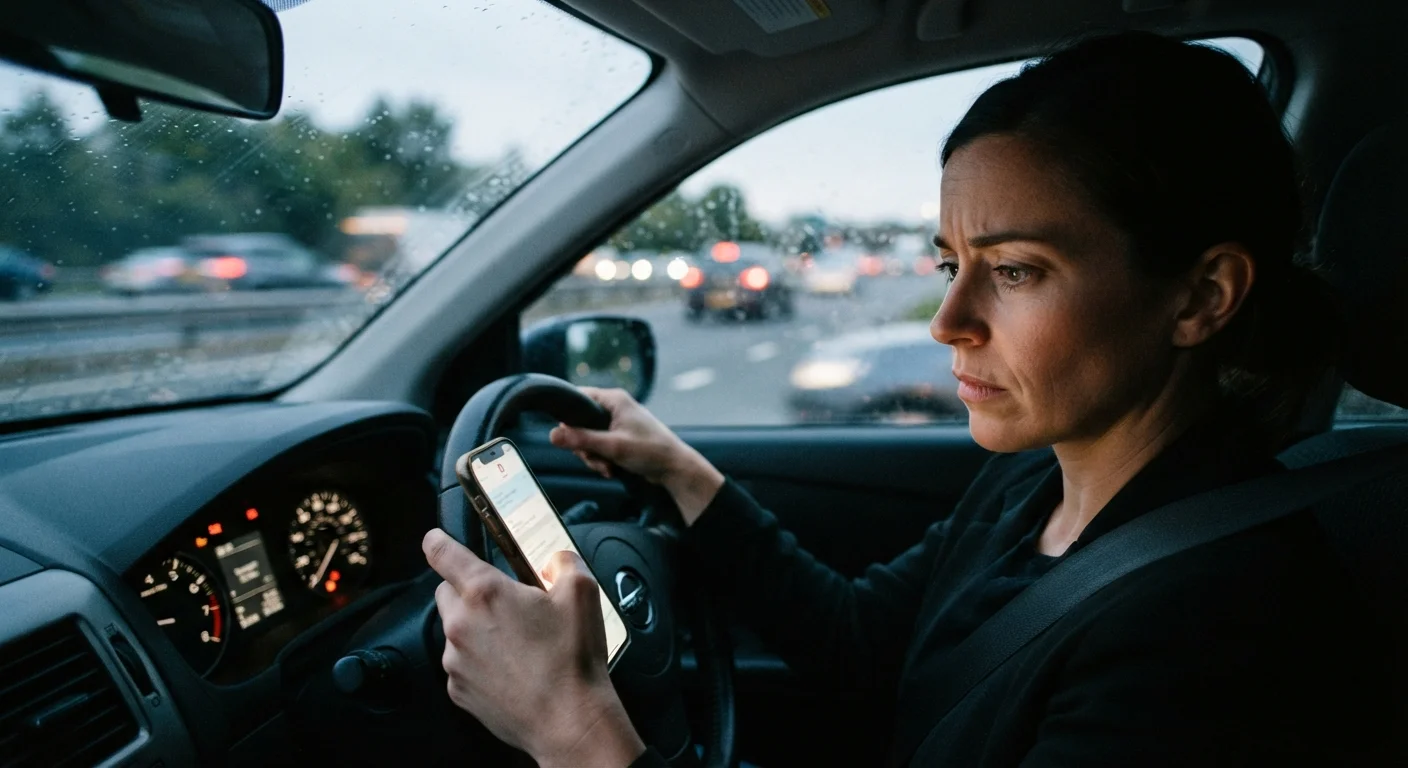
Why These Myths Persist - and Why They Matter
Distracted driving is one of the most preventable causes of crashes on US roads, yet widespread misconceptions continue to shape how drivers actually behave. According to the National Highway Traffic Safety Administration (NHTSA), distraction is a reported factor in tens of thousands of fatal crashes each year. The gap between what drivers believe about distraction and what crash data shows is significant - and dangerous.
Many myths survive because they feel intuitively true. Driving feels routine, phones feel manageable, and nothing bad has happened yet. That familiarity creates false confidence. Understanding where the science actually lands is the first step toward driving that's genuinely safer - not just reassuringly familiar.
For a broader view of how attention and judgment break down on the road, see our look at how fatigue and distraction compare - two risks that are often confused but require different responses.
Myth
Hands-free calling is safe because your hands stay on the wheel.
Fact
Hands-free calls still cause significant cognitive distraction - the physical setup is only one part of the problem.
The danger of phone use while driving isn't just about holding a device. Research by the National Safety Council and multiple university studies has consistently shown that the brain's workload during a conversation reduces the ability to process visual information - even when both hands are on the wheel. Drivers on hands-free calls have been found to miss traffic signals, pedestrians, and lane changes they would otherwise catch. The conversation itself competes for the same mental resources driving demands.
Myth
A quick glance at your phone only takes a second - that's not enough time for anything to go wrong.
Fact
At highway speeds, a five-second look away from the road covers approximately the length of a football field.
NHTSA has long highlighted that five seconds is roughly the average time a driver's eyes leave the road during a text-related glance. At 55 mph, that equals about 100 yards of travel with no meaningful visual awareness. Even at lower city speeds, a two-second distraction can be enough to miss a braking vehicle ahead or a pedestrian stepping off a curb. The brain doesn't pause the world while the eyes are elsewhere.
Myth
Experienced drivers can handle more distraction because driving becomes automatic.
Fact
Driving experience does not reduce the cognitive impact of distraction - it simply changes which driving tasks feel automatic.
While experienced drivers do automate some lower-level tasks like steering and basic lane keeping, higher-order demands - hazard detection, gap judgment, merging decisions - never become truly automatic. Distraction impairs precisely those higher-order processes. Studies have found that experienced drivers overestimate their multitasking ability, which can actually increase risk-taking behavior behind the wheel. Confidence built from years of uneventful driving is not the same as immunity from impairment.
Myth
Voice-to-text is safe because you're not looking at the screen.
Fact
Composing or listening to messages via voice still demands substantial mental effort that diverts attention from driving.
AAA Foundation for Traffic Safety testing found that voice-to-text systems - including those built into vehicles - produced high levels of cognitive distraction, sometimes higher than handheld texting in certain measures. The mental effort of formulating a message, correcting errors, and monitoring the output occupies working memory regardless of whether a screen is involved. Keeping your eyes forward is necessary but not sufficient for safe driving; your mind needs to be forward too.
Myth
Eating or adjusting the radio isn't really distracted driving - everyone does it.
Fact
Any activity that pulls visual, manual, or cognitive attention away from driving meets the definition of distraction - regardless of how common it is.
Distraction is formally categorized into three types: visual (eyes off road), manual (hands off wheel), and cognitive (mind off driving). Eating while driving can involve all three simultaneously - unwrapping food, looking down, and thinking about the task. The fact that a behavior is widespread doesn't reduce its risk. NHTSA data has linked secondary task engagement broadly - not just phones - to a meaningful share of crash-involved distraction events.
Myth
If you're familiar with a route, your brain can handle more distraction along the way.
Fact
Route familiarity can actually increase complacency, reducing the active hazard scanning that keeps driving safe.
On familiar roads, drivers tend to reduce their scanning of intersections, check mirrors less frequently, and rely more on habit than active awareness. This is exactly when an unexpected event - a child on a bike, a driver running a red light - requires full attention. Familiarity breeds automation of the route itself, but it cannot predict or compensate for novel hazards. In this sense, familiar routes may warrant more vigilance, not less.
What the Research Tells Us About Real-World Risk
The myths above aren't harmless habits - they translate directly into crash risk. Research from the AAA Foundation for Traffic Safety has found that cognitive distraction can persist for up to 27 seconds after a driver puts down a phone or stops using a voice system. That means even a brief interaction leaves a window of impaired awareness long after the task is technically finished.
~3,300
US distraction-related traffic fatalities annually
NHTSA has consistently reported approximately this figure in recent years, underscoring distraction as a serious and ongoing road safety issue.
27 sec
Cognitive distraction after a hands-free call ends
AAA Foundation for Traffic Safety research found residual mental distraction lasting up to 27 seconds after completing a voice-activated task while driving.
4x
Crash risk increase when using a handheld phone
Multiple large-scale studies, including research cited by NHTSA, estimate phone use roughly quadruples crash risk compared to driving without distraction.
Drivers who recognize these gaps can take concrete steps: putting phones in do-not-disturb mode before moving, pre-setting navigation and music before departure, and pulling over if a conversation or situation genuinely demands full attention. None of these require expensive technology - just honest acknowledgment that the brain has limits.
Defensive driving principles reinforce this point: a driver who anticipates hazards needs full cognitive bandwidth. Distraction strips that away quietly, before a driver even notices it's gone.
This article provides general road safety information for educational purposes. Always follow applicable traffic laws and official guidance from your state's motor vehicle authority.
The content provided on our blog site traverses numerous categories, offering readers valuable and practical information. Readers can use the editorial team’s research and data to gain more insights into their topics of interest. However, they are requested not to treat the articles as conclusive. The website team cannot be held responsible for differences in data or inaccuracies found across other platforms. Please also note that the site might also miss out on various schemes and offers available that the readers may find more beneficial than the ones we cover.