

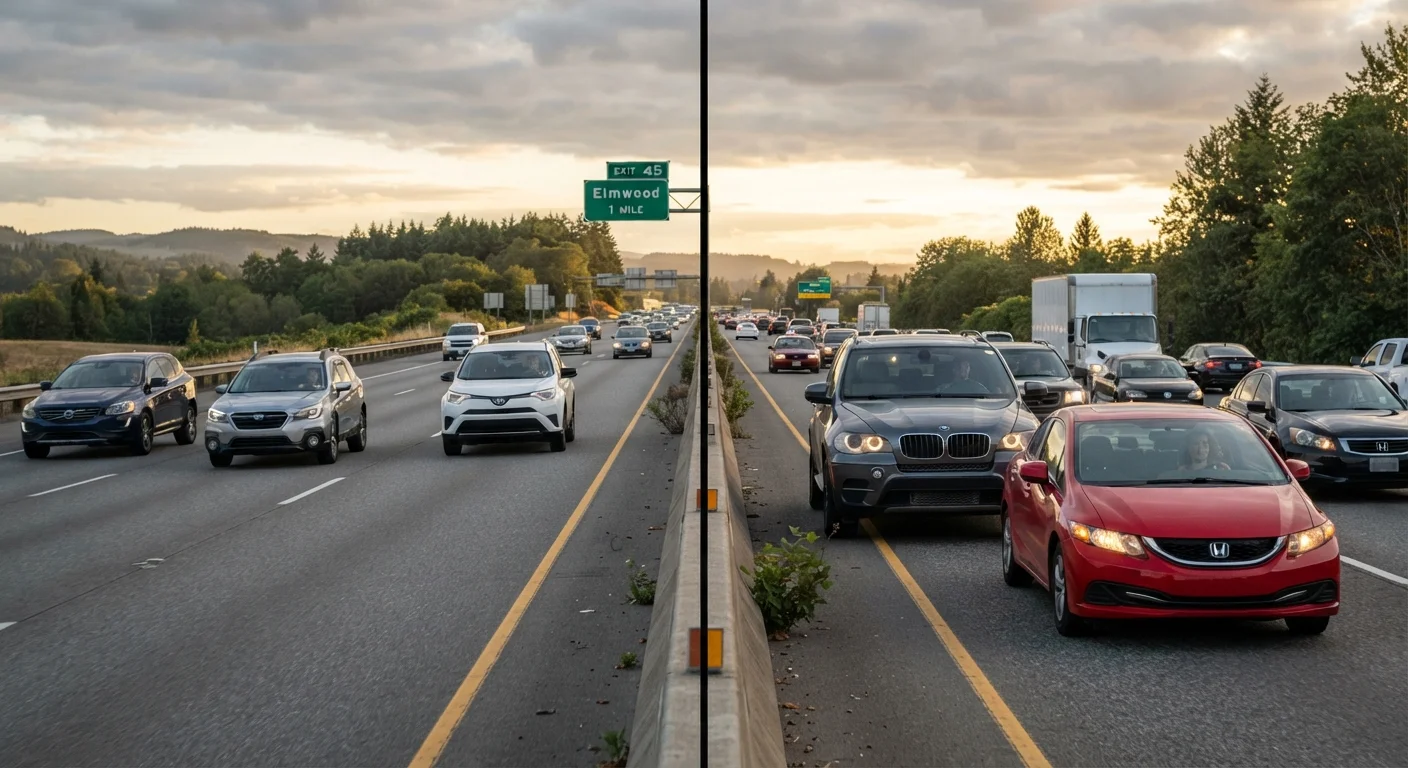
Option A
Defensive Driving
The proactive, safety-first mindset.
Best for: Drivers who want to reduce crash risk, stay calm under pressure, and arrive safely in any road condition.
Option B
Aggressive Driving
The reactive, risk-amplifying pattern.
Best for: Understanding what to avoid - aggressive behaviors are associated with significantly elevated crash and fatality risk.
Defining the Two Mindsets
The distinction between defensive and aggressive driving isn't just about speed. It's about intent, awareness, and how a driver frames their relationship with every other person on the road.
Defensive driving is the practice of anticipating hazards before they materialize and maintaining enough time and space to respond safely. The National Safety Council describes it as driving to save lives, time, and money - in spite of the conditions around you and regardless of the actions of others. A defensive driver treats following distance as a safety margin, not wasted space, and scans intersections, mirrors, and blind spots continuously rather than reactively. This active scanning approach is one of the key habits that separates experienced drivers from reactive ones.
Aggressive driving, as defined by the National Highway Traffic Safety Administration (NHTSA), is a pattern of unsafe behaviors - including speeding, tailgating, frequent unsafe lane changes, running red lights, and failure to yield - that puts other road users at risk. It's important to note that aggressive driving is not the same as road rage, which involves a criminal act driven by anger. Aggressive driving can happen without overt anger; it often reflects impatience, overconfidence, or simply learned bad habits. For a deeper look at how anger escalates behind the wheel, see our article on road rage and how to defuse it.
| Criterion | Defensive Driving | Aggressive Driving |
|---|---|---|
| Core mindset | Anticipate and prevent hazards | React to and contest the road |
| Following distance | 3+ seconds; more in poor conditions | Tailgating; minimal gap maintained |
| Speed management | Adjusted to conditions and visibility | Frequently exceeds limits or conditions |
| Lane changes | Signal, check mirrors and blind spots | Frequent, rapid, minimal signaling |
| Response to errors by others | Yield; create space; de-escalate | Contest right-of-way; retaliate |
| Crash risk outcome | Measurably reduced with consistent use | Associated with higher crash severity |
| Learnability | Teachable; formal courses available | Often habit-driven; can be unlearned |
What the Research Actually Shows
The safety case for defensive driving isn't anecdotal. The NHTSA and AAA Foundation for Traffic Safety have documented that aggressive driving behaviors - particularly speeding and following too closely - are contributing factors in a substantial share of traffic fatalities each year in the United States.
~29%
Speeding's share of US traffic fatalities
NHTSA data consistently shows speeding - a core aggressive driving behavior - as a factor in roughly 29% of annual US traffic deaths.
80%
Drivers who experienced road aggression
AAA Foundation for Traffic Safety reported that approximately 80% of US drivers expressed significant anger or aggression behind the wheel at least once in a given year.
3 seconds
Minimum recommended following gap
The National Safety Council recommends a minimum 3-second following distance, increasing to 4-5 seconds in adverse weather or at highway speeds.
Crashes that involve aggressive behaviors tend to be more severe, because higher speeds and shorter reaction windows leave less room for error. In contrast, techniques central to defensive driving - maintaining a 3-second following gap, reducing speed in poor conditions, and covering the brake near intersections - are specifically designed to expand the window for a safe response. Understanding how other cognitive factors compound risk is also useful: fatigue and distraction, for instance, can push even a normally cautious driver toward reactive rather than proactive decision-making.
It's also worth noting that defensive driving doesn't mean timid driving. Hesitating unnecessarily, braking unpredictably, or refusing to merge at speed can itself create hazards. The goal is controlled, deliberate movement - not passivity.
Core Behaviors: Side by Side
The gap between the two approaches becomes clearest when you examine specific, everyday decisions behind the wheel.
Following distance: A defensive driver maintains at least a 3-second gap - more in adverse weather or at highway speeds. An aggressive driver tailgates, reducing reaction time to fractions of a second and dramatically increasing rear-end crash risk.
Speed management: Defensive drivers match speed to conditions, not just the posted limit. Aggressive drivers routinely exceed limits or drive too fast for visibility, weather, or traffic density.
Lane changes: Checking mirrors, signaling, and confirming blind spots is standard defensive practice. Aggressive drivers cut across lanes with minimal signaling and tight clearances.
Intersections: A defensive driver covers the brake and scans cross-traffic before entering even on a green light. An aggressive driver accelerates through yellows and may roll stops at low-traffic junctions.
Response to other drivers' errors: Defensive drivers yield and give space rather than contest the right-of-way. Aggressive drivers may respond to others' mistakes with retaliation - a pattern that significantly escalates risk for everyone.
New drivers can find more on applying these principles in our highway driving guide, which walks through real-world decision points from on-ramp to exit.
Building Defensive Habits in Practice
Defensive driving isn't a fixed trait - it's a skill set that improves with intentional practice. Several US states offer formal defensive driving courses, and completion can qualify drivers for insurance considerations or traffic point reductions, though individuals should verify specific benefits with their insurer or state DMV.
Defensive Driving Courses: A Practical Option
Many US states recognize defensive driving courses offered through providers approved by the state DMV. Completion may reduce points on a license or qualify a driver for a potential auto insurance discount - though benefits vary by state and insurer. These courses typically cover hazard perception, space management, and adverse-condition driving. Checking your state DMV website is the most reliable way to find approved programs in your area.
At the habit level, three practices make the biggest difference for most drivers:
- The commentary drive: Narrating your observations aloud - "car merging, gap closing, brake lights ahead" - trains active scanning and keeps attention anchored on the environment rather than drifting.
- The pre-drive pause: Checking mirrors, seat position, and mental state before pulling out. Stress, fatigue, or distraction can subtly push driving behavior toward the reactive end of the spectrum.
- The cushion mindset: Framing every following distance and speed decision as creating buffer time, not losing time. Arriving 90 seconds later is an acceptable trade for a meaningful reduction in crash exposure.
For a comprehensive foundation, our complete safe driving resource covers the full range of skills and situational awareness every driver benefits from building.
The content provided on our blog site traverses numerous categories, offering readers valuable and practical information. Readers can use the editorial team’s research and data to gain more insights into their topics of interest. However, they are requested not to treat the articles as conclusive. The website team cannot be held responsible for differences in data or inaccuracies found across other platforms. Please also note that the site might also miss out on various schemes and offers available that the readers may find more beneficial than the ones we cover.