

Our Verdict
Raising a bilingual child in a monolingual home is genuinely achievable, but it requires intentional, sustained effort and realistic expectations. Children will likely progress more slowly than peers with a fluent speaker at home, and their language may skew more toward comprehension than confident speaking - at least initially. The payoff, however, is significant: cognitive benefits, cultural connection, and a skill that tends to compound over a lifetime.
Best suited to families with a clear motivation - whether heritage connection, future opportunity, or cognitive enrichment - who are willing to actively structure language exposure into daily life over the long term.
Why Families Try This - and What the Research Says
Many US families want their children to grow up speaking a second language but don't have a fluent speaker living at home. Whether driven by heritage preservation, preparation for a globalized workforce, or awareness of the cognitive benefits linked to bilingualism, the goal is common - and achievable, with the right approach.
Research consistently shows that children's brains are especially receptive to language acquisition during the early years, though this advantage does not disappear entirely in middle childhood. What matters most is not age alone but the quality, consistency, and quantity of exposure. A child who hears a language only sporadically, without meaningful context, will absorb far less than one whose exposure is structured and routine.
It's worth noting that "bilingual" spans a wide spectrum - from basic conversational ability to full academic fluency. Setting realistic expectations from the start helps families stay motivated without feeling like they're failing.
Approaches Families Use
There is no single path. Most families combine several strategies based on their budget, schedule, and the child's age.
- Media immersion: Children's programming, audiobooks, and podcasts in the target language can build vocabulary and listening comprehension, especially when paired with discussion. Passive screen time alone is less effective than interactive use.
- Language tutors or online classes: A live tutor - even one met weekly via video call - provides speaking practice and correction that media cannot. This is often the most direct way to compensate for not having a fluent speaker at home.
- Heritage language schools and community programs: Saturday or weekend language schools exist in most metro areas and serve families preserving a heritage language. These also offer cultural connection, which reinforces motivation.
- Dual-language immersion schools: Some public school districts offer dual-language programs in which a portion of instruction is delivered in a second language. This is often the highest-impact option available without moving.
- Language apps and games: Tools like vocabulary apps and interactive games can supplement other approaches, particularly for school-age children, though they rarely build speaking fluency on their own.
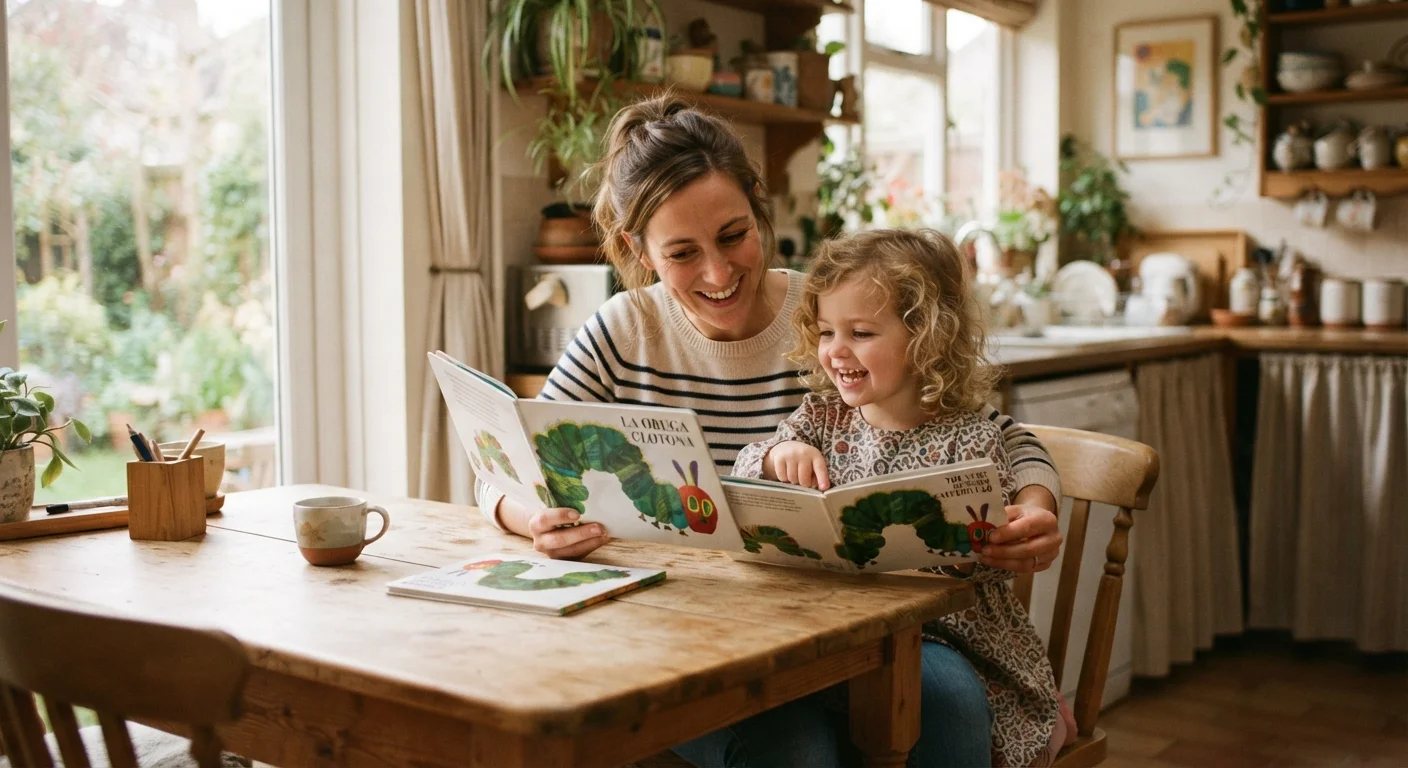
Reading aloud to children in the target language - even with imperfect pronunciation - can also reinforce vocabulary and a positive association with the language.
What Counts as 'Enough' Exposure?
Researchers often cite around 25-30% of waking hours as a rough threshold for meaningful bilingual development, though the quality of interaction matters as much as raw time. A one-hour weekly lesson alone is unlikely to build fluency, but it can be a meaningful anchor when combined with media, books, and community contact. Think of exposure as cumulative: small, consistent additions across the week tend to outperform occasional intensive efforts.
The Real Advantages
Cognitive benefits associated with bilingual development
Research links early bilingualism to stronger attention and mental flexibility, skills that may support academic performance across subjects.
Connection to heritage language and culture
Children who learn a family or community language gain access to relationships, traditions, and literature that can deepen their sense of identity.
Long-term career and social advantages
Bilingual individuals often have access to a broader range of professional opportunities, particularly in fields serving diverse communities.
Easier future language learning
Children who develop strong awareness of a second language often find it easier to acquire additional languages later in life.
Builds literacy skills that transfer across languages
Strong vocabulary and phonological awareness in one language can reinforce similar skills in another, supporting overall reading development.
The benefits extend beyond language itself. Studies have associated early bilingualism with stronger executive function - including attention switching and working memory - though researchers continue to refine their understanding of the size and conditions of this effect. Perhaps more durably, children who grow up with a second language often gain earlier access to family heritage, literature, and communities that would otherwise feel distant.
The Honest Trade-Offs
Slower progress without a fluent home speaker
Children in monolingual homes typically develop the second language more slowly than peers who hear it spoken naturally and consistently every day.
Requires sustained parental effort and coordination
Unlike heritage households where language exposure is organic, monolingual families must actively schedule and manage exposure - an ongoing commitment.
Risk of language attrition if exposure lapses
Without regular reinforcement, children - especially school-age ones - may lose ground quickly as the dominant language (usually English) crowds out the second.
Pronunciation and accent may not match native speakers
Without a fluent model at home, children may develop pronunciation patterns that differ from native speech, which can affect later fluency and comprehension.
Cost of tutors or programs adds up over time
Quality instruction - whether private tutors or community language schools - involves real financial commitment that not all families can easily sustain.
~20%
US children who speak a language other than English at home
According to US Census Bureau data, roughly one in five school-age children in the US lives in a home where a language other than English is spoken.
400+ hours
Estimated classroom hours to reach basic proficiency
The US Foreign Service Institute estimates it takes hundreds of instructional hours to reach basic spoken proficiency even in closely related languages - underscoring the value of starting early.
These challenges don't make the effort futile, but they do make it important to go in with clear expectations. Families who treat bilingual development as a long game - adjusting their methods as children grow - tend to see the most sustained results. For context on how other structured educational choices compare in effort and outcome, see our look at homeschooling vs. traditional school.
Practical Tips for Getting Started
If you're considering this path, a few principles can help structure your effort:
- Choose one method to anchor your approach - a tutor, a school program, or a community class - and treat supplementary tools as additions, not replacements.
- Build predictable routines. A consistent story time, a weekly lesson, or a daily vocabulary game works better than sporadic intensive sessions.
- Focus on motivation, not pressure. Children who associate a language with warmth, fun, and connection are more likely to stay engaged. Avoiding anxiety around language learning matters here just as much as it does with reading.
- Celebrate comprehension as a real milestone. Children often understand far more than they can produce, especially early on. Recognizing this progress keeps momentum going.
This article is for general informational and educational purposes only. Language development varies significantly among children; if you have concerns about your child's overall language progress, consult a qualified speech-language pathologist.
The content provided on our blog site traverses numerous categories, offering readers valuable and practical information. Readers can use the editorial team’s research and data to gain more insights into their topics of interest. However, they are requested not to treat the articles as conclusive. The website team cannot be held responsible for differences in data or inaccuracies found across other platforms. Please also note that the site might also miss out on various schemes and offers available that the readers may find more beneficial than the ones we cover.