

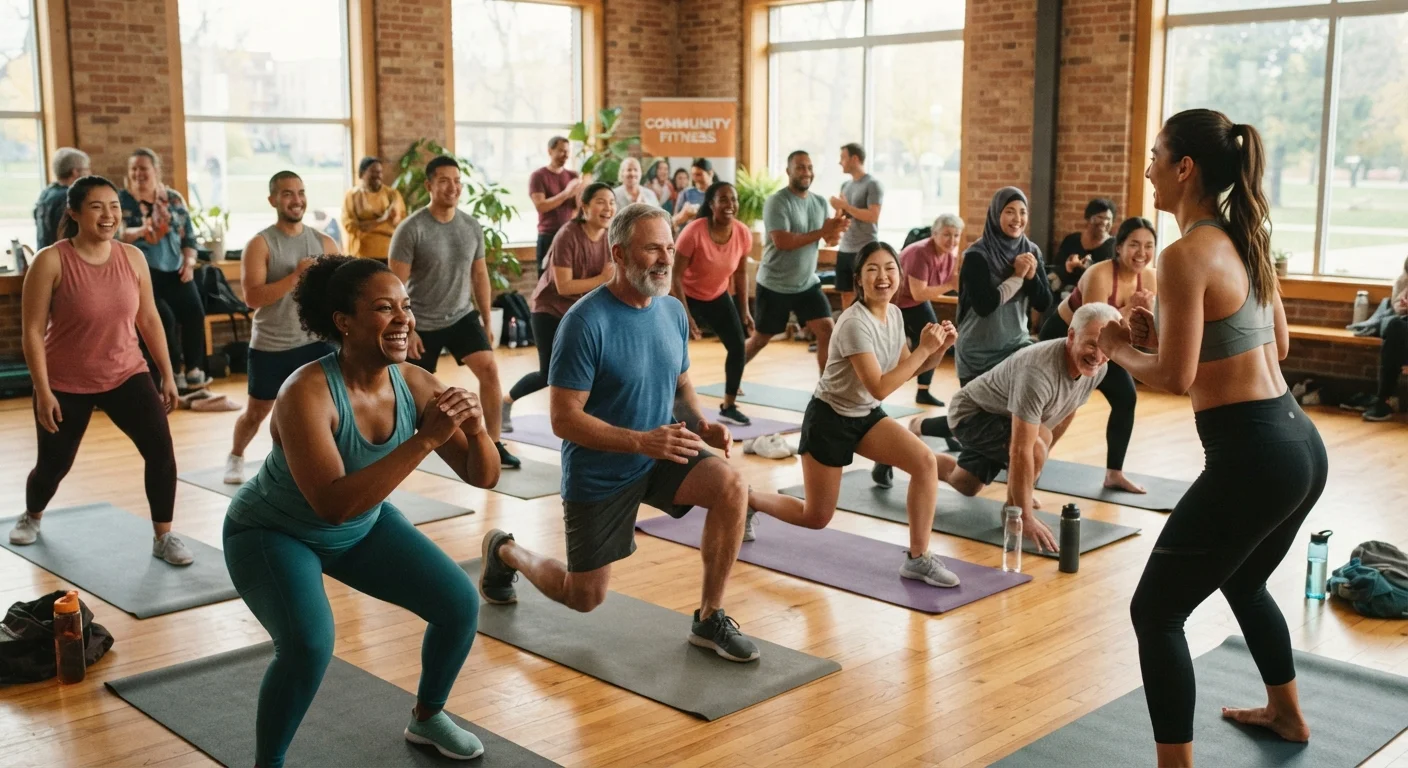
What Strength Training Actually Is
Strength training - also called resistance training - is any form of physical activity that asks your muscles to work against an opposing force. That force can be your own body weight, a resistance band, a water jug, a pair of dumbbells, or a machine at a gym. The defining quality is challenge, not equipment.
When a muscle contracts against resistance, tiny fibers experience microscopic stress. During recovery, the body repairs and reinforces those fibers, gradually building strength and endurance. This process works the same way regardless of your age, starting fitness level, or body type.
If you'd like to brush up on the vocabulary you'll encounter - words like reps, sets, and progressive overload - our plain-English fitness glossary defines each term clearly.
Who Benefits - And It's Broader Than You Think
Research consistently links regular resistance training to a wide range of health outcomes across diverse populations. The U.S. Department of Health and Human Services' Physical Activity Guidelines for Americans recommend muscle-strengthening activities for all adults, older adults, and even children - noting benefits beyond just physical appearance.
~30%
Adults meeting muscle-strengthening guidelines
CDC data consistently shows fewer than one in three U.S. adults meet the recommended two-or-more days per week of muscle-strengthening activity.
2+ days
Weekly resistance training recommended for adults
The U.S. Physical Activity Guidelines for Americans recommend muscle-strengthening activities on two or more days per week for all adults.
Significant
Fall-risk reduction in older adults
A substantial body of research, including systematic reviews, links regular resistance and balance training to meaningfully reduced fall risk in older adults.
Documented benefits in the broader research literature include improved bone density, better blood sugar regulation, reduced risk of falls in older adults, and support for mental health. For people managing chronic conditions, the American College of Sports Medicine notes that appropriately supervised resistance training can be part of a well-rounded care approach - though individual guidance from a healthcare provider is essential.
Strength training is not exclusively for athletes, bodybuilders, or young adults. People in their 60s, 70s, and beyond can make meaningful gains in strength and function with appropriately scaled exercise.
Common Barriers (and What the Evidence Says)
Many people assume strength training isn't for them based on beliefs that don't hold up under scrutiny. Our article on fitness myths that keep people from getting started goes deeper on this, but a few deserve direct attention here.
- "I'll bulk up too much." Significant muscle hypertrophy (visible bulk) requires very specific and sustained training protocols, high calorie intake, and often genetic predisposition. Recreational resistance training typically produces a leaner, more functional physique rather than dramatic size changes.
- "I'm too old to start." Research shows meaningful strength gains are achievable well into older adulthood. Starting later does not eliminate the benefit.
- "I don't have time or money for a gym." Effective resistance training requires neither. Bodyweight exercises like squats, push-ups, and lunges require no equipment and can be done in 20-30 minutes at home.
- "I'm not fit enough yet." Strength training is a tool for building fitness - not a reward for already having it. Everyone starts somewhere.
When starting out, choose a resistance level where the last two or three reps of a set feel genuinely challenging but still achievable with good form - not easy, not impossible.
This middle range, sometimes called 'leaving a rep or two in reserve,' builds strength effectively while keeping injury risk low for beginners whose tissues are still adapting.
Keep a simple log - even just a note on your phone - recording what you did each session. Seeing tangible evidence of small improvements is one of the most powerful tools for staying motivated.
Progress in the early months is real but easy to overlook without documentation, and perceived lack of progress is a leading reason beginners discontinue training.
How to Start Safely Without a Gym
Before beginning any new exercise program, it's worth doing an honest readiness check. Our personal readiness checklist walks through key considerations including physical health, schedule realism, and recovery planning. If you have a chronic condition, are pregnant, or are recovering from injury or illness, please consult your healthcare provider before starting.
For most beginners, a straightforward approach works well:
- Choose 4-6 foundational movements. Squats, hinges (like a deadlift pattern), push movements (push-ups), pull movements (rows using a resistance band or a sturdy table edge), and a core exercise cover the major muscle groups.
- Start with two sessions per week. Allow at least one rest day between sessions targeting the same muscles. Recovery is where adaptation actually happens - see our piece on why rest days are part of the workout.
- Prioritize form over load. Moving well through a full range of motion with a manageable resistance is safer and more effective than rushing to heavier weights.
- Distinguish normal from concerning discomfort. Muscle fatigue and mild soreness 24-48 hours after a workout are normal. Sharp pain, joint pain, or discomfort during exercise is a signal to stop and seek guidance.
If you're working from home, starting a home exercise routine from scratch offers a practical, equipment-free introduction to building the habit.
What Realistic Progress Looks Like
One of the most important things to understand early is that strength adaptations happen on a timeline of weeks and months, not days. In the first few weeks, much of the progress you feel - movements getting easier, balance improving - comes from neurological adaptation: your nervous system learning to recruit existing muscle more efficiently.
Visible changes in muscle size or body composition, when they occur, typically emerge over several months of consistent training. Progress is rarely linear. Weeks where nothing seems to change are a normal part of the process, not a sign that training isn't working.
It also helps to track progress in multiple ways: not just weight lifted, but how you feel climbing stairs, carrying groceries, or moving through daily activities. Functional improvements are often the most meaningful and motivating markers for beginners. For context on how strength training compares to cardio in building different capacities, see what cardio and strength training each build.
Building a Routine That Actually Sticks
Sustainability is the most underrated factor in fitness. A moderate program you follow consistently for six months will produce far better results than an aggressive program you abandon after three weeks.
A few principles that support long-term adherence:
- Anchor sessions to existing habits. Pairing exercise with something you already do - morning coffee, a lunch break, a commute - reduces the friction of starting.
- Make early sessions easy enough to feel successful. Building confidence matters as much as building strength in the beginning.
- Plan for interruptions. Travel, illness, and busy periods will happen. A missed week is not a reason to quit - it's a reason to resume.
- Progress gradually. The principle of progressive overload means slowly increasing challenge over time - more reps, slightly more resistance, or a harder variation. Rushing this is a common cause of injury and burnout.
Strength training, at its core, is an investment in your body's long-term capacity. You don't need to love it immediately - you just need to start, stay consistent, and give it enough time to show you what it can do.
This article is for general informational and educational purposes only and is not a substitute for professional medical advice, diagnosis, or treatment. Always consult a qualified healthcare provider before beginning a new exercise program, particularly if you have an existing health condition or injury.
The content provided on our blog site traverses numerous categories, offering readers valuable and practical information. Readers can use the editorial team’s research and data to gain more insights into their topics of interest. However, they are requested not to treat the articles as conclusive. The website team cannot be held responsible for differences in data or inaccuracies found across other platforms. Please also note that the site might also miss out on various schemes and offers available that the readers may find more beneficial than the ones we cover.