

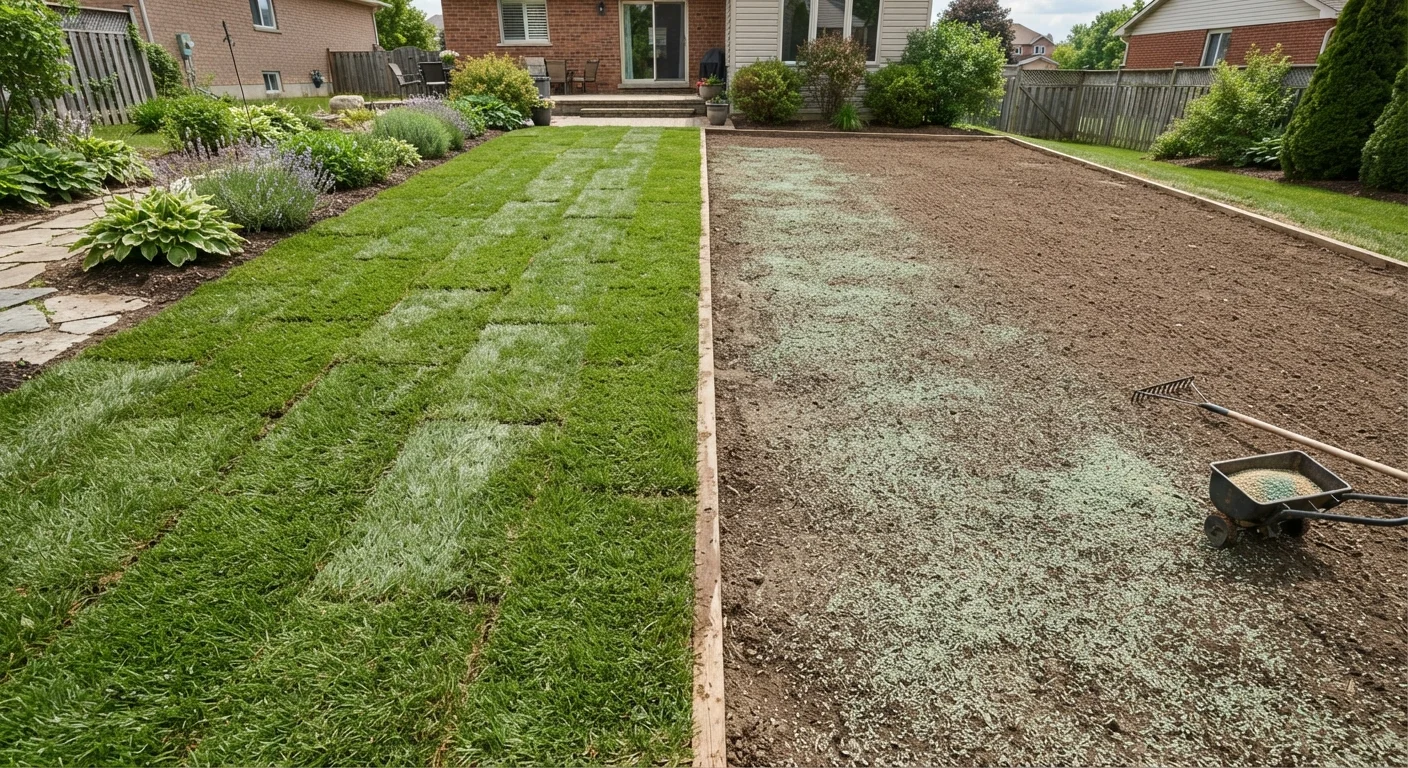
Option A
Grass Seed
The patient, budget-friendly approach to establishing turf.
Best for: Homeowners willing to invest time and consistent watering in exchange for lower upfront cost and greater grass-variety selection.
Option B
Sod
The instant-results solution for an established-looking lawn.
Best for: Homeowners who need usable turf quickly, are addressing erosion on slopes, or are tackling a high-visibility area with little margin for a patchy establishment phase.
Cost and Coverage: What Each Method Actually Runs
Cost is usually the first factor homeowners weigh, and the gap between seeding and sodding is significant. On a per-square-foot basis, quality grass seed typically runs from a few cents to around $0.20 depending on species and blend, while sod commonly ranges from $0.50 to over $1.00 per square foot before any installation labor is factored in. For a typical 1,000-square-foot lawn area, that difference can amount to several hundred dollars - and it scales sharply for larger projects.
Soil preparation costs are similar for both methods: you'll need to till, grade, and amend the soil regardless of which path you take. Where the costs diverge is in the material and, if you hire out sod installation, labor. Laying sod is physically demanding work that many homeowners choose to have done professionally, adding to the overall expense.
| Criterion | Grass Seed | Sod |
|---|---|---|
| Typical material cost | $0.05-$0.20 per sq ft | $0.50-$1.00+ per sq ft |
| Time to walkable turf | 8-12 weeks | 3-4 weeks |
| Immediate erosion control | Poor without added measures | Excellent |
| Grass variety selection | Very wide | Limited |
| Installation difficulty (DIY) | Moderate | Physically demanding |
| Weed competition risk | High during establishment | Low |
| Best installation timing | Season-dependent | Season-dependent |
Timeline and Establishment: How Long Before You Have a Real Lawn
Sod's most compelling advantage is speed. Because it's grown elsewhere and transplanted as mature turf, it creates a visually finished lawn almost immediately. Under proper conditions - consistent moisture and moderate temperatures - sod roots anchor into underlying soil within two to three weeks, and light foot traffic is usually tolerable by the third or fourth week.
Seeding demands patience. Germination alone takes anywhere from five to twenty-one days depending on species, and grass seedlings need several more weeks to develop enough root mass to handle stress. Most lawn care guidelines suggest waiting eight to twelve weeks before any significant use. During this entire period, the seedbed must stay consistently moist - a task that requires dedicated attention and, ideally, a well-planned watering schedule. See our guide to deep vs. frequent watering for how to support strong root development during establishment.
5-21 days
Germination window for common grass species
University extension programs note that soil temperature, not just air temperature, is the primary driver of germination speed.
2-3 weeks
Time for sod to root into underlying soil
Under adequate irrigation and moderate temperatures, sod typically anchors and resists gentle pulling within two to three weeks of installation.
3-10×
Higher cost of sod versus seed per square foot
The cost gap widens further when professional sod installation labor is included in the estimate.
Timing, Grass Selection, and Site Conditions
Both methods hinge on correct timing. Cool-season grasses - such as tall fescue, Kentucky bluegrass, and perennial ryegrass - establish most successfully when seeded or sodded in late summer to early fall. Warm-season grasses like Bermuda and Zoysia thrive when installed in late spring through early summer. Working against the season significantly increases failure risk for either method. Our article on why fall is the most important season for lawn repair explains why timing is so consequential.
Seed wins decisively on variety. Seed suppliers offer cultivars developed for shade tolerance, drought resistance, high traffic, or specific regional climates. Sod producers grow a narrower selection of proven, fast-maturing varieties - functional, but limiting if your site has challenging conditions like deep shade or heavy clay.
Slope and erosion risk favor sod. Seed applied to a slope steeper than roughly 10-15% is highly susceptible to washing away during rain before roots can hold it in place. Erosion-control measures like straw netting can help, but they add cost and labor. Sod provides near-immediate ground coverage and root anchoring, making it the more reliable choice in erosion-prone areas.
Effort, Maintenance, and Long-Term Outlook
The effort profile differs considerably in the short term but converges over time. Seeded lawns demand vigilant, frequent irrigation during germination - sometimes two or three light waterings per day to keep the top inch of soil moist without washing seed away. Once past the seedling stage, the lawn transitions to a standard deep-watering routine. Sod requires consistent moisture too, but the window of high-maintenance irrigation is shorter.
Over the long term, both approaches can produce equally healthy, dense turf - provided establishment goes well. Seeded lawns established from high-quality cultivars may even outperform sod in disease resistance and climate adaptation because the grass is grown in place from the start rather than transplanted and asked to re-root.
One overlooked factor: weed competition. A seeded lawn's bare, disturbed soil is an open invitation for weeds during the long germination and establishment phase. Pre-emergent herbicides cannot be used while grass is germinating, so hand-weeding or careful targeted treatment is required. Sod's dense, already-established canopy suppresses most weed encroachment from the outset.
Soil Preparation Is Non-Negotiable for Both Methods
Neither seed nor sod will perform well on compacted, poorly draining, or nutrient-depleted soil. Before installing either, till to a depth of at least four to six inches, correct drainage issues, and incorporate compost or other organic matter as needed. A soil test - available through most county cooperative extension offices - can identify pH imbalances and nutrient deficiencies before they undermine your investment. Skipping this step is one of the most common reasons new lawns fail regardless of which method is used.
The content provided on our blog site traverses numerous categories, offering readers valuable and practical information. Readers can use the editorial team’s research and data to gain more insights into their topics of interest. However, they are requested not to treat the articles as conclusive. The website team cannot be held responsible for differences in data or inaccuracies found across other platforms. Please also note that the site might also miss out on various schemes and offers available that the readers may find more beneficial than the ones we cover.