

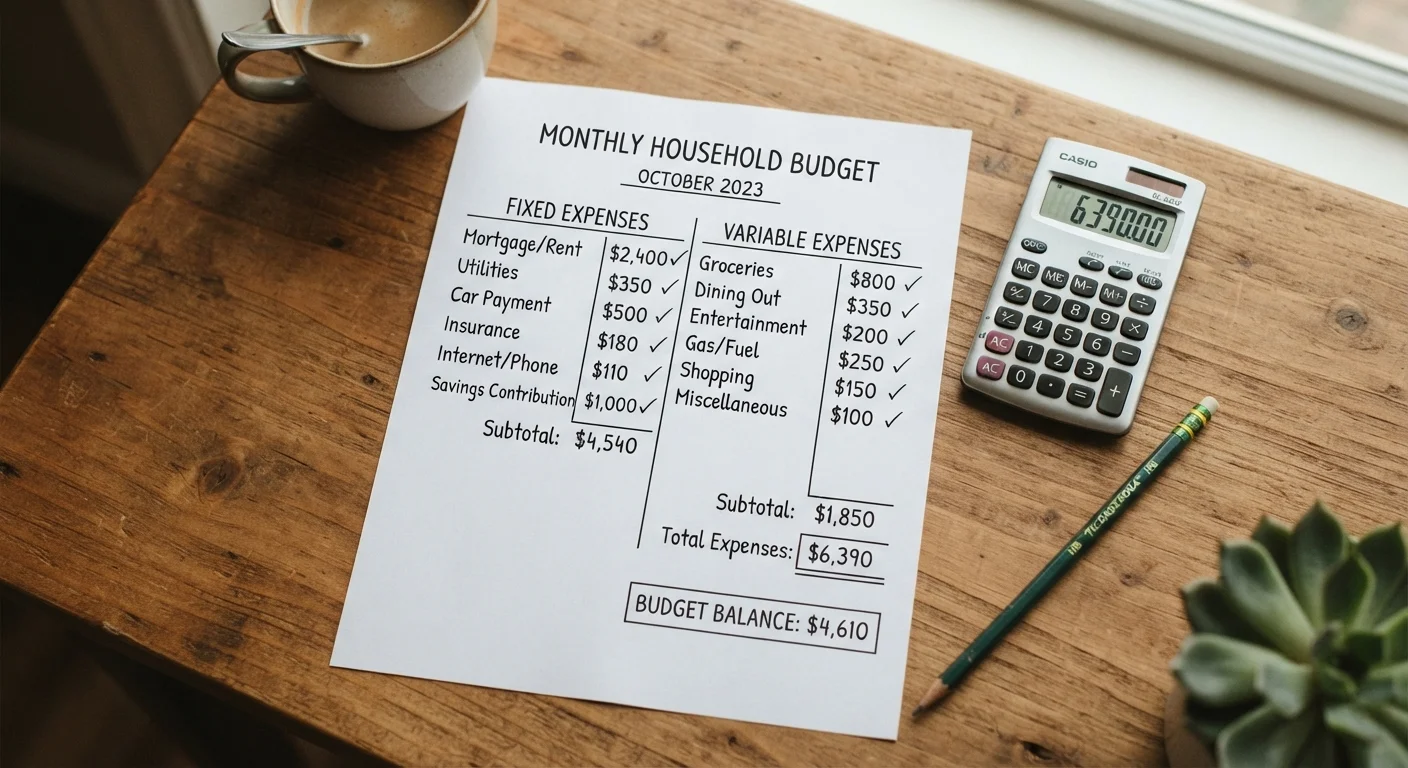
Why This Distinction Is the Foundation of Budgeting
Before you can build a budget that actually holds together, you need to know what you're working with. That means sorting your monthly costs into two buckets: the ones you can predict down to the dollar and the ones that shift depending on behavior, season, or circumstance.
Fixed expenses are predictable by design. Your landlord or mortgage servicer expects the same payment on the same date each month. Your car loan doesn't go up because you drove more. These costs give your budget its stable backbone - once you know them, you can subtract the total from your take-home pay and immediately see what's left to work with.
Variable expenses are where most of the day-to-day financial decision-making happens. Groceries, gas, entertainment, dining out - these respond to your choices and habits. That makes them harder to predict but also easier to influence. This is part of a broader framework for managing household money covered in our complete household budgeting guide.
~33%
Share of household budget spent on housing (fixed)
The U.S. Bureau of Labor Statistics Consumer Expenditure Survey consistently finds housing represents roughly a third of average household spending - making it the largest fixed cost most families carry.
~15%
Share of budget spent on food (variable)
According to BLS Consumer Expenditure data, food accounts for approximately 12-15% of average household budgets, split between groceries and dining out - both variable categories.
3-6 months
Recommended look-back period for variable expense estimates
Personal finance educators commonly advise reviewing at least three to six months of past spending to set realistic variable expense targets, since single-month figures can be misleading.
Fixed Expenses: What Qualifies and What Doesn't
A cost is genuinely fixed when the amount due doesn't change month to month, regardless of what you do. Classic examples include:
- Rent or mortgage payment
- Car loan or lease payment
- Insurance premiums (auto, homeowners, renters, health)
- Loan payments (student loans, personal loans)
- Flat-rate subscription services
It's worth noting that fixed doesn't mean permanent. You can refinance a mortgage, cancel a subscription, or renegotiate an insurance rate. But until you take that action, the amount is locked in - which means you can't reduce it just by changing how you behave this month.
List Fixed Costs Before Anything Else
When setting up or refreshing a budget, start by writing down every expense with a locked-in monthly amount. Seeing your total fixed obligations in one place gives you an accurate picture of your financial floor - the minimum you must cover regardless of what else happens. Everything after that is where your choices come in.
Variable Expenses: Where Your Habits Show Up
Variable expenses reflect your actual lifestyle choices more directly than fixed costs do. They include:
- Groceries and household supplies
- Gas and transportation
- Utilities (electric, gas, water - these shift with season and usage)
- Dining out and entertainment
- Clothing and personal care
- Medical copays and prescriptions
Because these change each month, the best approach is to look back at three to six months of actual spending and set a realistic target range rather than an exact number. If you overspend one month, you have room to pull back the next. Families who deal with changing income levels face an added layer of complexity here - strategies for that situation are explored in our article on budgeting on an irregular income.
One category worth planning for separately: irregular expenses that don't occur every month - annual fees, car repairs, school supplies, holiday spending. These technically belong under variable, but because they're easy to forget, many households benefit from treating them as their own budget line. Our article on irregular expenses explains how to build a simple plan for them.
How to Use Both Categories to Build a Realistic Budget
Once your expenses are sorted, the budget math becomes cleaner. A straightforward approach:
- List all fixed expenses and add them up. This is your non-negotiable monthly baseline.
- Estimate variable expenses using past spending as your guide. Build in a small buffer for the categories that tend to run over.
- Compare the total to your take-home income. If the numbers don't work, variable expenses are usually where adjustments happen first.
- Revisit regularly. Fixed costs change when you refinance, cancel services, or take on new obligations. Variable costs shift with seasons and life circumstances.
For plain-language definitions of other budgeting terms you'll encounter along the way, the personal finance glossary is a useful reference. And for practical daily habits that reinforce the bigger picture, see the Everyday Money Tips hub.
This article is for general informational and educational purposes only and does not constitute personalized financial advice. Consider consulting a qualified financial professional for guidance specific to your situation.
Frequently Asked Questions
A mortgage or rent payment is the clearest example - the amount due is the same every month regardless of what else is happening in your household. Other common examples include car loan payments, insurance premiums, and subscription services billed at a flat monthly rate.
Groceries are the most relatable example - how much you spend depends on what you buy, how many people you're feeding, and whether you stock up or buy minimally. Gas, dining out, clothing, and household supplies all follow the same pattern.
In practice, some variable costs settle into a fairly predictable range over time. If you consistently spend around $300 per month on groceries, you can budget that as a soft fixed target while still accounting for occasional swings. The key is tracking actual spending over a few months to find your realistic baseline.
Variable expenses usually offer more immediate flexibility because the amounts aren't locked in. Reducing dining out, entertainment, or discretionary shopping can free up cash quickly. Fixed expenses may require bigger decisions - like refinancing or canceling a subscription - which take more time but can produce lasting savings.
Utilities are typically variable - your electricity or gas bill changes with usage and season. Some people average their annual utility costs and set aside the same amount each month to smooth out the variation, which is a useful budgeting technique but doesn't change the underlying nature of the expense.
The two categories are related but not the same. Fixed expenses can include both needs (rent) and wants (a gym membership). Variable expenses can also be needs (groceries) or wants (restaurant meals). For a deeper look at that distinction, see our guide on <a href="/personal-finance/everyday-money-tips/needs-vs-wants-drawing-the-line-that-makes-budgets-actually-work">needs vs. wants</a>.
The content provided on our blog site traverses numerous categories, offering readers valuable and practical information. Readers can use the editorial team’s research and data to gain more insights into their topics of interest. However, they are requested not to treat the articles as conclusive. The website team cannot be held responsible for differences in data or inaccuracies found across other platforms. Please also note that the site might also miss out on various schemes and offers available that the readers may find more beneficial than the ones we cover.