

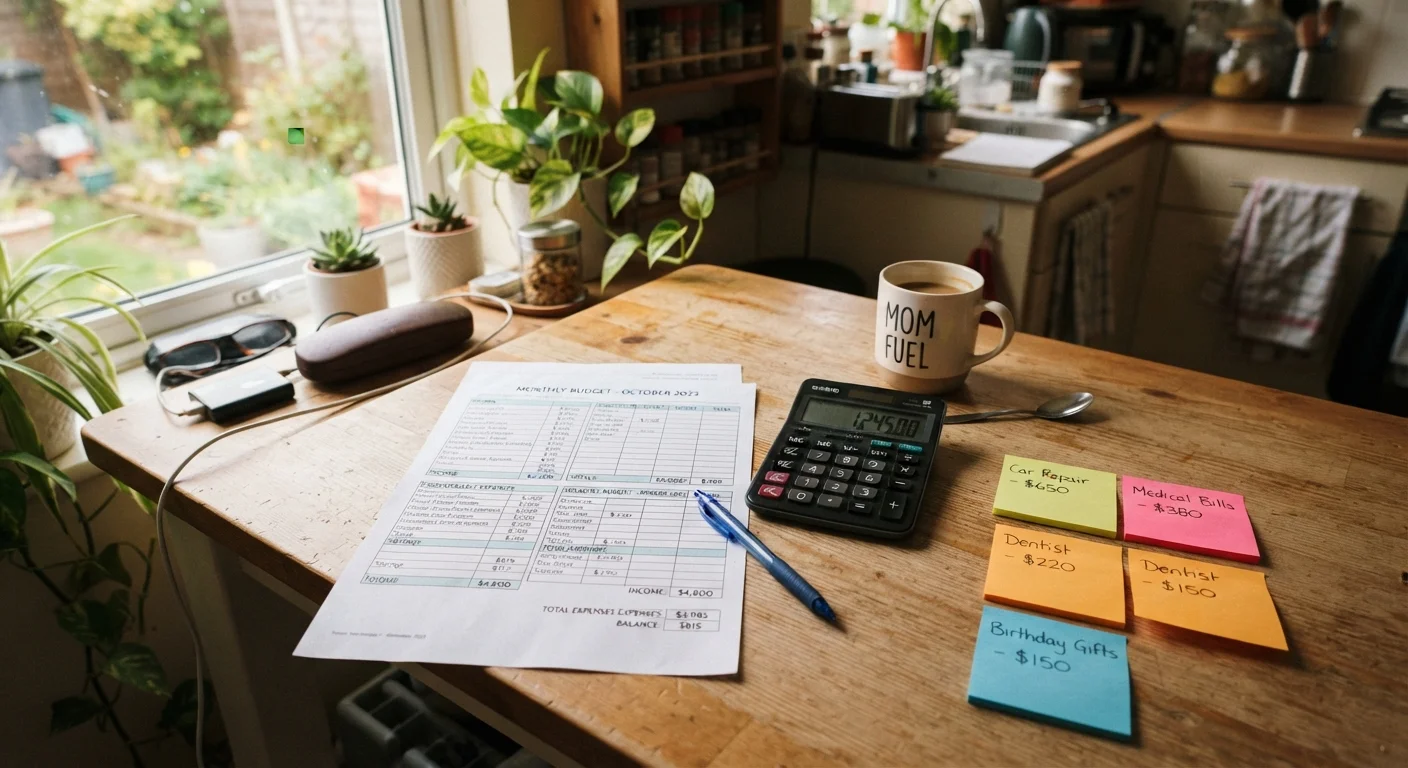
Why Irregular Expenses Break Budgets
Most household budgets are built around monthly costs — rent, utilities, groceries, phone bills. These are easy to plan for because they show up on a predictable schedule. The category that quietly wrecks those budgets is the one that doesn't: irregular expenses.
An irregular expense is any real, expected cost that doesn't land on a fixed monthly date. Think annual car registration, a semi-annual insurance premium, back-to-school supplies, the dentist visit that rolls around twice a year, or the appliance that finally breaks after years of service. None of these are surprises in a true sense — you knew they were coming. The problem is that most budgets don't have a home for them.
When these costs hit, households typically cover them by raiding savings, carrying a credit card balance, or cutting something else that month. That cycle is one of the main reasons monthly budgets fall apart for otherwise careful families. Understanding irregular expenses is a core building block of any working budget — see the Budgeting Basics hub for the broader picture.
Start Small If the Numbers Feel Overwhelming
You don't have to fund every category perfectly on day one. Pick your two or three highest-risk irregular expenses — the ones most likely to sting if they hit unplanned — and start there. Building the habit matters more than achieving perfect coverage immediately. You can add and refine categories over time as your budget stabilizes.
How to Build Irregular Expenses Into Your Budget
The solution is a concept sometimes called a sinking fund — a dedicated pool of money you contribute to each month so the funds are waiting when an irregular bill arrives. Here's how to set one up from scratch.
Pull up 12 months of actual spending
Log into your bank and credit card accounts and download or scroll through a full year of transactions. You're looking for any expense that didn't appear every single month. Flag each one: car repairs, annual software subscriptions, vet visits, tax prep fees, holiday gifts, home maintenance — everything.
Total each irregular category for the year
Group your flagged expenses into categories — auto, medical, home, subscriptions, holidays, etc. Add up what you actually spent in each category over the 12 months. This gives you a realistic annual cost figure based on your real life, not a guess.
Divide each annual total by 12
Take each category's annual total and divide by 12. That number is the monthly amount you need to set aside to be fully prepared when the expense arrives. For example, if auto expenses ran $900 over the year, you'd set aside $75 per month in an auto sinking fund.
Open a dedicated savings spot for these funds
Ideally, keep your sinking fund money somewhere separate from your everyday checking account so you're not tempted to spend it. A simple savings account works well. Some households use one account with mental sub-buckets; others prefer separate accounts per category. Either approach works — the key is that the money is clearly earmarked and not mixed with daily spending funds.
Add the monthly sinking fund contributions to your budget
Treat each monthly contribution as a fixed line item — just like rent or a car payment. Schedule an automatic transfer if possible so it happens without you having to remember. When the irregular bill arrives, the money is already sitting there. You pay it, and then resume monthly contributions to rebuild that category.
Review and adjust your categories annually
At least once a year — ideally in January or at the start of your fiscal year — compare what you budgeted against what you actually spent in each irregular category. Adjust your monthly contributions up or down based on what you learn. Life changes: kids get older, cars age, insurance premiums shift. Your irregular expense plan should shift with them.
Once your irregular expense categories are funded and running, fold this habit into your broader budgeting routine. The monthly budget reset checklist is a good place to review your sinking fund balances regularly. If you also juggle a paycheck that changes month to month, the same principles apply — budgeting on an irregular income offers tailored strategies for that situation.
Don't Confuse Sinking Funds With Your Emergency Fund
A sinking fund covers costs you can anticipate — even if you don't know the exact month. An emergency fund covers genuinely unexpected events like a job loss or a medical crisis. These two buckets serve different purposes and should be kept separate. Spending your emergency fund on a car registration fee leaves you exposed if a real emergency hits. Build both over time through the Saving & Debt resources.
For a deeper look at how irregular expenses fit alongside your fixed and variable costs, understanding fixed vs. variable expenses fills in that framework. And if you're building your household budget from the ground up, the complete household budgeting guide walks through the full setup.
This article is for general informational purposes only and does not constitute personalized financial advice. Consider speaking with a qualified financial professional about decisions specific to your household situation.
The content provided on our blog site traverses numerous categories, offering readers valuable and practical information. Readers can use the editorial team’s research and data to gain more insights into their topics of interest. However, they are requested not to treat the articles as conclusive. The website team cannot be held responsible for differences in data or inaccuracies found across other platforms. Please also note that the site might also miss out on various schemes and offers available that the readers may find more beneficial than the ones we cover.