

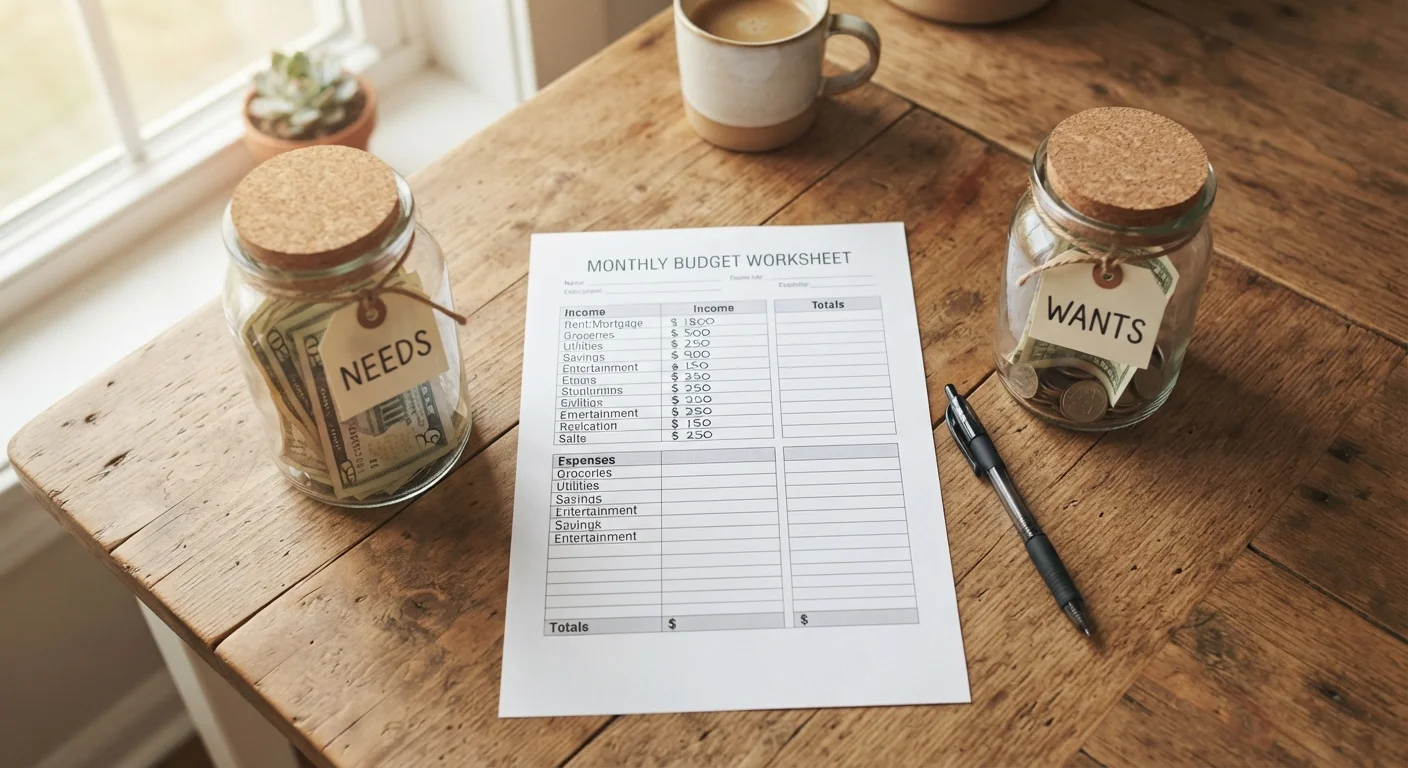
Option A
Needs
The non-negotiable spending your household cannot function without.
Best for: Expenses that must be covered every month regardless of income fluctuations or lifestyle preferences.
Option B
Wants
The spending that improves life but isn't required to sustain it.
Best for: Discretionary purchases that add comfort or enjoyment and can be adjusted when money is tight.
What Needs and Wants Actually Mean
A need is any expense your household cannot safely go without. Housing, utilities, basic groceries, essential medications, and reliable transportation to work all qualify. Remove them and your family's health, safety, or ability to earn income is at risk.
A want is everything that improves your life but isn't required to sustain it — streaming subscriptions, restaurant meals, upgraded phones, gym memberships, and vacations. None of these are bad purchases. The point isn't guilt; it's clarity.
This distinction is the load-bearing wall of any working budget. Without it, every spending category feels equally important, which makes cutting anything feel impossible. The complete guide to household budgeting covers how this categorization fits into building a full budget from scratch.
| Criterion | Needs | Wants |
|---|---|---|
| Definition | Required to maintain health, safety, or income | Enhances quality of life but isn't essential |
| Examples | Rent, utilities, groceries, medications | Streaming services, dining out, vacations |
| Budget flexibility | Little to none — must be funded first | High — can be reduced or paused when needed |
| What happens if skipped | Serious consequences for household stability | Inconvenience or reduced comfort only |
| Gray area risk | Low — core needs are usually clear | High — wants often disguise themselves as needs |
| Budget priority | Allocated before anything else | Funded from what remains after needs are covered |
Why the Line Is Harder to Draw Than It Looks
Most people can separate extreme examples easily — rent is obviously a need; a luxury watch is obviously a want. The challenge lives in the middle, and that's where most household spending actually happens.
Consider internet service. For a remote worker or a student doing homework online, it's a need. For a household where it's used mainly for entertainment, it leans toward a want — or at least a partially optional expense. Context determines category.
The same logic applies to your phone plan, your car payment, and even some food spending. Basic groceries are a need; weekly takeout is a want. A modest, reliable vehicle to get to work is a need; the premium trim level is a want bundled into the same payment.
When a Want Becomes a Need Over Time
Some expenses start as wants and gradually become needs as your life changes. High-speed internet was once a luxury; for many households today it's essential for work or school. Review your categories at least once a year — or after any major life change like a new job, a child, or a move — to make sure your definitions still reflect reality. The goal is accuracy, not judgment.
This blurring is precisely why honest self-assessment matters more than following someone else's list. The gray area between needs and wants is real, and acknowledging it leads to more realistic budgets than pretending every expense is black-and-white.
A Practical Way to Categorize Your Spending
Go through your last two months of bank and credit card statements. For each expense, ask two questions: What happens if I don't pay this? and Is there a lower-cost version that still meets the core need?
If skipping the expense would put your health, housing, or income at risk — it's a need. If you'd be uncomfortable or inconvenienced but fundamentally okay — it's a want. If a $30-per-month option covers the same function as the $80 one you currently pay — the difference is a want.
Once categorized, total each column. Most households are surprised to find that wants represent a larger share of monthly spending than they expected. That's not a moral failing — it's useful data. It tells you exactly where budget flexibility exists. This approach pairs well with understanding fixed vs. variable expenses, since wants are almost always variable costs.
~33%
Share of income spent on discretionary categories
U.S. Bureau of Labor Statistics Consumer Expenditure data consistently shows that roughly a third of average household spending falls in discretionary categories — the broad territory where wants live.
~$1,000
Median monthly discretionary spending per U.S. household
Estimates based on BLS Consumer Expenditure Survey averages suggest many households spend roughly this amount monthly on non-essential categories, representing significant potential budget flexibility.
If you want to build savings or pay down debt, the wants column is where the money is. See the saving and debt hub for practical next steps once you've freed up room in your budget.
This article is for general informational and educational purposes only and does not constitute personalized financial advice. Consider speaking with a qualified financial professional about your specific situation.
The content provided on our blog site traverses numerous categories, offering readers valuable and practical information. Readers can use the editorial team’s research and data to gain more insights into their topics of interest. However, they are requested not to treat the articles as conclusive. The website team cannot be held responsible for differences in data or inaccuracies found across other platforms. Please also note that the site might also miss out on various schemes and offers available that the readers may find more beneficial than the ones we cover.