

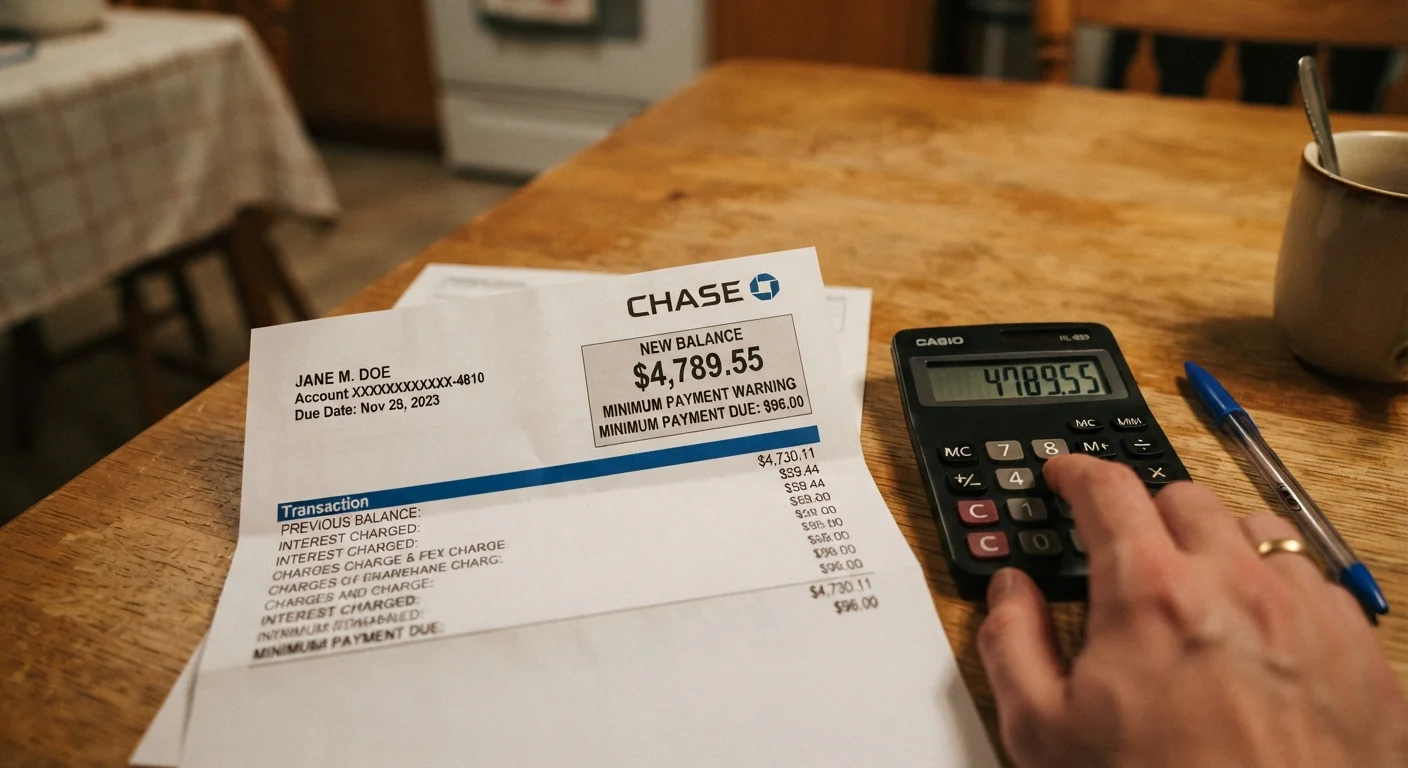
How Interest Charges Actually Accumulate
Most people understand that borrowing money costs something. What's harder to feel in real time is how fast that cost compounds when the rate is high. With a 22% APR credit card, you're not just paying 22 cents per dollar per year in a neat, predictable line — you're paying interest on a balance that grows a little every single day.
Here's the basic mechanism: your card issuer takes your APR, divides it by 365, and applies that daily rate to whatever balance you're carrying. Interest charges are then folded back into your balance. Tomorrow's interest calculation uses that slightly larger number. This is what compounding means in practice — and it's why compound interest works powerfully against borrowers, not just for savers.
At a 22% APR, your daily interest rate is roughly 0.060%. On a $5,000 balance, that's about $3 in interest added on day one. Small — but it repeats every day, on a balance that doesn't shrink unless your payment exceeds what interest added. By the end of a year of minimum-only payments, you may have paid hundreds of dollars while the principal has barely moved.
~20%+
Average credit card APR in recent years
Federal Reserve data has tracked average credit card interest rates above 20% in recent reporting periods, the highest levels in decades.
15+ years
Potential payoff timeline on minimum payments
Consumer financial education resources commonly illustrate that a mid-size credit card balance paid at minimum-only rates can take 15 or more years to eliminate.
~0.060%
Daily interest rate at 22% APR
Dividing a 22% annual rate by 365 days shows how small daily charges accumulate into significant annual costs on any carried balance.
The Minimum Payment Trap
Credit card minimum payments are not designed to help you get out of debt quickly. They're typically calculated as a small percentage of your balance — often 1% to 3% — sometimes with a fixed-dollar floor. At a high APR, a large portion of each minimum payment goes straight to covering interest charges. Only the remainder chips away at the actual amount you borrowed.
Consider a $6,000 balance at 20% APR. If the minimum payment starts around $120 and you never pay more than required, the payoff timeline can stretch past 20 years, and total interest paid can exceed the original balance. That's not a worst-case projection — it's a predictable mathematical outcome of how minimum payments interact with high compounding rates.
Even a small, consistent increase above the minimum can make a meaningful difference. Paying an extra $50 or $100 a month reduces the principal faster, which in turn lowers the base on which interest is calculated. The effect builds over time in your favor.
A Simple Way to Test Your Own Numbers
The Consumer Financial Protection Bureau (CFPB) offers a free credit card payoff calculator at consumerfinance.gov. Plug in your balance, APR, and current payment to see exactly how long payoff takes and how much interest you'll pay. Then try increasing the payment by $50 and watch the timeline shrink — seeing the actual numbers is often the clearest motivation to act.
Why High-Interest Debt Deserves Specific Attention in Your Plan
Not all debt behaves the same way. A mortgage at 7% and a credit card at 24% are structurally different problems. The mortgage has a defined payoff schedule built into your monthly payment; the credit card gives you the flexibility — and the temptation — to pay only the minimum indefinitely. That flexibility is what makes it dangerous.
From a purely mathematical standpoint, paying down a debt that charges 20%+ is equivalent to earning a guaranteed 20%+ return on that money — something no conventional savings product reliably offers. This is one reason many financial educators suggest treating high-interest debt payoff as a financial priority, and why it's central to the broader question of paying off debt vs. building savings.
That doesn't mean ignoring savings entirely. Most guidance recommends at minimum a small emergency cushion — enough to handle a car repair or medical co-pay — so a surprise expense doesn't send you back to the credit card. From there, directing as much as reasonably possible toward high-interest balances tends to produce the most durable financial improvement.
If you're also managing an installment loan, understanding how its structure differs is useful context — see how APR and loan terms affect total cost for a comparison. For households balancing multiple goals at once, the principles for managing debt without derailing savings can offer a practical framework.
This article is for general informational purposes only and does not constitute personalized financial advice. Consult a qualified financial professional for guidance tailored to your situation.
Frequently Asked Questions
There's no universal cutoff, but debt carrying an APR above 10% is often considered high-interest, and credit cards frequently charge 20% or more. Personal loans and some store cards can also fall into this range. The higher the rate, the more urgently it tends to warrant attention in a debt payoff plan.
Minimum payments are typically set as a small percentage of your balance — often around 1–3%. On a high-APR account, most of that payment goes directly toward interest charges, leaving very little to reduce what you actually owe. That's why balances can stay nearly flat for months even when you pay every month.
Credit card issuers usually calculate interest daily by dividing your APR by 365 and applying that daily rate to your balance. Interest accrued is then added to your balance, which becomes the new base for tomorrow's calculation. Over time, you're paying interest on previously accumulated interest, not just the original amount you charged.
For many households, paying off high-interest debt first makes mathematical sense because no savings account reliably earns more than a 20% APR costs. That said, maintaining a small emergency fund alongside debt payoff is widely recommended so unexpected expenses don't force you to borrow more. A qualified financial adviser can help you weigh your specific situation.
The difference compounds significantly over time. A $5,000 balance at 25% APR with only minimum payments can easily take well over a decade to eliminate and cost several thousand dollars in interest. The same balance at 15% takes less time and costs less — illustrating why even a few percentage points in APR matter a great deal.
The content provided on our blog site traverses numerous categories, offering readers valuable and practical information. Readers can use the editorial team’s research and data to gain more insights into their topics of interest. However, they are requested not to treat the articles as conclusive. The website team cannot be held responsible for differences in data or inaccuracies found across other platforms. Please also note that the site might also miss out on various schemes and offers available that the readers may find more beneficial than the ones we cover.