

The Three Variables That Determine What You Pay
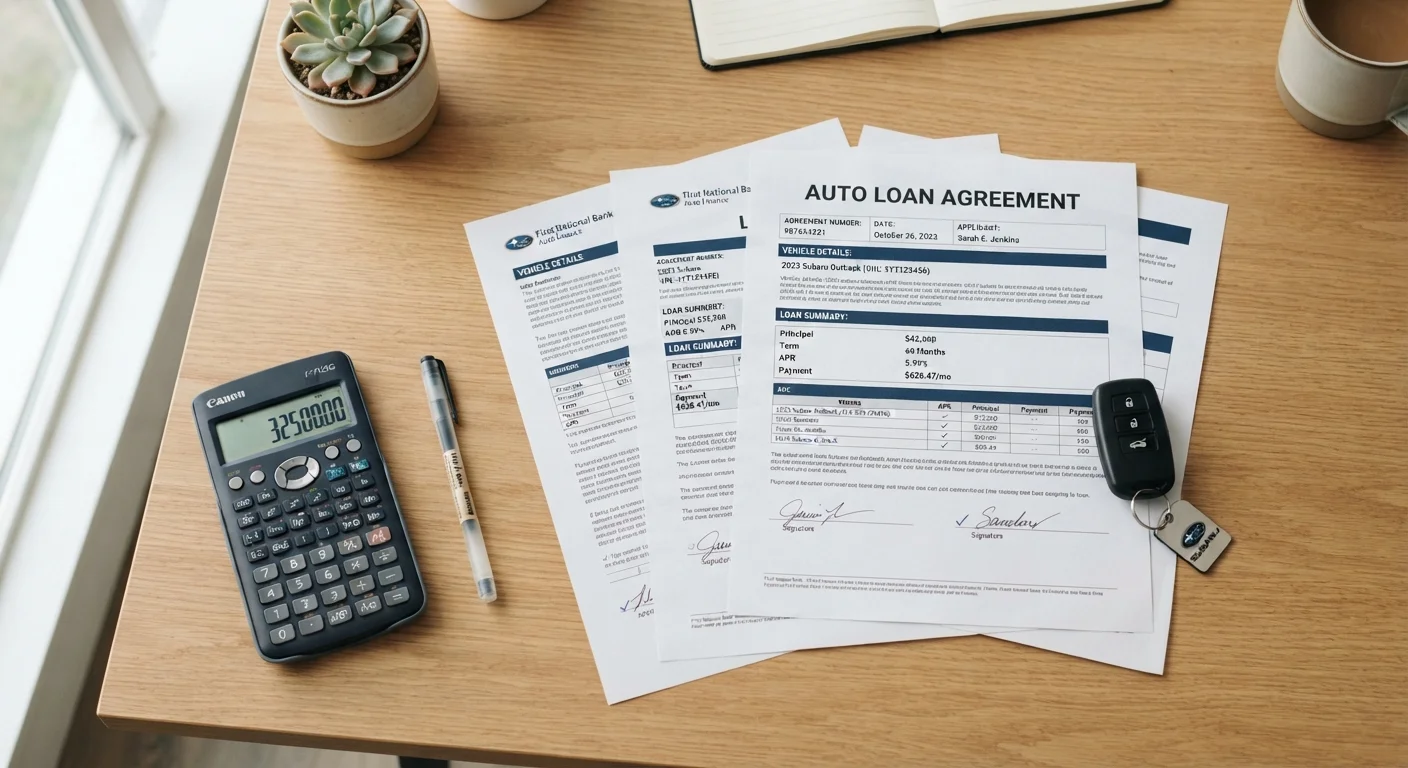
Every auto loan is shaped by three core factors: the APR, the loan term, and the amount you borrow (your principal, which is the vehicle price minus any down payment). These variables don't operate in isolation - they multiply each other's effects, which is why a seemingly small difference in APR or loan length can translate to hundreds or thousands of dollars in total cost.
For a plain-language reference on key borrowing terms like principal and amortization, see our Household Debt Glossary. Understanding these terms before you walk into any financing conversation gives you a meaningful advantage.
$40,000+
Average new car transaction price in the US
According to Kelley Blue Book data, average new vehicle transaction prices have exceeded $40,000 in recent years, making loan structure decisions more consequential than ever.
69 months
Average new car loan term length
Experian's State of the Automotive Finance Market reports have consistently shown average new vehicle loan terms approaching or exceeding 69 months in recent years.
~$1,500+
Extra interest from extending 48- to 72-month term
On a typical mid-range auto loan, stretching the term by 24 months at the same APR can add more than $1,500 in total interest paid, depending on principal and rate.
How APR Works in Practice
APR determines how much interest accumulates each month on your remaining balance. Auto loans typically use simple interest: each payment period, the lender calculates interest on what you still owe. Early in the loan, more of each payment goes toward interest; as the principal shrinks, more of each payment goes toward the actual balance. This process is called amortization.
For example, borrowing $25,000 at 5% APR over 60 months results in a monthly payment of roughly $472 and total interest of about $3,300. Raise the APR to 9% with the same term and principal, and total interest climbs to approximately $6,200 - nearly double. Your credit score, the loan term length, and whether you finance through a dealer or directly through a lender all influence the rate you're offered.
If you want to understand how elevated rates accelerate debt growth, our piece on high-interest debt walks through the math in detail.
Get Preapproved Before You Shop
Applying for loan preapproval from a bank or credit union before visiting a dealership gives you a concrete APR to compare against any dealer financing offer. This shifts the conversation from "what monthly payment works for you?" to "what is the total cost of this loan?" - a far more useful frame for evaluating your options.
Loan Term: The Monthly Payment Trade-Off
Loan terms for new vehicles commonly range from 36 to 84 months. A longer term reduces the monthly payment, which can make a more expensive vehicle seem manageable - but it increases the total interest paid and extends the period during which you may owe more than the car is worth (known as being upside down or underwater).
Consider two scenarios on a $28,000 loan at 6% APR:
- 48-month term: ~$657/month, total interest ~$3,550
- 72-month term: ~$465/month, total interest ~$5,500
The 72-month loan saves $192 per month but costs roughly $1,950 more overall. It also means you're making payments on a vehicle that may have depreciated substantially by the time you pay it off. Common car-buying myths suggest long loan terms are simply a smart way to manage cash flow - our article on car-buying myths addresses why that framing is incomplete.
Down Payments, Total Cost, and Your Financing Options
A down payment directly reduces your loan principal, which has a compounding benefit: less principal means less interest accrues each month, lowering both the monthly payment and the total amount paid. A 10-20% down payment is a commonly cited guideline, though the right amount depends on your budget and the vehicle's depreciation rate.
Where you get the loan matters too. Banks, credit unions, and online lenders each set their own rates - and comparing preapproved offers before visiting a dealership gives you a baseline. Dealer-arranged financing goes through third-party lenders, and dealers may add a markup. For a side-by-side look at how both paths work, see our explainer on dealer financing vs. outside financing.
Auto loan costs are just one layer of what a vehicle actually costs to own. Registration, insurance, fuel, and maintenance add up quickly - our guide to the true cost of owning a car puts the full picture together.
This article provides general financial information for educational purposes and is not personalized financial or lending advice. Consult a qualified financial professional regarding decisions specific to your situation.
Frequently Asked Questions
APR varies widely based on credit score, loan term, and lender. Borrowers with strong credit (typically 720 or above) generally qualify for lower rates, while those with fair or poor credit may see significantly higher APRs. Checking offers from multiple lenders - including credit unions and banks - helps you find a competitive rate for your situation.
Yes, extending the loan term reduces monthly payments, but it increases the total interest you pay over time. A 72-month loan will cost more in total interest than a 48-month loan at the same APR. Longer terms also raise the risk of becoming "upside down" - owing more than the car is worth.
A down payment reduces the amount you need to borrow (the principal). A lower principal means less interest accrues over the loan term, which lowers both your monthly payment and your total cost. It can also reduce your lender's risk, sometimes leading to better rate offers.
Most auto loans allow early payoff, but some lenders charge a prepayment penalty. Before making extra payments, review your loan agreement or ask your lender directly. Paying ahead of schedule reduces the outstanding principal, which cuts the total interest you'll pay.
The interest rate is the base cost of borrowing, while APR incorporates that rate plus any applicable lender fees, giving you a broader view of total cost. For auto loans, the two figures are often close but not always identical - always compare APR when evaluating loan offers.
The content provided on our blog site traverses numerous categories, offering readers valuable and practical information. Readers can use the editorial team’s research and data to gain more insights into their topics of interest. However, they are requested not to treat the articles as conclusive. The website team cannot be held responsible for differences in data or inaccuracies found across other platforms. Please also note that the site might also miss out on various schemes and offers available that the readers may find more beneficial than the ones we cover.