

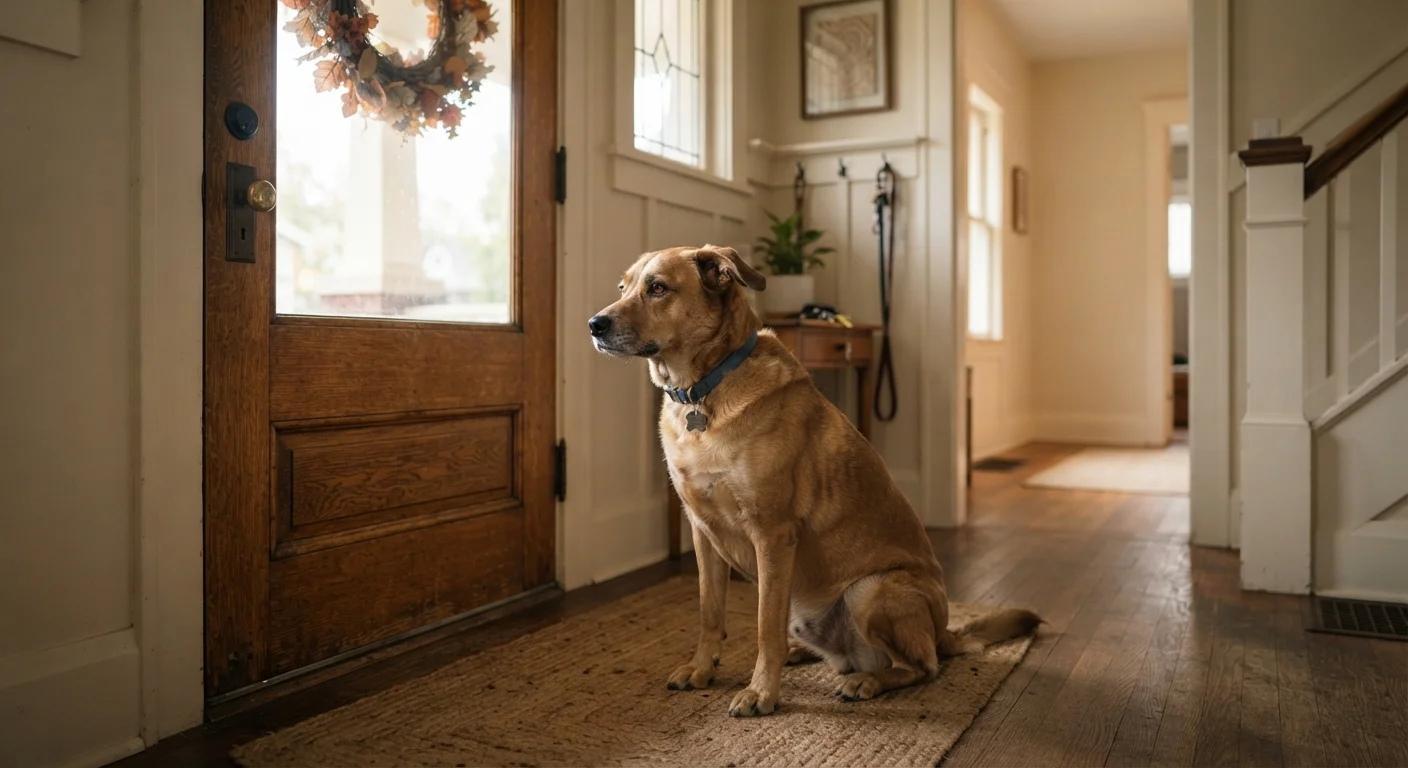
What True Separation Anxiety Actually Looks Like
Separation anxiety is defined by its trigger: the absence of an attachment figure. Unlike general misbehavior, the distress begins at departure — sometimes during pre-departure cues like picking up keys — and is not simply about being unsupervised.
Common signs of true separation anxiety include:
- Persistent vocalization (howling, barking, whining) that doesn't settle
- Destructive behavior focused near exits — doors, windows, and gate areas
- House soiling in a dog that is otherwise reliably house-trained
- Excessive salivation, panting, or self-injury from escape attempts
- Refusal to eat or engage with toys while alone
The key distinction is that these behaviors are distress responses, not willful disobedience. A dog with separation anxiety isn't retaliating for being left — it is experiencing something closer to panic. This is why approaches rooted in punishment are not only ineffective but actively harmful. See our overview of training misconceptions for more on why punishment-based methods often backfire.
Separation Anxiety Can Mimic Other Conditions
Not all anxious-looking behavior when alone qualifies as separation anxiety. Noise phobia (fear of traffic, thunder, or neighborhood sounds), confinement distress, or boredom can produce similar symptoms. A thorough behavioral history — including video evidence — is essential before assuming a specific diagnosis. When in doubt, seek professional assessment.
Separation Anxiety vs. Boredom and Other Look-Alikes
One of the most common mistakes owners make is labeling boredom or under-stimulation as separation anxiety. The behaviors can overlap — chewing, barking, getting into trash — but the cause and the solution are very different.
Boredom-driven behavior typically shows up when a dog hasn't had adequate physical exercise or mental enrichment. It may happen at any time — not exclusively when the owner is away — and tends to target accessible items rather than exit points. A well-exercised, mentally stimulated dog will usually rest contentedly when alone.
Incomplete training is another frequent culprit. A dog that has never been taught that alone time is safe and normal will test boundaries when unsupervised. This isn't anxiety — it's a gap in learning that responds well to structured training. Our training session readiness checklist can help you establish a consistent routine.
Video is the most objective diagnostic tool available to owners. Recording your dog for the first 30–60 minutes after you leave will reveal whether distress begins immediately — pointing toward anxiety — or emerges gradually after a period of calm, which suggests boredom or low stimulation.
~17%
Dogs estimated to experience separation-related behaviors
Research published in veterinary behavioral literature suggests roughly 14–20% of dogs show some form of separation-related distress, though many go undiagnosed.
Top 3
Reason dogs are relinquished to shelters
Behavioral issues, including separation-related destruction and vocalization, are consistently cited among the leading reasons owners surrender dogs, according to shelter intake surveys.
Evidence-Based Training Strategies That Help
The foundation of treating separation anxiety is systematic desensitization — gradually increasing the time a dog is alone in very small steps, ensuring the dog remains below its anxiety threshold at each stage. This approach, supported by veterinary behaviorists, works by teaching the dog that departures are safe and temporary.
Starting with pre-departure cues
Many anxious dogs react to signals that a departure is coming — grabbing a bag, putting on shoes, or picking up keys. Begin by neutralizing these cues. Pick up your keys, then sit back down. Put on your coat, then make a cup of coffee. Repeat until these cues stop triggering a stress response.
Graduated absences
Begin with absences of just a few seconds. Step outside, return before any anxiety begins, and reward calm behavior. Increase duration incrementally over days and weeks — never jumping ahead faster than the dog's comfort allows. Progress is nonlinear; expect setbacks and plan for them.
Independence training
Encourage the dog to be comfortable in a separate room while you are home. Use a baby gate or closed door to create brief separations during everyday activities. This builds tolerance for distance without the pressure of full departure.
For dogs with a history of rehoming or uncertain early life experiences, patience is especially important. Our guide to training rescue dogs outlines how to build foundational trust before advancing to more challenging exercises.
Film Before You Diagnose
Before starting any treatment plan, record your dog using a phone or home camera for the first hour after you leave. Watch for the timing, intensity, and type of behaviors. This footage is also invaluable if you later consult a veterinary behaviorist — it gives them objective data to work from rather than owner recollection alone.
When Training Alone Isn't Enough
For dogs with moderate to severe separation anxiety, behavior modification on its own may not be sufficient — at least not initially. A veterinary behaviorist can assess whether medication is appropriate to reduce baseline anxiety enough for training to take hold. Medication is not a substitute for behavior modification; it works in tandem with it.
It's also worth ruling out underlying medical factors. Pain, cognitive changes in older dogs, or other health conditions can alter behavior in ways that resemble anxiety. If a dog's behavior has changed suddenly or is accompanied by other symptoms, a veterinary visit should come first. Our article on why trained dogs stop listening explores how health and environment affect behavior more broadly.
Management strategies — dog walkers, doggy daycare, or asking a neighbor to check in — can reduce the number of alone-time exposures while training is underway. These are helpful bridges, not long-term solutions, but they protect a dog from repeatedly reaching peak distress while its tolerance is still being built.
This article is for general informational and educational purposes only and is not a substitute for professional veterinary or behavioral advice. If your dog is showing signs of significant distress, consult a licensed veterinarian or certified applied animal behaviorist.
Frequently Asked Questions
Set up a camera and record your dog shortly after you leave. A bored dog typically explores, settles, or sleeps within 20–30 minutes. A dog with separation anxiety shows distress — pacing, whining, destructive behavior, or attempts to escape — that begins almost immediately after departure and doesn't resolve on its own.
It depends on the individual dog. Some dogs find crates calming and feel safer in a confined space. Others experience increased panic when crated, which can worsen the condition. Introduce crates gradually and monitor your dog's reaction before using one as a management tool for anxiety.
Many dogs show significant improvement with consistent behavior modification, especially when started early. Some dogs reach a point where they are comfortable alone for normal periods. Others require ongoing management, including environmental adjustments or long-term medication. No outcome can be guaranteed.
This is generally not recommended as a primary strategy. Dogs with true separation anxiety are attached to a specific person, not just any companion — a second dog often doesn't resolve the distress. It may also introduce new behavioral challenges and should not replace professional guidance.
Consult a veterinary behaviorist if your dog's distress is severe, if the behaviors are causing injury or significant property damage, or if several weeks of consistent training haven't produced improvement. Medication may be warranted and should only be prescribed by a licensed veterinarian.
No — punishment is counterproductive for anxiety-based behaviors. Since the dog is reacting from fear and distress rather than choice, punishment increases anxiety and erodes trust. Evidence-based approaches use positive reinforcement and systematic desensitization instead.
The content provided on our blog site traverses numerous categories, offering readers valuable and practical information. Readers can use the editorial team’s research and data to gain more insights into their topics of interest. However, they are requested not to treat the articles as conclusive. The website team cannot be held responsible for differences in data or inaccuracies found across other platforms. Please also note that the site might also miss out on various schemes and offers available that the readers may find more beneficial than the ones we cover.