

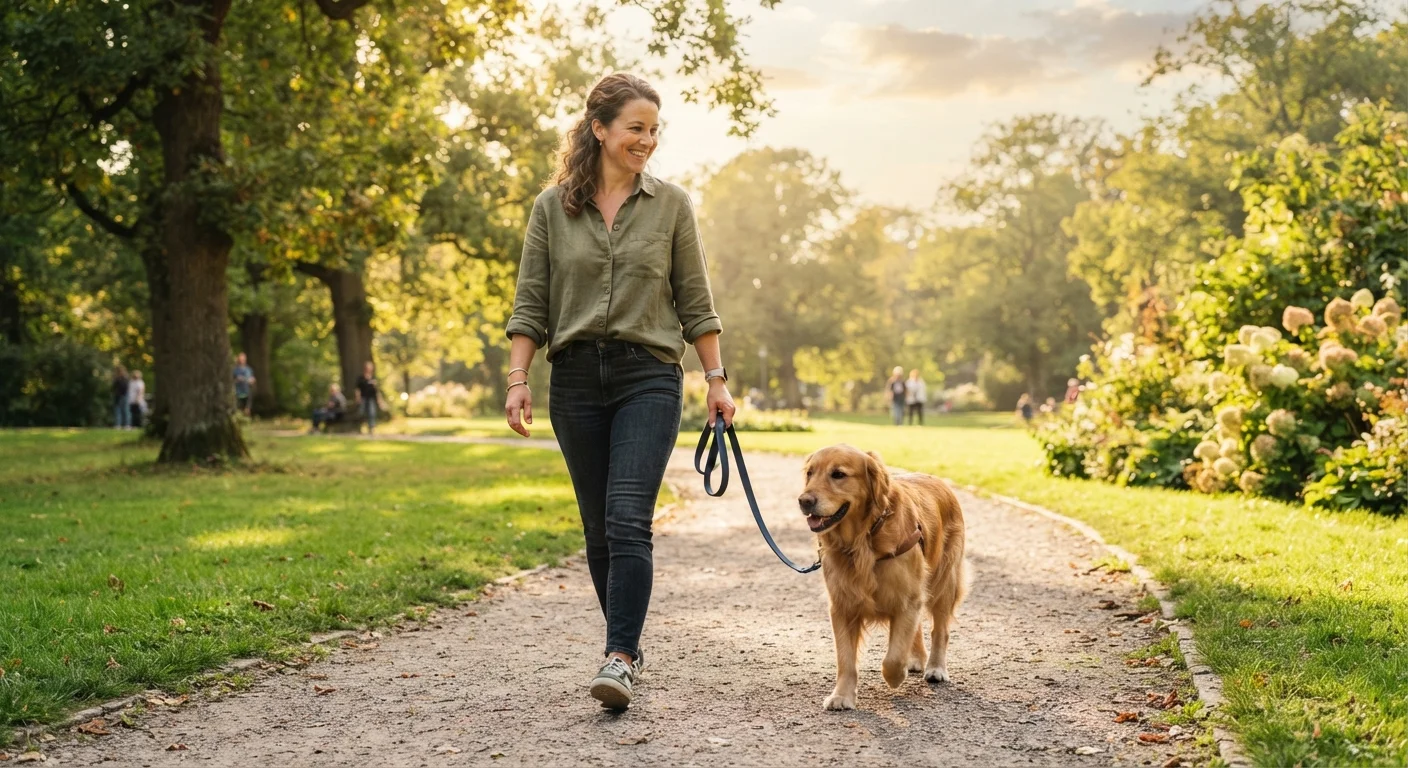
Why Dogs Pull in the First Place
Leash pulling is almost never a dominance display or a sign that a dog is trying to be "alpha." It is simply a behavior that has been reinforced — often without the owner realizing it. Dogs move forward naturally when curious, and if walking forward follows pulling, the pulling is rewarded. Over hundreds of walks, this becomes a deeply ingrained habit. Dominance-based explanations for pulling are among the most persistent misconceptions in pet training, and acting on them can make the problem worse.
There is also a physiological factor: the opposition reflex. When pressure is applied to a dog's chest or neck, the nervous system's natural response is to push into that pressure — not away from it. This means that a taut leash can actually encourage the dog to lean forward harder. Understanding this reflex makes it clear why simply restraining a dog does not teach it to walk calmly.
Avoid Gear That Suppresses Pulling Through Pain
Choke chains, prong collars, and shock collars may interrupt pulling momentarily, but they do not teach the dog what to do instead. They also carry risks of physical injury and can create negative associations with walks or other dogs nearby. Common training myths often underpin the appeal of these tools — understanding the evidence helps owners make more informed choices.
Breed and age also play a role. High-energy breeds, young dogs, and dogs with limited leash history will typically require more patience and more repetitions. That's not a character flaw — it's biology and learning history. For owners building routines with a new dog, establishing healthy daily habits early can reduce problem behaviors before they become entrenched.
The Mechanics of Teaching a Loose-Leash Walk
Loose-leash walking is a trained skill, not a default behavior. Teaching it requires two parallel efforts: stopping the reinforcement of pulling, and actively reinforcing the alternative. Both must happen together. Withholding reward from pulling alone creates frustration; rewarding correct position alone, without addressing what happens when the leash tightens, leaves a gap in the dog's understanding.
What you will need
Equipment matters, though it is secondary to technique. A front-clip harness can reduce the mechanical advantage a dog has when pulling, making management easier while training is in progress. For a full breakdown of how different tools work and when each is appropriate, see training tools explained. Regardless of the equipment used, the foundational skill — teaching the dog that a loose leash produces good things — must be built deliberately.
Flat collar or front-clip harness
Provides a safe attachment point for the leash without concentrating pressure on the throat.
Standard 4–6 foot leash
Gives you reliable control and clear tactile feedback when the leash goes slack or taut.
High-value treats (small, soft pieces)
Used as reinforcers delivered precisely at the moment of correct leash position.
Treat pouch or accessible pocket
Keeps rewards ready for immediate delivery so reward timing stays tight.
Clicker (optional marker tool)
Provides a precise auditory marker to bridge the gap between the correct behavior and treat delivery.
Match Your Reward Rate to the Difficulty
In a new or high-distraction environment, reward much more frequently — even every few steps. As your dog grows confident in that setting, you can gradually space rewards further apart. Dropping your reward rate too fast is a leading cause of training plateaus. For a deeper look at how timing and reward schedules work, see reward timing and fading fundamentals.
Consistency Across All Handlers Is Critical
If one household member allows pulling while another does not, the dog learns that pulling works some of the time — which actually makes the behavior more persistent. Everyone who walks your dog must follow the same rules and use the same responses. Inconsistency is one of the most common reasons loose-leash training stalls or regresses. See why trained dogs stop listening for more on how inconsistency affects learned behavior.
Establish a clear marker signal
Before working on leash skills, teach your dog that a specific sound — a verbal "yes" or a clicker click — means a reward is coming immediately. Practice this away from the leash: make the sound, then deliver a treat. After 10–15 repetitions across a couple of short sessions, your dog should show visible anticipation when they hear it. This marker becomes the precise communication tool you'll use during leash training.
Introduce the reward position
Decide which side your dog will walk on — left is conventional, but either works as long as you're consistent. Hold a treat at your hip on that side and let your dog find it. Mark and reward the moment their head or shoulder aligns with your leg. Repeat this stationary exercise until your dog actively seeks that position. This builds the muscle memory of where the rewarding zone is before any movement is involved.
Take one step, then reward
Attach the leash and take a single step. If your dog moves with you and the leash stays loose, mark and reward at your hip immediately. If the leash goes taut before you mark, stop moving. Do not yank or correct — simply become a statue. Wait for the dog to release the tension by backing up or turning toward you, then mark and reward that slack leash. One step at a time builds an accurate picture of what earns the reward.
Gradually add steps between rewards
Once your dog is reliably walking one step at a time with a loose leash, begin extending the duration before you mark. Try two steps, then three, varying the count unpredictably so your dog stays engaged. Keep sessions in a low-distraction environment — a hallway, backyard, or quiet street — until this foundation is solid. Reward frequently; the goal at this stage is to make the correct behavior feel highly worthwhile.
Introduce mild distractions gradually
Once your dog maintains a loose leash for 15–20 steps in a quiet space, begin practicing in slightly busier environments. Increase your reward rate whenever you raise the difficulty — more distractions mean more competition for your dog's attention, so the reinforcement needs to be more compelling. If your dog loses focus and starts pulling regularly, you've moved too fast; return to a simpler setting and rebuild before trying again.
Build real-world reliability over time
Loose-leash walking in genuinely busy environments — dog parks nearby, traffic, other pedestrians — takes weeks to months of consistent practice for most dogs. Continue rewarding intermittently even after the skill feels established. As the skill becomes fluent, the walk itself, interesting smells, and social interaction can naturally begin to serve as additional reinforcers. See how to fade prompts and rewards as fluency develops.
The content provided on our blog site traverses numerous categories, offering readers valuable and practical information. Readers can use the editorial team’s research and data to gain more insights into their topics of interest. However, they are requested not to treat the articles as conclusive. The website team cannot be held responsible for differences in data or inaccuracies found across other platforms. Please also note that the site might also miss out on various schemes and offers available that the readers may find more beneficial than the ones we cover.