

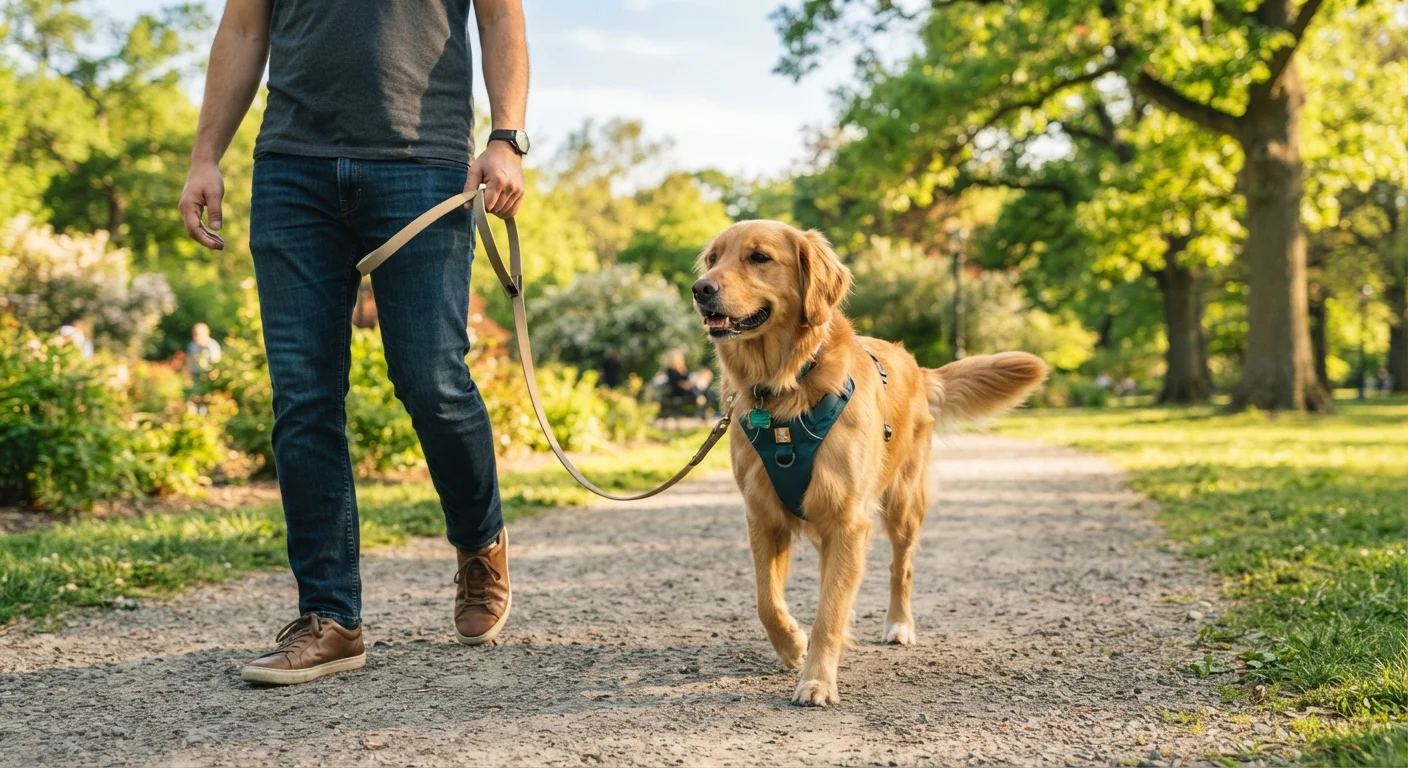
How Training Equipment Actually Works
Training tools are best understood as management aids — they shape what's physically possible in the moment and create cleaner opportunities to reinforce the behavior you actually want. They don't teach on their own. That distinction matters, because many owners expect equipment to resolve pulling, reactivity, or wandering without pairing it with consistent training.
The three categories covered here — harnesses, head collars, and long lines — each serve different purposes. Matching the right tool to the right situation is part of building an effective training plan. For context on how reward-based methods underpin all of this, see our overview of the science behind positive reinforcement training.
| Primary use of front-clip harness | Reducing pulling by redirecting forward momentum |
| Primary use of back-clip harness | Comfortable everyday walking and small or calm dogs |
| Primary use of head collar | Directional control for strong or reactive dogs |
| Primary use of long line | Recall practice and supervised off-leash freedom |
| Long line typical length range | 15 to 50 feet |
| Head collar function | Controls head direction; does not restrict the mouth |
| Key principle | Equipment manages behavior; training changes it |
Harnesses: Front-Clip vs. Back-Clip
Harnesses distribute leash pressure across the chest and shoulders rather than the neck, making them a broadly comfortable option for most dogs. But not all harnesses function the same way.
Back-Clip Harnesses
The leash attaches at the dog's back. This setup is comfortable and easy to put on, and works well for dogs that already walk calmly or for small breeds where pulling pressure is less of a concern. However, a back-clip configuration can actually make pulling easier for a dog — the attachment point allows forward momentum to go unchecked.
Front-Clip Harnesses
The leash attaches at the dog's chest. When the dog pulls forward, the leash redirects the body sideways, which naturally interrupts pulling momentum and makes it easier to reinforce a loose leash. This makes front-clip harnesses a common choice during loose-leash walking practice. Fit matters considerably — a harness that shifts or pinches can create discomfort and affect gait, so proper sizing is essential.
Equipment Is a Starting Point, Not a Solution
No harness, head collar, or long line will train your dog on its own. These tools create conditions that make training easier — but the behavioral change comes from consistent reinforcement. For a deeper look at why reward-based methods work, see our article on the science behind positive reinforcement training.
Head Collars: What They Do and Don't Do
A head collar fits over the dog's muzzle and behind the ears, with the leash attaching beneath the chin. Because where the head goes, the body follows, handlers gain meaningful directional control — particularly useful with large, strong, or reactive dogs where a harness alone may not provide enough guidance.
Common misconception: Head collars are not muzzles. Dogs wearing them can still open their mouths, eat, drink, pant, and carry objects. The equipment controls direction, not the mouth.
Many dogs require a deliberate introduction period before they accept a head collar comfortably. Rushing this step can create a negative association with the equipment and with walks generally. A gradual desensitization process — pairing the collar's presence with treats and positive experiences — is typically recommended before attaching a leash. This kind of careful, trust-building introduction is especially relevant for dogs with unknown histories.
Long Lines: Building Skills at a Distance
A long line is a lightweight leash — usually 15 to 50 feet — that allows a dog to explore, sniff, and move freely while remaining safely connected. It's most commonly used for:
- Recall training: Practicing the come command at realistic distances before transitioning to off-leash environments
- Controlled outdoor time: Giving dogs exercise and enrichment in open spaces where fully off-leash activity isn't permitted or safe
- Building confidence: Allowing anxious or newly adopted dogs to engage with their environment on their own terms within a safety boundary
Long lines are not passive tools — they require an attentive handler. Allowing excessive slack in wooded or crowded areas creates entanglement risks. Lightweight biothane or nylon lines are common material choices because they drag easily without collecting debris. Starting a long-line session with a pre-session readiness check helps set both dog and handler up for a productive practice.
Front-clip harness
A harness with the leash attachment ring located on the dog's chest. When the dog pulls forward, the design naturally redirects the body sideways rather than allowing full forward momentum.
Back-clip harness
A harness with the leash attachment ring on the dog's back. It distributes pressure across the chest and shoulders and is generally considered comfortable for most dogs, though it does not inherently reduce pulling.
Head collar
A piece of equipment that fits around a dog's muzzle and behind the ears, giving the handler control over the direction of the dog's head. It is not a muzzle and does not prevent the dog from opening its mouth.
Long line
A lightweight leash, typically 15 to 50 feet in length, that allows a dog to move freely at a distance while remaining connected to the handler. Commonly used to practice recall and build off-leash skills safely.
Loose-leash walking
A trained behavior in which a dog walks beside the handler without pulling, maintaining slack in the leash. This is a learned skill, not an automatic outcome of any equipment choice.
Management vs. training
A key distinction in behavior work: management tools (like harnesses or head collars) prevent unwanted behavior in the moment, while training builds new behaviors through reinforcement over time. Both play a role, but only training changes long-term behavior.
The content provided on our blog site traverses numerous categories, offering readers valuable and practical information. Readers can use the editorial team’s research and data to gain more insights into their topics of interest. However, they are requested not to treat the articles as conclusive. The website team cannot be held responsible for differences in data or inaccuracies found across other platforms. Please also note that the site might also miss out on various schemes and offers available that the readers may find more beneficial than the ones we cover.