

Summary
28 items · 45–90 minutes
Why a Documents Checklist Matters Before Every Trip
Most travel problems that spiral into genuine emergencies share a common root: a missing or inaccessible document at exactly the wrong moment. A lost passport in a foreign city, a medical card left at home when a child needs urgent care, or an insurance policy number you can't locate while standing at a hospital counter — these are stressful, but they're also largely preventable.
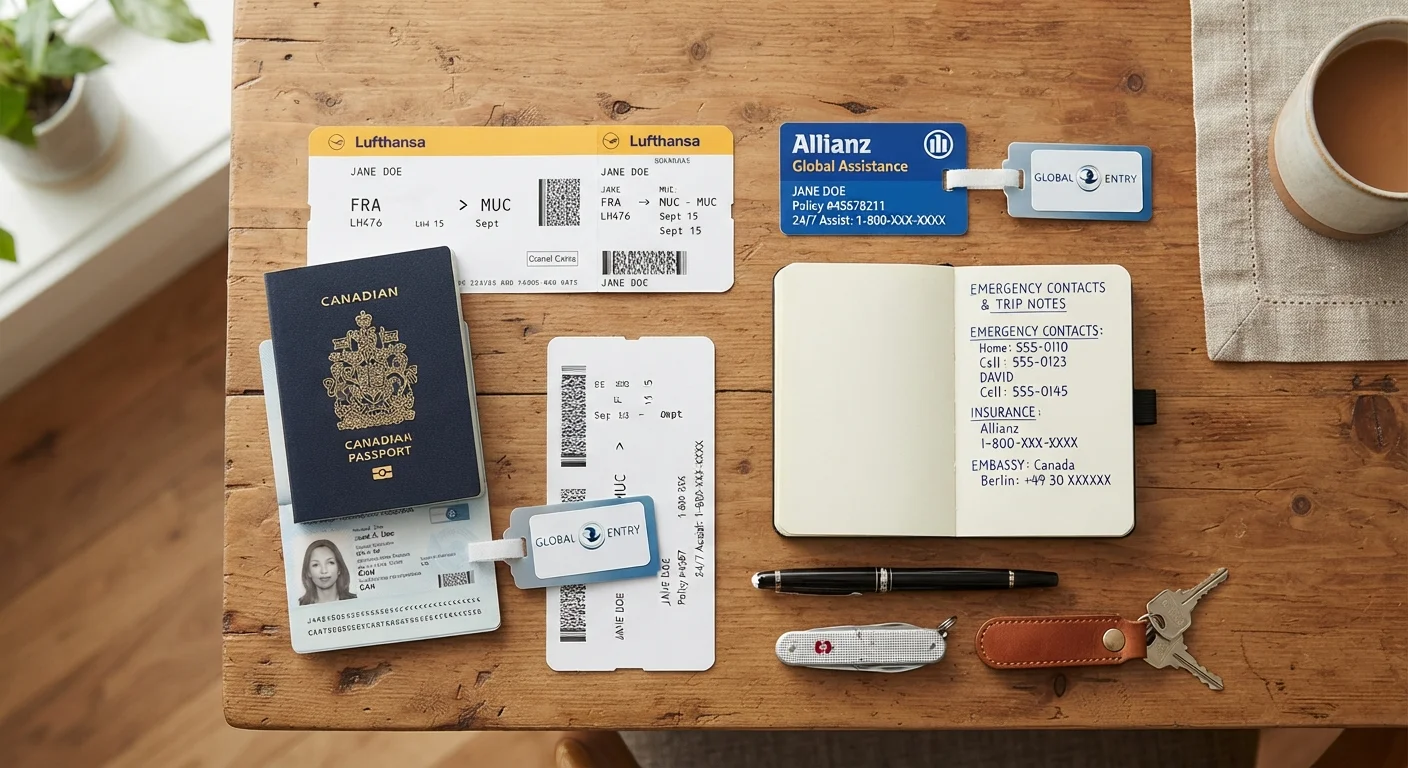
This checklist is designed for everyday US families heading anywhere from a cross-country road trip to an overseas adventure. It covers the documents you need on your person, the emergency contacts worth writing down (not just saving in your phone), and the digital backups that give you a safety net if the physical copies disappear. Pair this with our full pre-departure checklist for complete coverage before you leave.
Run through each group below about one to two weeks before departure — not the night before. That window gives you time to order replacement documents, make copies, or fill gaps you hadn't noticed.
Secure cloud storage service
Upload and share scanned copies of all critical documents with family members and a trusted contact at home.
Portable scanner or scanning app
Create clear digital copies of passports, insurance cards, and other physical documents before departure.
Password manager
Securely store account numbers, policy numbers, and emergency PINs accessible from any device.
Waterproof document pouch
Protect physical copies of passports, insurance cards, and the emergency contact sheet in carry-on luggage.
US Department of State STEP enrollment
Register your international travel itinerary to receive destination safety alerts and expedite embassy assistance if needed.
The Complete Document and Backup Checklist
The items below are organized into four logical groups. Work through them in order: get your identity documents sorted first, then financial backup, then emergency contacts, then health records. Each group builds on the previous one.
Identity & Entry Documents
Financial & Insurance Documents
Emergency Contacts
Health Records & Medical Documents
Verify Entry Requirements Directly with Official Sources
Visa rules, passport validity requirements, and health documentation standards vary by country and change without much notice. Always check the US Department of State website (travel.state.gov) and the destination country's official embassy website for the most current entry requirements. Do not assume information from previous trips or third-party aggregators is still accurate.
For travelers heading abroad, entry requirements — including visa rules, vaccination proof, and passport validity windows — change regularly. Always verify current requirements directly through the US Department of State and the destination country's official embassy or consulate website before you travel. Do not rely solely on third-party travel sites for this information.
If your trip involves traveling with prescription medications, see what families should know about traveling with medications for guidance on documentation and international rules.
Don't Store Everything in One Place
Keeping all your original documents, cards, and cash in a single bag or wallet creates a single point of failure. If that bag is lost, stolen, or misplaced, you lose everything at once. Distribute originals and copies across your carry-on, a money belt or secondary pouch, and the cloud — so losing one location doesn't mean losing access to everything.
Storing and Sharing Your Backups Effectively
Collecting documents is only half the job — how you store and share them determines whether they'll actually help in a crisis. Here's a practical system that works for families:
- Cloud folder: Create a shared folder (using whichever service your family already uses) and upload clear photos or scans of every document on this checklist. Give access to every adult traveler and one trusted person at home.
- Offline copies on your phone: Download copies locally so they're accessible without cell service or Wi-Fi. Foreign data coverage is never guaranteed.
- Physical packet: Keep a small folder in your carry-on — separate from your main bag — with photocopies of passports, insurance cards, and your emergency contact sheet. If luggage is lost or stolen, you still have something.
- Email yourself: Send a single email with all key document scans attached. It's low-tech, but accessible from any device with internet access worldwide.
Consider reviewing your travel insurance coverage as part of this preparation — knowing your policy number and the insurer's emergency line before you need it is exactly the kind of detail this checklist is designed to lock in.
Finally, if you're still in the early stages of planning, run through our destination research checklist to make sure the trip itself is well-matched to your family's needs before you focus on logistics.
The content provided on our blog site traverses numerous categories, offering readers valuable and practical information. Readers can use the editorial team’s research and data to gain more insights into their topics of interest. However, they are requested not to treat the articles as conclusive. The website team cannot be held responsible for differences in data or inaccuracies found across other platforms. Please also note that the site might also miss out on various schemes and offers available that the readers may find more beneficial than the ones we cover.