

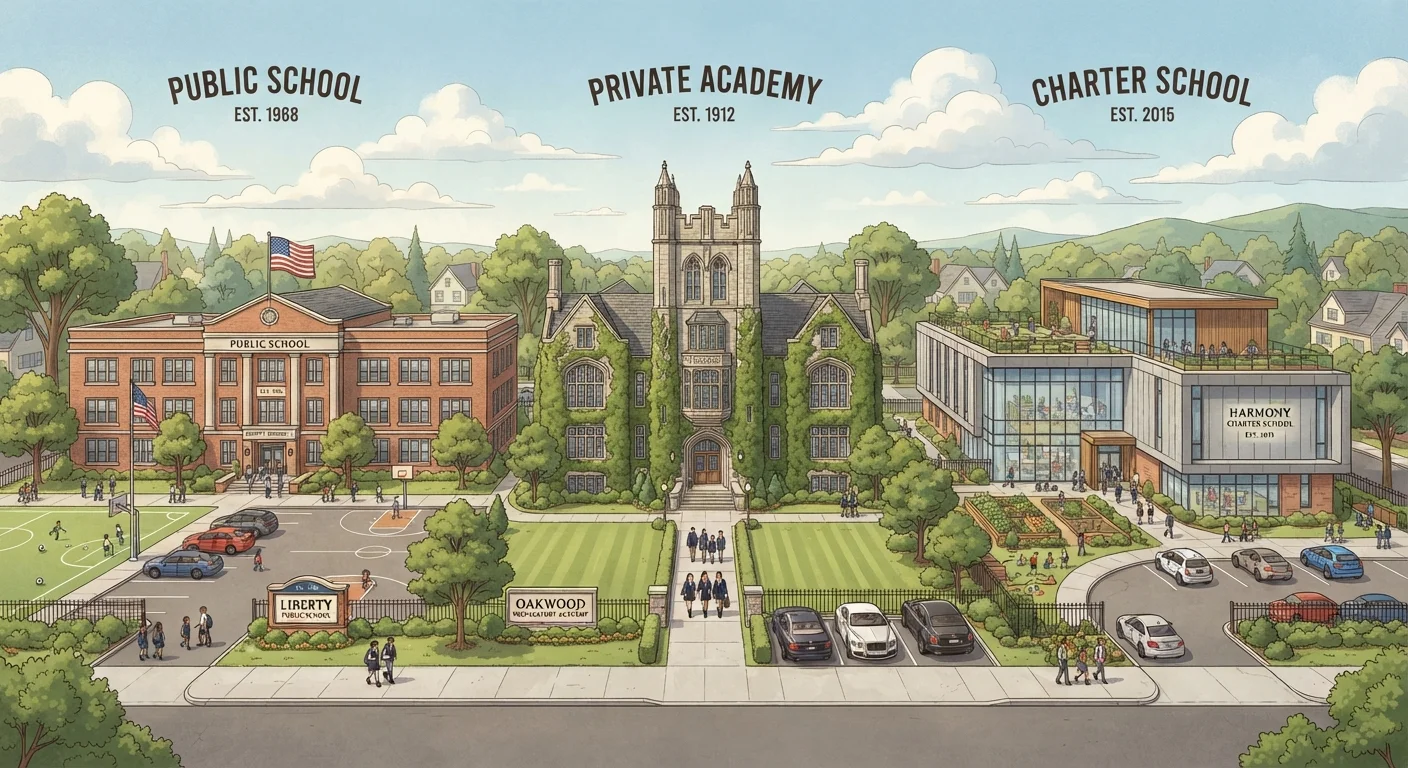
Our Verdict
Public, private, and charter schools each offer distinct structures, funding models, and academic environments. Understanding those differences - rather than relying on reputation alone - is the most reliable way to find a school that genuinely supports your child's growth. There is no single best option; the right choice depends on your child's learning style, your family's values, and the specific schools available in your area.
| Best for | Recommended |
|---|---|
| Families prioritizing open enrollment, no tuition cost, and district-based community ties | Public School |
| Families seeking specific religious instruction, specialized curricula, or smaller class environments | Private School |
| Families wanting public-school access with a focused academic theme or instructional approach | Charter School |
How Each School Type Is Funded and Who Can Attend
Funding and access are the most fundamental distinctions between school types - and they shape nearly everything else about a school's structure.
Public schools are funded through a combination of local property taxes, state allocations, and federal dollars. They are operated by local school districts and governed by elected school boards. Enrollment is open to all children within the district boundaries at no cost to families.
Private schools receive no government funding and rely primarily on tuition, endowments, and donations. Because they operate independently, they can set their own admissions criteria, which may include applications, interviews, or entrance assessments. Tuition varies widely - from a few thousand dollars annually at some parochial schools to well over $40,000 per year at elite independent schools.
Charter schools occupy a middle ground. They receive public funding - typically on a per-pupil basis from the state - but are managed by independent organizations rather than school districts. They are free to attend, and most use a lottery system when demand exceeds enrollment capacity. In exchange for operational flexibility, charter schools must meet performance goals outlined in their founding charter.
| Public School | Private School | Charter School | |
|---|---|---|---|
| Funding Source | Government (taxes) | Tuition, donations, endowments | Public funds, per-pupil allocation |
| Cost to Families | Free | Tuition required | Free |
| Admissions | Open by district residence | Application, may have criteria | Open; lottery if oversubscribed |
| Curriculum Control | State standards required | School sets own curriculum | State standards, flexible delivery |
| Teacher Licensing | State license required | Varies by school | Varies by state |
| Accountability Body | District & state board | Board of trustees only | Charter authorizer |
| Specialization | Limited; general curriculum | High; religious, classical, etc. | Moderate; themed schools common |
Curriculum, Standards, and Academic Flexibility
One of the most practical questions parents ask is: what will my child actually be taught, and how?
Public schools must follow state academic standards and administer state-mandated assessments. Teachers are generally required to hold state licensure. This standardization creates consistency but limits how much an individual school can deviate from established curriculum frameworks. Understanding how your state reports student performance is important - see what 'grade-level proficiency' really means for a closer look at how to interpret those results.
Private schools can design their own curricula without being bound by state standards, though they may choose to align with them. This freedom allows for specialized approaches - classical education, Montessori methods, religious instruction, or rigorous college-preparatory programs. Private school teachers are not always required to hold state teaching licenses, though many do.
Charter schools generally must meet state academic standards and participate in state assessments, since their public funding depends on demonstrated performance. However, they often have more freedom in how they teach - which allows for theme-based schools (STEM, arts, language immersion) that aren't typically available in a standard district model.
Visit Before You Decide
School type tells you about structure, not culture. Visiting a school in person - ideally while classes are in session - gives you a far more accurate picture than any ranking or category label. Ask to speak with a teacher and, if possible, with a current parent. The day-to-day environment matters more than the funding model.
Accountability, Oversight, and What Happens When Schools Underperform
How a school is held accountable matters for families - particularly if you're considering a newer or less-established option.
Public schools are overseen by local school boards and state education departments. Schools that persistently underperform face state interventions, which can range from additional support to restructuring or closure.
Private schools face far less external accountability. They are not required to publish standardized test results and are primarily accountable to their own boards and - indirectly - to the families who pay tuition. Accreditation from regional or national bodies provides some quality assurance, but it is voluntary in most states.
Charter schools are reviewed against the terms of their charter, typically by an authorizing body such as a school district, university, or state agency. Charters that fail to meet academic or financial benchmarks can be revoked - and some are. Research on charter school performance is mixed: some charter networks demonstrate strong outcomes, while others perform similarly to or below comparable public schools. Investigating a specific charter school's performance record is essential rather than assuming the model itself guarantees quality.
For families weighing an even broader range of options, homeschooling vs. traditional school offers another lens on the trade-offs involved.
Making the Decision: Questions Worth Asking
Choosing a school is not about picking a category - it's about evaluating the specific school your child would attend. Consider these practical questions:
- What is the school's approach to academic support? Ask how they identify and respond to students who are struggling or who need more challenge. Pair this with after-school enrichment options if supplemental support is a priority.
- What does the school's performance data show? Request standardized test results, graduation rates, or other measurable outcomes specific to that school - not the type in general.
- How are admissions and enrollment handled? Understand lottery timelines for charters, application deadlines for private schools, and district boundary rules for public schools.
- What are the logistical realities? Transportation, after-care programs, and extracurricular offerings differ considerably across school types and individual schools.
- How does the culture fit your child? Visit when school is in session if possible. Talk with current families. A school's stated values and its actual day-to-day environment can differ.
If your child is approaching a transitional year, the middle school transition and high school course selection are both worth reading alongside this comparison, as the school environment shapes the academic options available at each stage.
This article is for general informational purposes only and does not constitute educational or legal advice. School policies, funding structures, and regulations vary by state and locality. Families should verify current rules and options with their local school district or state education agency.
The content provided on our blog site traverses numerous categories, offering readers valuable and practical information. Readers can use the editorial team’s research and data to gain more insights into their topics of interest. However, they are requested not to treat the articles as conclusive. The website team cannot be held responsible for differences in data or inaccuracies found across other platforms. Please also note that the site might also miss out on various schemes and offers available that the readers may find more beneficial than the ones we cover.