

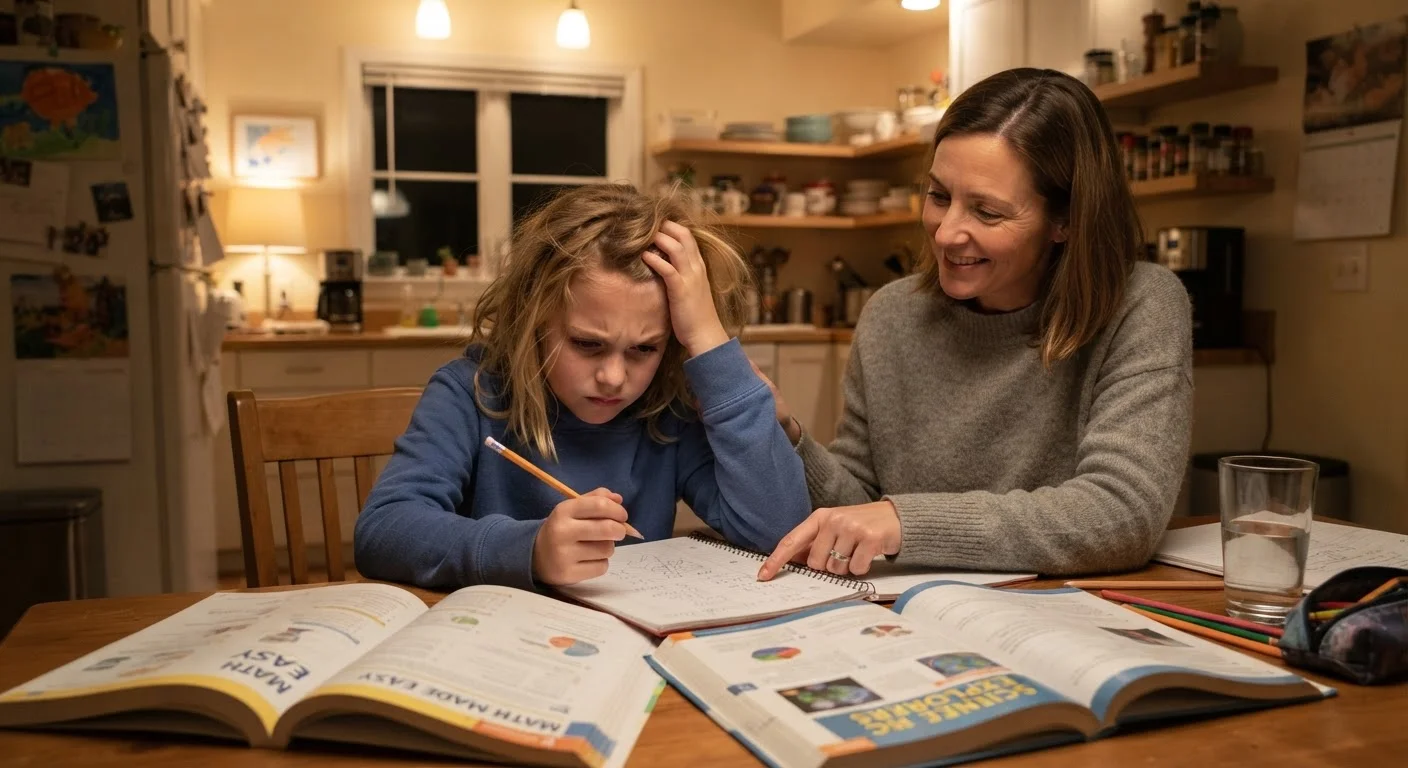
Why Homework Battles Feel Unavoidable
For many families, the after-school hours become a second battlefield. A child who was perfectly cooperative at breakfast is now slumped over a worksheet, refusing to write a single sentence. Parents feel like they're nagging. Kids feel like the school day never ends. Both sides dig in.
The good news is that this pattern is predictable - and predictable problems have addressable causes. Research in educational psychology consistently points to a cluster of factors that fuel homework conflict: timing, environment, parental involvement style, and unaddressed learning gaps. When families understand these levers, they can pull the right ones instead of repeating the same evening argument.
It's also worth noting that homework's academic value varies considerably by grade level. Studies, including well-cited work associated with researcher Harris Cooper, suggest homework shows stronger benefits for high school students than for elementary-age children - a useful frame for keeping homework stress in perspective.
Sitting beside your child and providing answers whenever they hesitate.
Why it happens: Parents want to reduce their child's frustration quickly and keep the evening moving, so stepping in feels helpful in the moment.
Allowing homework to begin immediately in front of a television or with a phone nearby.
Why it happens: After a long day, children resist giving up entertainment, and parents may not want another confrontation before homework even starts.
Letting homework happen at inconsistent times each day depending on family schedule.
Why it happens: Busy households have unpredictable schedules - sports practices, errands, and varying parent work hours make a fixed time feel impractical.
Treating every homework struggle as defiance rather than a signal of confusion or fatigue.
Why it happens: Resistance can look like stubbornness, especially under the pressure of a busy evening, making it easy to misread avoidance as willful noncompliance.
Never communicating with the teacher when homework battles persist week after week.
Why it happens: Parents often assume the problem is their child's attitude or their own parenting, and feel uncertain about how or when to reach out to school staff.
Building a Routine That Actually Works
Structure is the foundation of a calmer homework experience. Children's brains benefit from predictability: knowing when homework happens removes the daily negotiation that drains everyone's energy. But a routine only works if it's genuinely sustainable for your household.
10 min/grade
Recommended daily homework per grade level
The "10-minute rule" - 10 minutes of homework per grade level per night - is widely endorsed by the National PTA and the National Education Association as a reasonable guideline.
~30%
Students reporting homework as a major stressor
A Stanford University study of high-achieving high schoolers found roughly 56% identified homework as a primary stressor; in broader national surveys, stress rates vary but remain significant across grade levels.
A few evidence-informed principles can guide the design of a routine. First, allow a short break after school - 20 to 30 minutes - before homework begins. Children who transition directly from school to assignments often hit a cognitive wall. Second, establish a consistent workspace that is quiet, well-lit, and free of screens. Research on study environments consistently shows that divided attention slows completion time and reduces retention. If your home is running low on organized space, strategies for managing creating lasting order can help carve out that dedicated area.
Third, keep the homework window bounded. An open-ended session invites procrastination. A defined end time - even if the work isn't fully done - teaches children to work with focus rather than stall indefinitely. Any persistent incomplete work is worth flagging to the teacher directly. Speaking of which, knowing how to communicate effectively with your child's teacher can turn homework friction into a productive partnership rather than a private struggle.
When Homework Volume Seems Excessive
If your child is consistently spending two or more hours nightly on homework in elementary or middle school, that volume may exceed what research supports as beneficial. Document the time spent over a week and bring that data to a teacher conference. Chronic overload can erode a child's intrinsic motivation and make school feel punitive rather than engaging.
Finally, if your child's homework struggles feel structural - tied to learning differences, chronic disengagement, or a mismatch between school and learning style - it may be worth exploring your full range of educational options. Our overview of homeschooling versus traditional school lays out the honest trade-offs families face.
This article is for general informational and educational purposes only. For concerns about a child's learning, attention, or development, consult a qualified educator, school psychologist, or healthcare professional.
The content provided on our blog site traverses numerous categories, offering readers valuable and practical information. Readers can use the editorial team’s research and data to gain more insights into their topics of interest. However, they are requested not to treat the articles as conclusive. The website team cannot be held responsible for differences in data or inaccuracies found across other platforms. Please also note that the site might also miss out on various schemes and offers available that the readers may find more beneficial than the ones we cover.