

Option A
Whole Grains
The complete, minimally processed grain in its full form.
Best for: Households seeking maximum fiber, vitamins, and sustained energy from grain-based foods.
Option B
Refined Grains
The streamlined, longer-shelf-life grain with a milder taste.
Best for: Situations where texture, palatability, or shelf stability takes priority over nutrient density.
What Actually Happens Inside a Grain Mill
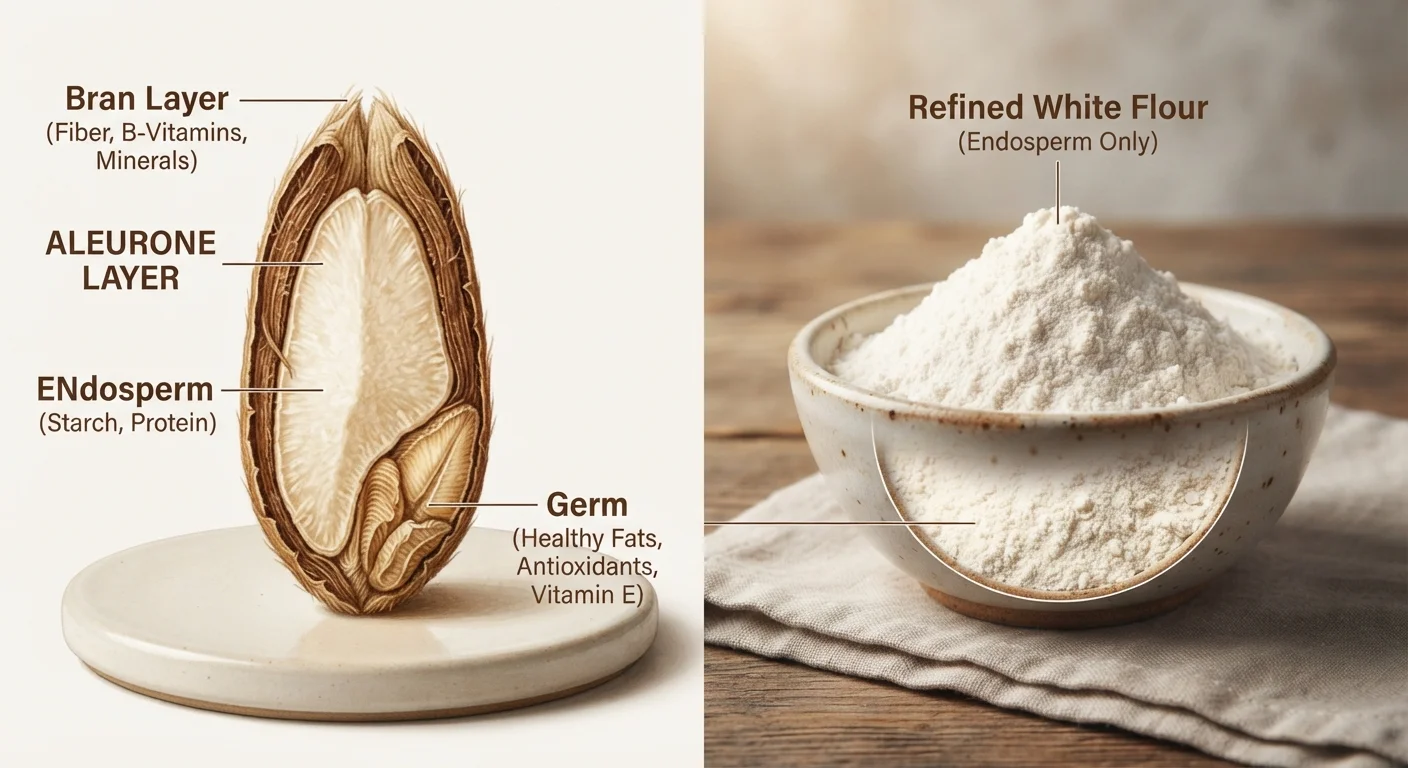
A grain kernel is made up of three distinct layers, each with a different nutritional role. The bran is the tough outer shell, packed with fiber, B vitamins, and trace minerals. The germ is the nutrient-dense embryo at the core, rich in vitamin E, healthy fats, and additional B vitamins. The endosperm - the largest layer - is mostly starch, providing energy but relatively little else.
When grains are refined, they are milled to remove the bran and germ entirely, leaving only the starchy endosperm. This produces a smoother, paler flour or grain that cooks faster, tastes milder, and stays shelf-stable longer because the oily germ (which can go rancid) has been removed. The trade-off is substantial: up to 25% of a grain's protein and the majority of its fiber, vitamins, and minerals leave with those two layers.
Whole grains, by contrast, retain all three layers - either intact, as with oats or brown rice, or milled together so the original proportions are preserved, as with whole wheat flour.
| Criterion | Whole Grains | Refined Grains |
|---|---|---|
| Kernel layers retained | All three (bran, germ, endosperm) | Endosperm only |
| Fiber content | High | Low |
| B vitamins | Naturally present | Mostly removed; some added back if enriched |
| Vitamin E | Present in germ | Largely removed, not restored |
| Shelf life | Shorter (germ oils can go rancid) | Longer |
| Texture and taste | Heartier, nuttier, denser | Lighter, milder, smoother |
| Phytochemicals and antioxidants | Naturally rich | Significantly reduced |
What You Gain - and Lose - Nutritionally
The nutritional difference between whole and refined grains is not subtle. A single ounce of whole wheat flour contains roughly 3 grams of fiber; the same amount of white all-purpose flour contains less than 1 gram. That gap accumulates across a day's worth of bread, pasta, and cereal choices - and most US households are already well below the recommended daily fiber intake. For a closer look at why this shortfall matters, see our guide to dietary fiber.
Beyond fiber, the bran and germ carry folate, iron, zinc, magnesium, and a range of phytochemicals - plant compounds linked in research to cardiovascular and metabolic health. When grains are enriched after milling, manufacturers add back a handful of B vitamins (thiamine, riboflavin, niacin, folic acid) and iron to partially compensate. However, enrichment does not restore fiber, vitamin E, magnesium, or the many antioxidant compounds naturally present in the bran.
~5%
US adults meeting daily fiber recommendations
Research published in the American Journal of Lifestyle Medicine estimates that only about 5% of Americans meet recommended daily fiber intakes, a gap that grain choices directly influence.
25%+
Protein lost during grain refining
Milling studies show that removing the bran and germ can reduce a grain's protein content by roughly a quarter, alongside far steeper losses in fiber and micronutrients.
3x
More fiber in whole wheat vs. white flour
Per ounce, whole wheat flour typically contains approximately three times the dietary fiber of refined all-purpose white flour, based on USDA nutrient data.
It's worth noting that not all refined grain products are equal in impact. How a food is prepared, what else is in it, and portion size all influence its overall nutritional contribution. Over-relying on fortified processed snacks as a nutritional shortcut is a pattern worth examining - common nutrition missteps like this can quietly erode a family's diet quality over time.
Reading Labels and Making Practical Swaps
Food labeling can be confusing, but a few reliable signals make it easier to identify true whole grain products. Look for "whole grain" or "whole wheat" as the first ingredient on the package. Terms like "multigrain," "stone-ground," or "made with whole grain" do not guarantee the product is predominantly whole grain - they can appear on products that are mostly refined flour.
Practical swaps don't require a pantry overhaul. Switching from white rice to brown or wild rice, choosing whole grain pasta, or picking oatmeal over sweetened refined cereals are incremental changes that add up. When baking, many recipes tolerate replacing up to half the all-purpose flour with whole wheat flour without significantly changing the texture.
It's also worth paying attention to added sugars in grain-based products, since sweetened whole grain cereals or breads can offset some of the nutritional advantage. Understanding added versus natural sugars on food labels can help you make more complete comparisons at the store.
A Note on Gluten and Grain Sensitivity
Both whole and refined forms of wheat, barley, and rye contain gluten. For people with celiac disease or non-celiac gluten sensitivity, the whole-versus-refined distinction is secondary to avoiding gluten-containing grains entirely. Gluten-free whole grain options - such as oats (certified gluten-free), quinoa, buckwheat, and brown rice - can still provide meaningful fiber and nutrients. Always discuss dietary restrictions with a healthcare provider or registered dietitian before making significant changes.
This article is for general informational purposes only and is not a substitute for personalized medical or dietary advice. If you have specific health conditions or nutritional concerns, please consult a qualified healthcare provider or registered dietitian.
The content provided on our blog site traverses numerous categories, offering readers valuable and practical information. Readers can use the editorial team’s research and data to gain more insights into their topics of interest. However, they are requested not to treat the articles as conclusive. The website team cannot be held responsible for differences in data or inaccuracies found across other platforms. Please also note that the site might also miss out on various schemes and offers available that the readers may find more beneficial than the ones we cover.