

Our Verdict
Organizing a shared family space involves genuine trade-offs between flexibility and structure, individuality and cohesion. There is no universally correct setup, but households that invest time in defining zones, agreeing on ground rules, and selecting adaptable storage consistently report less daily friction. The effort upfront pays off in a space that actually gets used - and actually gets tidied.
Households with mixed ages, routines, or hobbies who need a common area to pull double or triple duty without constant reorganization.
Why Shared Spaces Break Down
A living room that serves as a homework station, gaming den, TV lounge, and remote-work overflow is not a design failure - it is a modern household reality. The breakdown usually happens not because the space is too small, but because no one has explicitly decided how it should work. When expectations are unspoken, every person defaults to their own logic, and clutter becomes a symptom of competing systems.
Before choosing any organizational approach, it helps to map out who uses the space, when, and for what. A teenager doing homework at 4 p.m. and a parent watching television at the same time need different lighting, noise conditions, and surface access. Acknowledging these overlaps is the first step toward a layout that actually functions. For a structured way to identify what's working and what isn't room by room, see the room-by-room organization audit checklist.
The Case for Defined Activity Zones
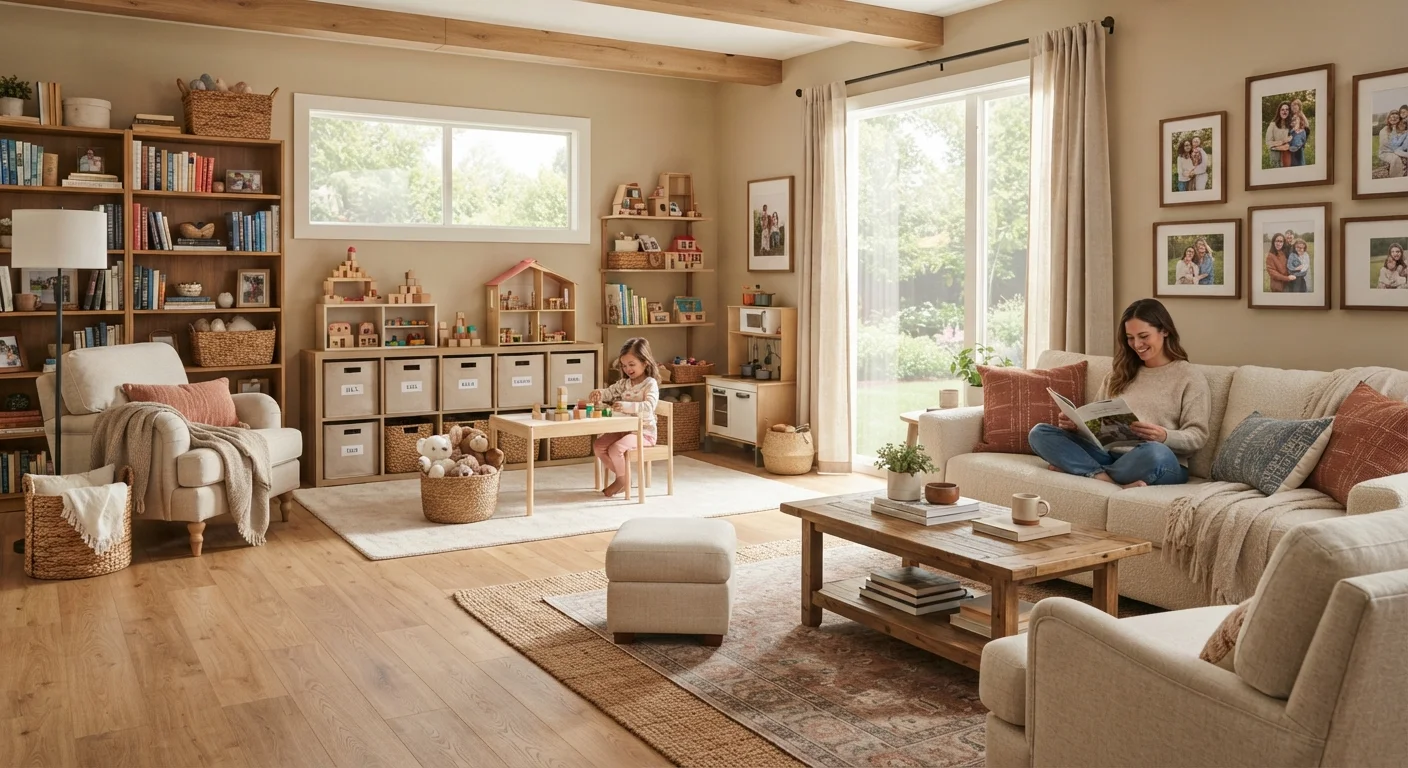
Dividing a shared room into distinct zones - a reading corner, a play area, a media zone - gives each household member a designated territory and reduces conflict over surface space.
Reduces daily conflict over shared surfaces and space
When each person knows where their activities and belongings belong, the implicit negotiations over table space or floor area decrease noticeably.
Creates visual clarity that reinforces tidying habits
Physical boundaries - a rug, a shelf, a labeled bin - communicate where things go without requiring constant reminders, which is especially useful for children.
Accommodates different schedules and activity types simultaneously
A well-zoned room can support homework at the desk while another household member watches television, without either activity fully disrupting the other.
Makes it easier to onboard everyone into a shared system
A visible, logical layout gives household members a framework to follow, reducing the learning curve when introducing new organizational habits.
Defined zones create visual cues that help everyone, including young children, understand where things belong and where activities happen. A bookshelf as a room divider, a rug anchoring a seating cluster, or a dedicated bin for gaming accessories all communicate structure without requiring constant verbal reminders.
This approach pairs well with dedicated storage philosophies - the idea that every category of item has one fixed home. You can explore that concept further in the companion piece on dedicated storage zones vs. distributed tidying.
The Trade-Offs of Zoning a Shared Space
Zoning works well in theory, but it carries real limitations that households should weigh honestly before committing to a rigid layout.
Rigid zones can feel confining in smaller homes
In apartments or compact houses, designating fixed zones may make the space feel segmented and cramped rather than functional and open.
Maintenance requires consistent effort from all users
Even the most thoughtfully designed system breaks down if only one person is responsible for enforcing it - shared spaces demand shared habits.
Layouts may not adapt well to changing household needs
A zone designed for a toddler's play area may be obsolete in two years; families need to build in a process for revisiting and adjusting the setup.
Competing noise and light needs are hard to resolve spatially
Zoning addresses physical clutter but not sensory conflicts - a homework-doer and a TV watcher in the same room still have to negotiate noise levels regardless of layout.
Smaller homes or apartments may not have enough square footage to support distinct zones without the space feeling cramped. And as children grow, or as a household's needs shift - a new baby, a family member working from home, a teenager who now needs a study area - fixed zones can become obstacles rather than aids.
If your home is short on floor area, vertical storage can expand what's possible without sacrificing zones. The article on underused vertical space in small homes covers practical ways to use walls and height to your advantage.
Flexible Setups: Pros, Cons, and When They Work
An alternative to strict zoning is a flexible, activity-based layout where furniture and storage shift to support whatever is happening at the moment. Nesting tables, ottomans with storage, and modular shelving units make this easier.
Flexibility Requires a Shared Agreement
A flexible room layout only works when every household member understands how the space is intended to shift between uses. Without that shared understanding, flexible systems tend to default to whoever tidied last - or whoever didn't. Consider posting a simple, visible reference (even a handwritten note) that outlines the reset expectation for the room.
The advantage of flexibility is adaptability: the space can respond to the household rather than the household contorting itself to fit a fixed layout. The disadvantage is that flexible systems require consistent buy-in from all users. Without shared habits, a flexible setup quickly becomes an undefined one - and undefined spaces accumulate clutter fastest.
Households with older children or adults tend to manage flexible setups more successfully than those with young children, who generally benefit from clearer physical cues about where things belong. For shared sleeping spaces - which carry similar negotiation dynamics - the shared bedroom organization guide offers relevant framing.
65%
Households reporting clutter causes daily stress
According to a survey by the National Association of Professional Organizers, a majority of US households identify clutter as a consistent source of home-related stress.
2-3x
More surface area lost to undefined zones
Home organization research consistently finds that rooms without designated activity areas lose usable surface space to accumulating items that have no fixed home.
Practical Steps to Make Any System Stick
Regardless of which organizational approach a household chooses, a few practices significantly improve long-term results:
- Hold a brief household conversation about how the space will work before reorganizing it. Even a 15-minute discussion surfaces competing assumptions.
- Assign ownership, not just location. When a zone or storage bin belongs to a specific person, that person is more likely to maintain it.
- Build in a reset routine. A nightly 10-minute tidy - shared among household members - prevents small messes from becoming entrenched disorder.
- Revisit the setup seasonally. Needs change with school schedules, seasons, and life stages. A layout that worked in September may not serve the household in March.
No organizational system eliminates friction entirely. The goal is a shared space that works well enough, most of the time, for most of the people using it - and that can be adjusted when it stops doing so.
The content provided on our blog site traverses numerous categories, offering readers valuable and practical information. Readers can use the editorial team’s research and data to gain more insights into their topics of interest. However, they are requested not to treat the articles as conclusive. The website team cannot be held responsible for differences in data or inaccuracies found across other platforms. Please also note that the site might also miss out on various schemes and offers available that the readers may find more beneficial than the ones we cover.