

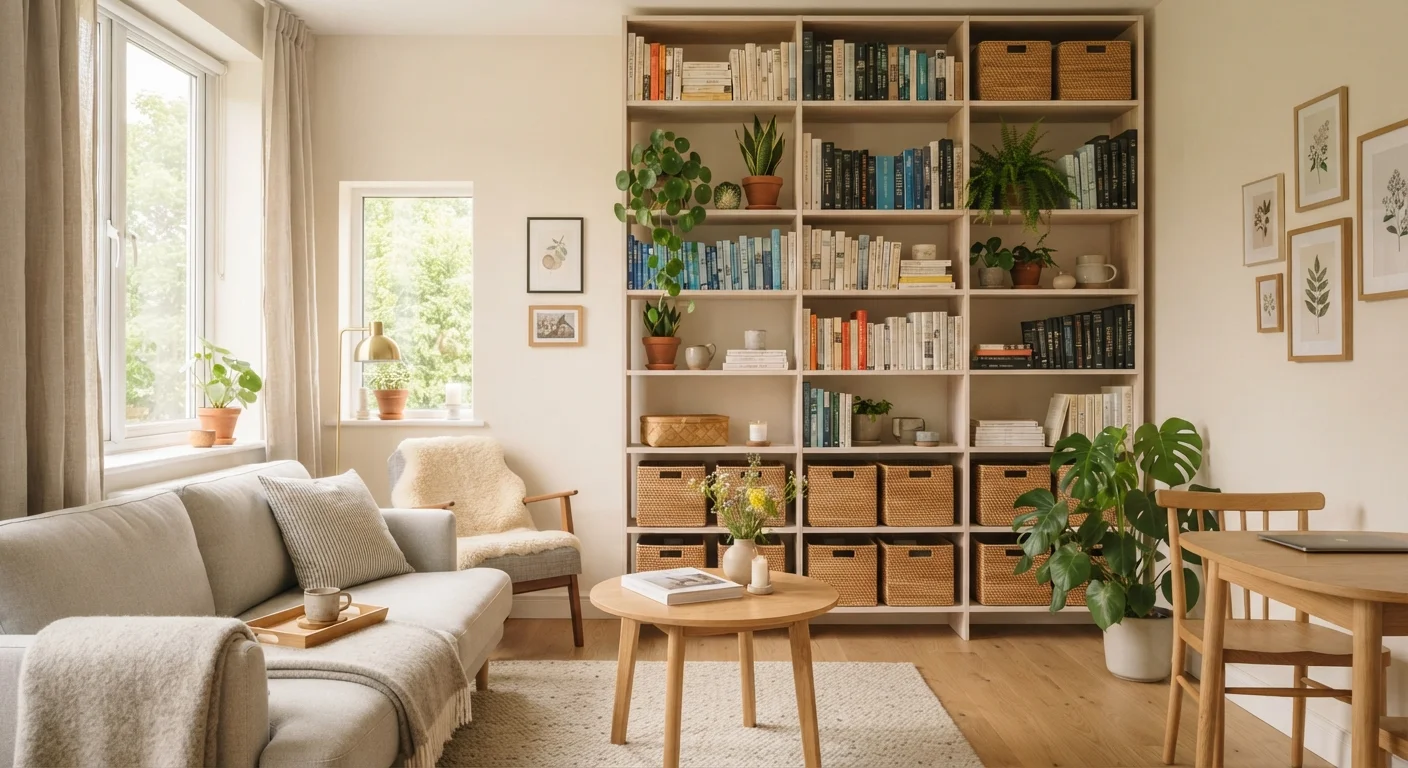
Why Walls Beat Floor Plans
When a home feels cramped, the instinct is to look for unused corners or under-bed clearance. But the most abundant storage surface in any room isn't on the floor - it's on the walls above your head. In a standard US home with 8-foot ceilings, the upper third of most walls is entirely bare. In rooms with 9- or 10-foot ceilings, that gap is even more pronounced.
Floor-based organization has real limits. Every bin, basket, or shelving unit placed on the floor competes with foot traffic, furniture, and the visual sense of openness that makes a small space feel livable. Vertical storage doesn't take that trade-off. A shelf mounted at 72 inches holds the same volume as a floor unit while leaving the room feeling airier and more spacious beneath it.
The strategies below cover the most effective ways to reclaim that vertical real estate - room by room, surface by surface. Whether you're renting with limited ability to drill or own your home outright, there are approaches here that can work for your situation. For a deeper look at how storage philosophy shapes the choices you make, see our piece on dedicated storage zones vs. distributed tidying.
Mount shelves above the furniture line
Most shelving sits at furniture height - roughly 30 to 48 inches off the floor - which puts it in direct competition with desks, sofas, and dressers. Shifting shelves to the 60-to-84-inch range, or running them continuously from mid-wall to ceiling, opens up a storage band that furniture can't occupy.
In living rooms and home offices, tall shelving flanking a window or doorway adds substantial capacity without blocking light. In kitchens, a second row of upper cabinets reaching the ceiling - or simple open shelving in the gap above standard uppers - is one of the most practical upgrades in a small kitchen. Our comparison of open shelving vs. closed cabinets can help you decide which approach suits your kitchen habits.
Shifting shelves above the furniture line opens a storage band furniture can never occupy.
Use the backs of doors strategically
Every interior door in your home has a back surface that is almost certainly doing nothing. Over-door organizers - available in wire, fabric, and solid-panel configurations - can hold pantry items, cleaning supplies, shoes, jewelry, toiletries, or office supplies without requiring a single hole in the wall.
In bathrooms, an over-door rack can replace an entire under-sink cabinet's worth of clutter. In bedrooms, it can absorb accessories, scarves, or bags that otherwise land on chairs and floor space. Measure the door gap before purchasing: most standard interior doors allow 1 to 2 inches of clearance between the door and the wall when open, which limits organizer depth.
Every interior door has an untouched back surface that can absorb a surprising volume of everyday items.
Stack with intention using labeled containers
Stacking storage containers is one of the easiest vertical gains available - but only if the stack is navigable. Bins without labels become archaeological digs. The fix is straightforward: use uniform containers that stack stably, label the front face of each one clearly, and limit stacks to a height you can safely reach without a step stool for items you access regularly.
Clear containers have the obvious advantage of visibility without pulling things down, but they work less well in exposed, high-traffic spaces where visual clutter is a concern. Opaque containers with large printed labels strike a balance. Whatever you choose, keep the heaviest or most-used items in the lower half of any stack.
Labeled, uniform containers make stacking genuinely functional rather than just delaying the next reorganization.
Install pegboards and wall rails for flexible hanging storage
Pegboards are experiencing a well-deserved revival beyond the garage workshop. In kitchens, they hold pots, utensils, and small appliances. In home offices, they manage cables, supplies, and headphones. In entryways, they handle bags, keys, mail, and outerwear - all in a compact vertical footprint.
Wall-mounted rail systems work similarly, using horizontal tracks with adjustable hooks, shelves, and baskets. Both systems share a key advantage: they're reconfigurable without new holes. As your needs shift, the hooks and accessories move rather than the mounting hardware. For renters, adhesive-mounted pegboard panels and rail systems that use existing fixtures or tension mounting are increasingly viable options.
Pegboards and rail systems give you reconfigurable vertical storage that evolves with your changing needs.
Take ceiling height seriously in storage rooms and closets
Closets are where vertical space gets ignored most dramatically. A standard reach-in closet is often fitted with a single rod and one shelf above it, leaving 18 or more inches of dead space near the ceiling. Double-hang rod configurations, stackable drawer units, and upper shelving that reaches the ceiling can nearly double a closet's functional capacity.
In dedicated storage rooms - laundry rooms, utility closets, pantries - ceiling-height shelving with step-stool access for the upper rows is often the most space-efficient system available. In shared bedrooms where two people's belongings compete for space, maximizing vertical closet capacity is frequently the most impactful single change possible. See our shared bedroom organization guide for how to approach this equitably.
Most closets leave 18 or more inches of ceiling-adjacent space completely unused - easy to reclaim with basic hardware.
Treat staircase walls and landings as prime real estate
In multi-story homes, the long diagonal wall running alongside a staircase is a consistently overlooked opportunity. A run of floating shelves following the stair pitch creates a dramatic amount of display and storage space in an area that otherwise contributes nothing. Books, plants, framed photos, and decorative objects all work well here - items that benefit from visibility but don't need to be grabbed frequently.
Landings at the top or bottom of stairs can support narrow console-depth shelving or a tall bookcase if wall width allows. Because staircase walls are typically drywall over studs, standard shelf-bracket hardware applies - just locate studs carefully before mounting anything that will carry meaningful weight.
A staircase wall can support a full run of shelving that transforms dead diagonal space into genuine storage.
Putting It Together
Vertical storage works best when it's matched to how you actually live. Items you reach for daily should stay at or just below eye level. Things you access monthly - seasonal gear, backup supplies, archival documents - can live higher up, labeled clearly so you're not guessing. Reserve the lowest reachable shelves for children or household members who need independent access to their belongings.
Before buying any hardware, spend ten minutes sketching which walls in each room are load-bearing candidates for shelving (most exterior and partition walls are suitable for standard shelf anchors into studs), which doors are underutilized, and which zones are piled with things that don't yet have a home. That mental map will prevent the common mistake of buying storage products that don't fit the actual problem.
Start With a Step Stool Investment
Before committing to high shelving, make sure your household has a stable, appropriately sized step stool - ideally a two-step model with a handle or grip rail. Vertical storage only works long-term if reaching upper areas feels safe and routine. A good step stool removes the hesitation that causes people to abandon high shelves over time.
If your garage is part of the storage equation, the same vertical logic applies at a larger scale - our garage organization guide covers wall-mounted systems, overhead ceiling racks, and zoning strategies suited to that space.
The content provided on our blog site traverses numerous categories, offering readers valuable and practical information. Readers can use the editorial team’s research and data to gain more insights into their topics of interest. However, they are requested not to treat the articles as conclusive. The website team cannot be held responsible for differences in data or inaccuracies found across other platforms. Please also note that the site might also miss out on various schemes and offers available that the readers may find more beneficial than the ones we cover.