

Our Verdict
Dedicated storage zones offer clarity and consistency, making them well-suited to households that value order and can commit to returning items to a single home base. Distributed tidying reduces daily friction and works naturally in homes where items are used in the same spot repeatedly. In practice, most households benefit from layering both approaches - centralizing infrequently used items while distributing everyday essentials close to their point of use.
| Best for | Recommended |
|---|---|
| Households seeking predictable, easy-to-maintain order | Dedicated Storage Zones |
| Busy families or multi-person homes with varied routines | Distributed Tidying |
| Small homes where floor space is limited | Dedicated Storage Zones |
| Households wanting low-effort, habit-friendly systems | Distributed Tidying |
Understanding the Two Philosophies
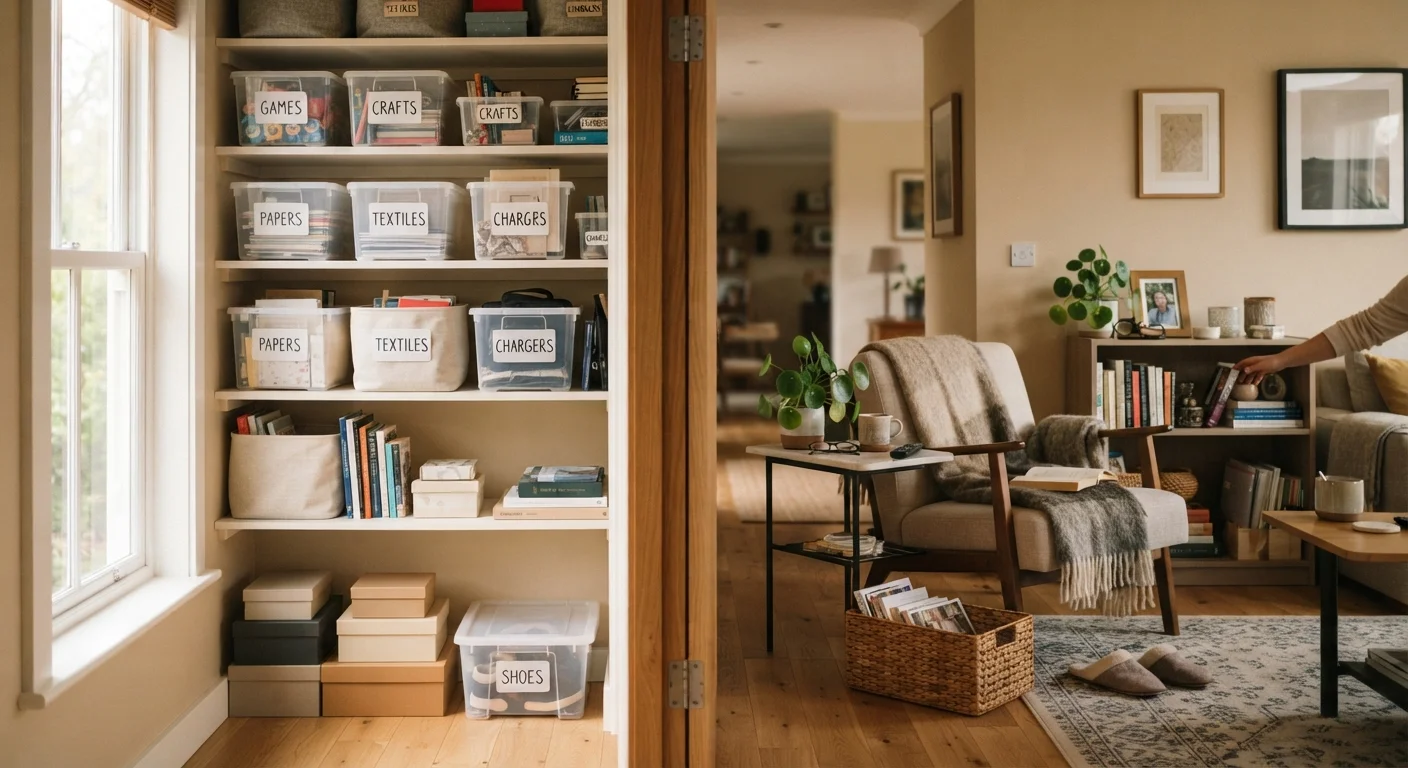
Home organization generally follows one of two foundational logics: dedicated storage zones, where every category of item has a single, fixed home regardless of where it gets used, or distributed tidying, where items live closest to the spot where they are most frequently needed.
A dedicated zone approach might mean all batteries live in one kitchen drawer, all first-aid supplies sit in a hall closet, and all office supplies occupy one desk organizer - full stop. The distributed approach, by contrast, places scissors in the kitchen, scissors in the home office, and scissors in a craft room, because each location regularly needs them independently.
These aren't just personal preferences - they reflect genuinely different theories about how habits form and how clutter accumulates. Understanding each on its own terms makes it easier to choose or blend them thoughtfully. For a related angle, see how category-based decluttering challenges room-by-room thinking in a similar way.
The Case for Dedicated Storage Zones
Dedicated zones work on a simple premise: when every item has one fixed location, household members always know where to look and where to return things. This predictability reduces the mental load of tracking possessions and makes it easier to notice when something is missing or running low.
This approach pairs especially well with clear labeling systems, which help everyone in the household - including children and guests - navigate the system without needing to ask. Zones also make periodic audits straightforward: checking one location tells you the full status of that category.
The tradeoff is that dedicated zones require discipline to maintain. If items are used in one room but stored in another, someone has to make that return trip consistently. In households where routines are rushed or responsibilities aren't shared evenly, items drift back to wherever they were last used - which is precisely how clutter creep begins.
| Dedicated Storage Zones | Distributed Tidying | |
|---|---|---|
| Core principle | One fixed location per item category | Items live where they are used |
| Best for | Shared, infrequent-use items | Everyday, location-specific items |
| Household predictability | High - everyone knows where to look | Variable - depends on use patterns |
| Daily maintenance effort | Higher - requires returning items across rooms | Lower - storage matches natural behavior |
| Works well in small homes | Yes, reduces duplicate stockpiles | Can create redundancy across rooms |
| Multi-person household fit | Good if rules are shared and followed | Flexible for varied individual habits |
| Inventory awareness | Easy - check one location | Harder - items spread across spaces |
| Clutter risk | Low if returns are consistent | Medium - items accumulate at use points |
The Case for Distributed Tidying
Distributed tidying is built around reducing friction. The core insight is that people are far more likely to put something away when "away" is within arm's reach of where they just used it. A phone charger on the nightstand, a notepad by the phone, sunscreen near the back door - these placements match storage to behavior rather than asking behavior to conform to storage.
For shared spaces, this approach can reduce conflict. When family members use the same space differently, distributed storage can accommodate multiple usage patterns simultaneously without requiring everyone to adopt the same habits.
The challenge arises when items are genuinely multi-location - used in several rooms with no obvious home base. In those cases, distributed tidying can produce redundant stockpiles in some spots and shortages in others. It also makes inventory harder: you may not realize you're out of something until you need it and can't find it.
Try a Hybrid Before Committing Fully
Before reorganizing your entire home around one philosophy, pilot test both in a single room. Pick one frequently used space - a bathroom, home office, or entryway - and spend two weeks observing where items naturally land at the end of each day. Those natural landing spots are strong candidates for distributed storage; items that consistently get carried back across the house may be better served by a dedicated zone.
Side-by-Side: Key Differences at a Glance
Both systems have practical strengths and real limitations. The table above outlines how they compare across the criteria most households care about. One useful frame: dedicated zones tend to perform better for items used infrequently or by the whole household, while distributed tidying tends to outperform for everyday items with a consistent, location-specific use pattern.
Storage format matters too. Open shelving vs. closed cabinets is a decision that intersects with both philosophies - open shelves can reinforce distributed tidying by making items visible and accessible in context, while closed cabinetry can help dedicated zones stay contained and uncluttered.
Combining Both Approaches Strategically
Most functional homes don't operate on a single philosophy exclusively. A practical hybrid treats storage decisions as location-specific rather than whole-home commitments. Consider these principles:
- Centralize low-frequency items. Seasonal tools, specialty equipment, and backup supplies benefit from dedicated zones because they don't have a consistent daily use location. See seasonal clothing storage as one example of centralized, category-based organization done well.
- Distribute high-frequency essentials. Items used daily - chargers, pens, reading glasses, keys - should live where they are used. Fighting that pattern rarely works long-term.
- Anchor shared items. Anything the whole household needs (medications, important documents, batteries) works better with a single, known location. Paper clutter is a classic example of a category that spirals when it lacks a fixed home.
- Use vertical space to expand zone capacity. In smaller homes, vertical storage solutions can make dedicated zones viable even without a dedicated room or large closet.
The goal isn't ideological consistency - it's a system your household will actually maintain. For a deeper look at why organization efforts often stall, explore the common reasons tidying doesn't hold and what sustainable systems look like in practice.
The content provided on our blog site traverses numerous categories, offering readers valuable and practical information. Readers can use the editorial team’s research and data to gain more insights into their topics of interest. However, they are requested not to treat the articles as conclusive. The website team cannot be held responsible for differences in data or inaccuracies found across other platforms. Please also note that the site might also miss out on various schemes and offers available that the readers may find more beneficial than the ones we cover.