

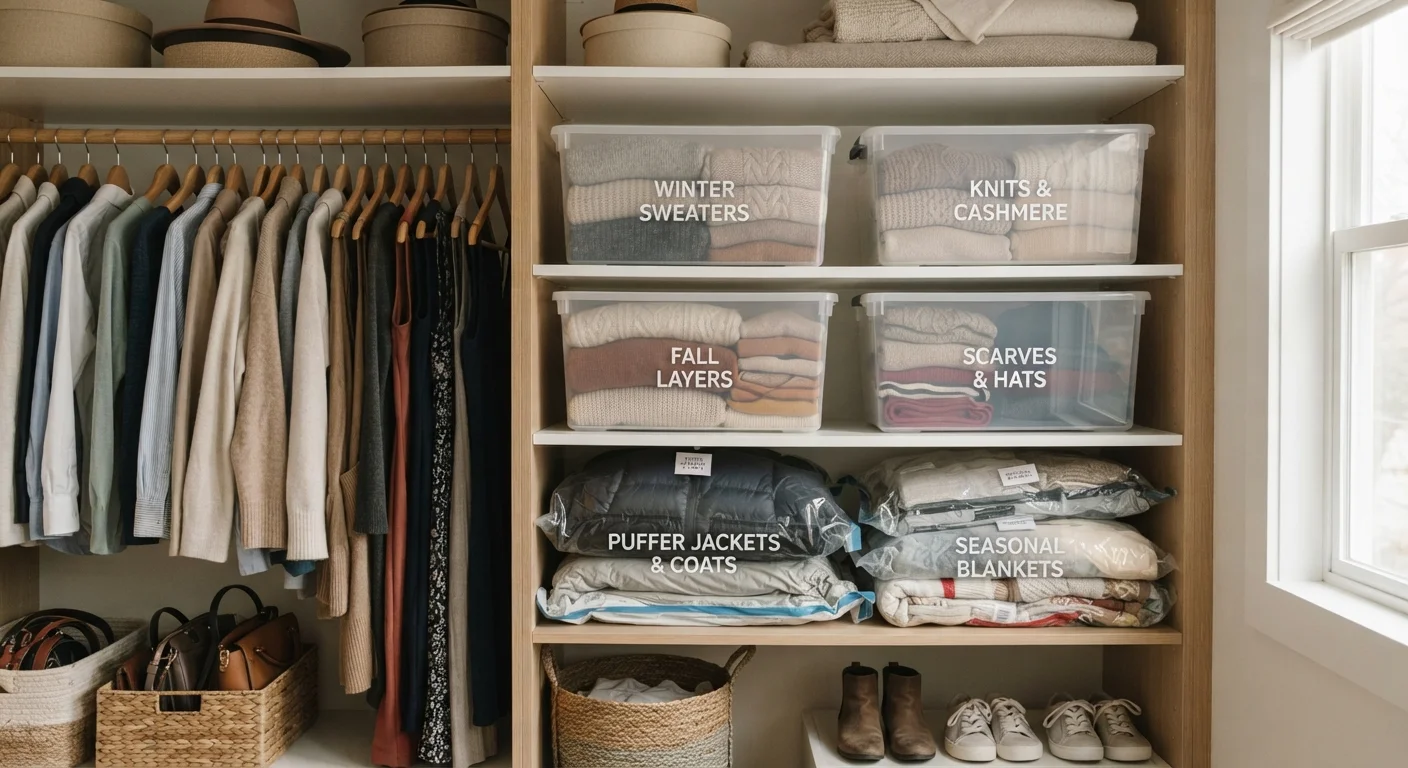
Why Seasonal Rotation Matters
Storing off-season clothing is about more than freeing closet space - it directly affects how long your garments last. Crowded closets compress fabric, expose clothing to dust and light, and make it harder to see what you own. A deliberate seasonal swap, done correctly, extends the life of your wardrobe and makes daily dressing noticeably easier.
The principles behind smart clothing storage align closely with broader home organization thinking. Dedicated storage zones create predictable homes for items you use only part of the year - reducing decision fatigue every time the weather shifts.
~60°F-72°F
Ideal storage temperature range for most textiles
Textile conservation guidelines from museum collections consistently recommend cool, stable temperatures to minimize fiber degradation in long-term storage.
30%-50%
Recommended relative humidity for clothing storage
Humidity above 60% significantly increases the risk of mold and mildew on stored natural fibers, according to general textile preservation guidance.
Best Practices for Storing Seasonal Clothing
The following practices reflect guidance from textile care experts and professional organizers. Applying even a handful of them consistently will improve both the condition of your clothing and the usability of your storage space.
Launder or dry-clean every garment before placing it in storage.
Body oils, food residue, and invisible stains oxidize over months and become permanent. Insects - particularly moths - are also attracted to soiled natural fibers. Clean fabric stores far better than fabric with even light soil.
Match your storage container to the fiber type of the garment.
Natural fibers like wool, cashmere, linen, and silk need to breathe. Airtight plastic bins trap moisture and can cause mildew or fiber breakdown over a full season. Synthetic fabrics tolerate sealed containers more safely.
Use vacuum-seal bags only for synthetic, compressible items - never for structured or delicate pieces.
Vacuum bags are effective space-savers but crush padding, distort shoulder shaping, and irreversibly compress wool fibers. Once a structured blazer loses its shape in a vacuum bag, it rarely recovers fully.
Store clothing in a cool, dry, and dark environment.
Heat accelerates fiber degradation, humidity promotes mildew and mold, and sustained light exposure fades color. Attics - which often reach extreme temperatures - and damp basements are the two worst common storage locations.
Add cedar blocks or lavender sachets rather than mothballs for pest deterrence.
Traditional mothballs contain naphthalene or paradichlorobenzene - chemicals that leave a persistent odor, require careful ventilation, and can be hazardous around children and pets. Cedar and lavender provide natural deterrence without those risks, though cedar effectiveness diminishes as it dries out and should be lightly sanded to refresh.
Fold knits; hang structured wovens on padded hangers.
Hanging heavy knit sweaters stretches the shoulders and distorts the neckline over a storage season. Woven garments that are meant to be worn structured - blazers, dress shirts, trousers - hold their shape better on a hanger than folded under pressure in a bin.
Quick Wins: Where to Start Today
If a full seasonal swap feels overwhelming, focus on a few high-impact moves first. These actions deliver immediate results without requiring a complete closet overhaul.
Labeling, Retrieval, and Year-Round Habits
The best storage system fails if you can't find things when you need them. Clear, consistent labeling turns your storage area into a retrievable system rather than a guessing game. Labeling systems that work in practice include using waterproof labels on bins, noting contents and season directly on the container, and placing labels on the front face - not the top - so you can read them when bins are stacked.
Seasonal clothing rotation pairs naturally with other home maintenance rhythms. The twice-yearly wardrobe swap is a natural anchor for related tasks like reviewing your storage areas for moisture or pests - just as seasonal vehicle checks help you stay ahead of mechanical issues. (For a parallel look at seasonal upkeep in another area of home life, see seasonal home maintenance tasks most homeowners skip.)
Do a Condition Check Before Re-Hanging
When you retrieve clothing at the start of a new season, inspect each piece before returning it to your active closet. Look for moth damage, staining that appeared during storage, and any repairs needed. Addressing issues immediately - rather than hanging a damaged item back up - prevents those garments from sitting unworn for another full year.
The content provided on our blog site traverses numerous categories, offering readers valuable and practical information. Readers can use the editorial team’s research and data to gain more insights into their topics of interest. However, they are requested not to treat the articles as conclusive. The website team cannot be held responsible for differences in data or inaccuracies found across other platforms. Please also note that the site might also miss out on various schemes and offers available that the readers may find more beneficial than the ones we cover.