

Why Companion Planting Deserves a Place in Your Garden Plan
Companion planting - growing different plants in deliberate proximity to benefit one or both - has been practiced for centuries and continues to attract interest from home gardeners seeking low-input ways to manage pests and support plant health. While not every folk pairing holds up to scrutiny, a number of combinations are supported by horticultural research and consistent real-world results.
The mechanisms vary. Some plants release volatile compounds that confuse or repel insects. Others attract beneficial predators that feed on common pests. Nitrogen-fixing legumes can enrich soil for nearby heavy feeders. And dense plantings can shade out weeds or reduce water loss from the soil surface. If you're planning a new vegetable garden, building companion pairings into your layout from the start is far easier than rearranging later.
Below are five well-supported companion planting combinations worth trying in your own yard.
Three Sisters: Corn, Beans, and Squash
This grouping, developed by Indigenous North American agriculturalists over generations, remains one of the most studied and reliably effective companion planting systems. Corn provides a tall structure for pole beans to climb. Beans fix atmospheric nitrogen and transfer some of it to the soil, benefiting the other two heavy feeders. Squash spreads along the ground, shading the soil to retain moisture and suppress weeds while its prickly leaves can deter some animals.
Plant corn first, then beans once the corn is several inches tall, then squash around the perimeter. This timing ensures the structure is in place before the climbers need it. The Three Sisters system works particularly well in larger garden spaces; it can be adapted for raised beds or in-ground plots, though it requires adequate square footage.
Corn, beans, and squash support each other structurally, nutritionally, and through ground-level weed suppression.
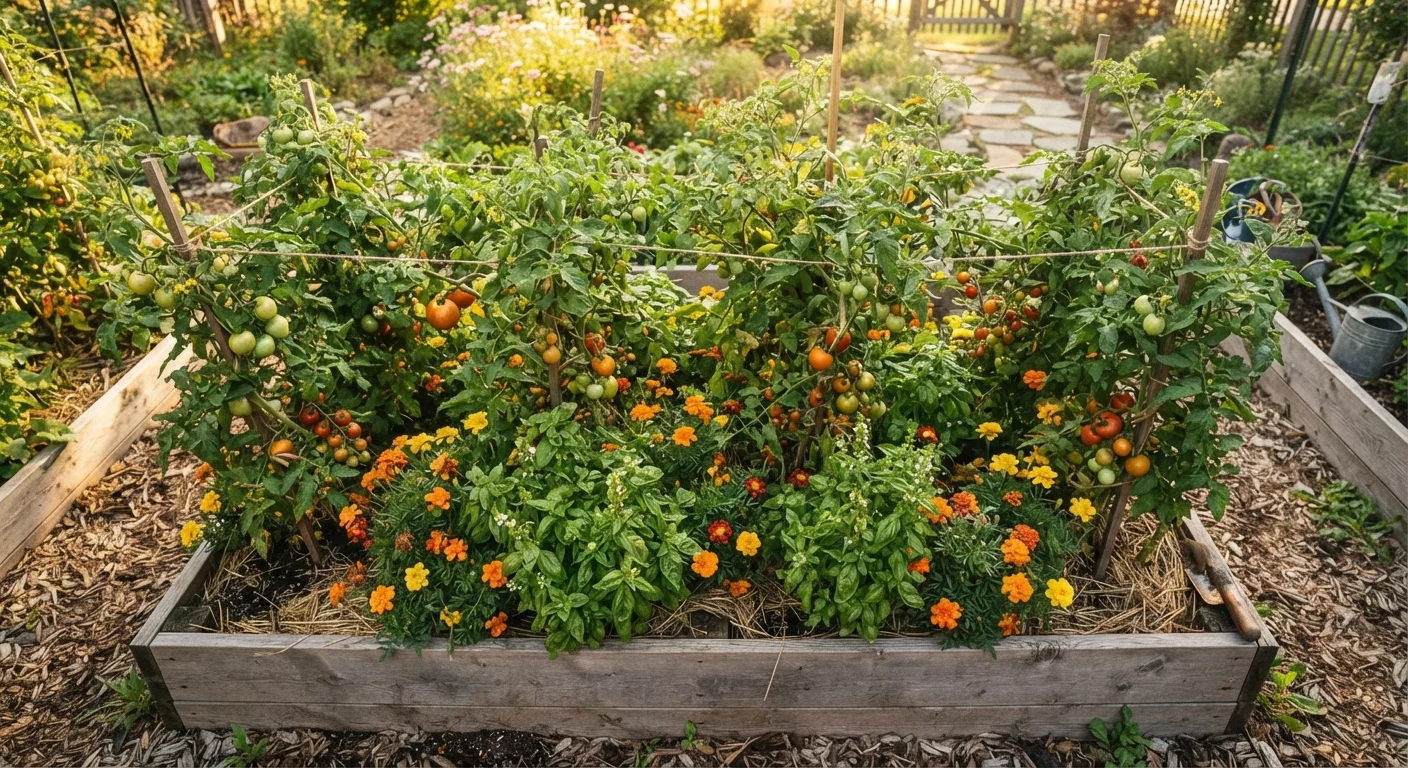
Tomatoes and Basil
This pairing is beloved by gardeners, and while the exact mechanism is still studied, there is practical evidence that basil planted near tomatoes may help deter thrips and certain aphids through its aromatic oils. Basil also attracts pollinators, which benefits fruit set on tomato flowers. As a practical bonus, basil and tomatoes share similar watering and sunlight needs, making them easy companions to care for together.
Plant basil around the base of tomato plants or interplanted between them in the row. Avoid letting basil bolt early by pinching flower heads as they appear - this keeps the plant producing the aromatic oils most associated with pest-deterrent effects.
Basil's aromatic oils may deter certain pests while its flowers attract pollinators to nearby tomatoes.
Marigolds and Vegetable Crops
French marigolds (Tagetes patula) are among the most frequently cited companion plants in vegetable gardens, and the research backing is more substantive than for many folk pairings. They produce compounds in their roots that are toxic to certain soil nematodes - microscopic worm-like pests that damage root systems. For this benefit to take effect, marigolds need to be planted densely and allowed to grow through the season, not just scattered around the edge.
Above ground, marigolds attract hoverflies and parasitic wasps, which prey on common garden pests including aphids and caterpillars. Plant them throughout vegetable beds rather than as a single border row, and allow some to flower continuously for the longest-lasting insect attraction benefit.
Dense marigold plantings can suppress soil nematodes and draw pest-predating insects into vegetable beds.
Dill and Brassicas
Dill is a powerhouse for attracting beneficial insects, particularly parasitic wasps that target cabbage worms and aphids - two of the most damaging pests for brassicas like broccoli, kale, and cabbage. Its umbrella-shaped flower clusters (called umbels) provide an ideal landing platform for small beneficial insects that would otherwise have difficulty accessing nectar.
One important caution: mature dill can inhibit the growth of nearby carrots and tomatoes. Position it deliberately near brassicas and keep it away from those crops. Also note that dill and fennel planted together can cross-pollinate and produce inferior seed from both plants, so keep them separated in the garden.
Dill's flower clusters draw parasitic wasps that naturally control cabbage worms and aphid populations.
Nasturtiums as Trap Crops
Nasturtiums work differently from the other pairings here: rather than repelling pests, they attract them - specifically aphids, which are strongly drawn to nasturtiums. This makes nasturtiums effective as a trap crop, drawing aphid colonies away from vegetables and concentrating them in one easy-to-monitor spot. Once aphids cluster on nasturtiums, you can remove and dispose of affected stems or let predatory insects like ladybugs and lacewings find and consume them.
Plant nasturtiums at the edges of garden beds or in containers nearby. They also attract hummingbirds and pollinators, making them doubly useful. Their flowers and leaves are edible, so any unaffected growth can be harvested for salads - an added benefit with no waste.
Nasturtiums lure aphids away from vegetables, acting as a sacrificial trap crop that concentrates pests.
Putting Companion Planting Into Practice
The most important step is to start simple. Choose one or two pairings relevant to the crops you already grow, observe how your plants respond, and keep brief notes across the season. Companion planting works best as one layer of an integrated approach - alongside healthy soil, consistent watering, and good airflow between plants.
Keep a Simple Garden Journal
Even a basic notebook where you record what you planted where and what you observed - pest activity, plant vigor, harvest amounts - will help you refine pairings over time. Companion planting results are highly site-specific, so your own observations are among the most valuable data you have. Note what worked, what didn't, and try one variable at a time for the clearest picture.
It's also worth noting that companion planting is not a guaranteed pest solution. Results vary by climate, soil, local pest populations, and garden layout. For a clear-eyed look at which gardening beliefs are backed by evidence versus folklore, see our guide to common garden myths. Pair these strategies with practices like proper mulching and enriched soil from homemade compost to give all your plants the best possible foundation.
The content provided on our blog site traverses numerous categories, offering readers valuable and practical information. Readers can use the editorial team’s research and data to gain more insights into their topics of interest. However, they are requested not to treat the articles as conclusive. The website team cannot be held responsible for differences in data or inaccuracies found across other platforms. Please also note that the site might also miss out on various schemes and offers available that the readers may find more beneficial than the ones we cover.