

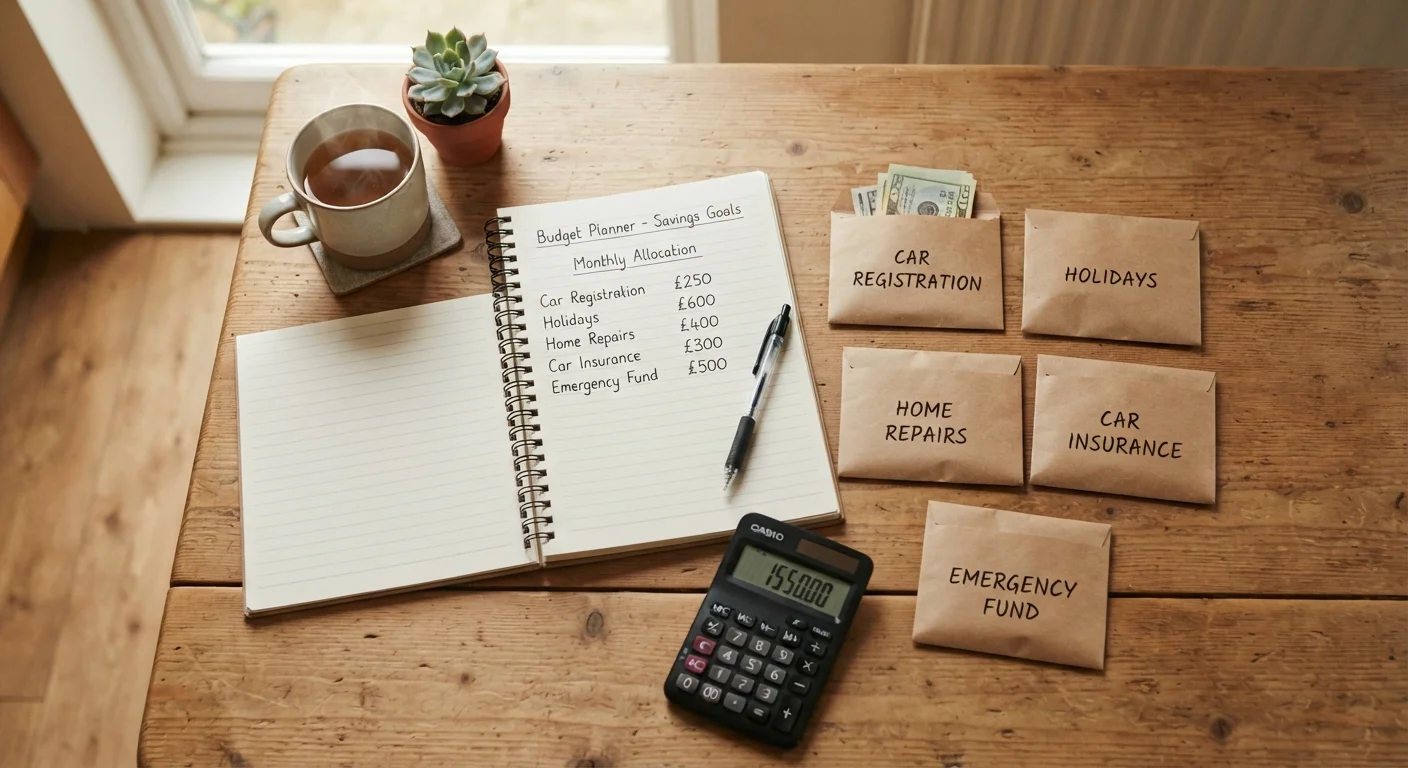
Why Irregular Expenses Break So Many Budgets
Most households budget around monthly bills - rent, utilities, groceries, streaming subscriptions. That system works well until a $400 car registration arrives in October, a $900 dental bill shows up in March, or the holiday season hits in December and suddenly the credit card balance jumps by $800.
None of those costs are surprises, exactly. They're predictable in size and roughly predictable in timing. The problem is that most budgets don't have a place for them, so they land as disruptions. That's the gap sinking funds are designed to close.
Irregular expenses are the budget category most households forget to plan for - and once you start listing yours, you'll likely find they add up to more than you expected.
~$1,400
Average holiday spending per US household
According to the National Retail Federation's annual consumer surveys, holiday spending consistently ranks among the largest single irregular household expenses each year.
1 in 3
Americans who can't cover a $400 emergency
Federal Reserve surveys on household economic well-being have consistently found that a significant share of US adults would struggle to cover an unexpected $400 expense without borrowing or selling something.
$500-$700
Typical annual vehicle maintenance cost per car
Industry estimates from AAA suggest the average driver spends several hundred dollars per year on routine vehicle maintenance, not counting unexpected repairs.
How to Build a Sinking Fund in Three Steps
The mechanics are straightforward. Here's the basic process:
- List every non-monthly expense you expect in the next 12 months. Go through last year's bank and credit card statements. Include car registration, annual insurance premiums, holiday gifts, school supplies, vet visits, home maintenance, and any planned travel.
- Estimate each expense and divide by months remaining. If holiday spending runs about $600 and it's currently June, you have roughly six months. That's $100 per month to set aside. Do this math for each category.
- Move the money somewhere you won't spend it casually. Whether that's a labeled sub-account at your bank, a separate savings account, or a clearly tracked category in a budgeting app, the key is that it's earmarked and visible.
When the bill arrives, the money is waiting. No scrambling, no credit card debt, no guilt.
Start with Just One Fund
If building multiple sinking funds at once feels overwhelming, pick just one - ideally the irregular expense that's coming up soonest or has caught you off guard before. Getting one fund working smoothly builds the confidence and habit to add more over time. Small and consistent beats ambitious and abandoned every time.
Common Sinking Fund Categories Worth Considering
Every household is different, but these are among the most frequently useful categories:
- Vehicle costs: Registration, inspection fees, oil changes, tires, and an allowance for unexpected repairs.
- Home maintenance: A general rule of thumb many financial educators suggest is to budget roughly 1% of your home's value per year for upkeep - though actual costs vary widely by home age and condition.
- Medical and dental: Copays, prescriptions, and out-of-pocket costs that fall outside your regular monthly spending.
- Holidays and gifts: Birthdays, back-to-school shopping, and the winter holiday season.
- Annual subscriptions and memberships: Software, gym memberships, professional dues, or anything billed yearly.
- Travel: A vacation fund you build toward rather than charge in full.
You don't need to start all of these at once. Pick the categories where you've historically been caught off guard and begin there.
Making Sinking Funds a Habit That Sticks
The biggest reason sinking funds fail isn't the math - it's remembering to move the money. That's why pairing this approach with automation makes a real difference. Setting up an automatic transfer on payday means the funds move before you have a chance to spend that money elsewhere.
Automating your savings turns a good intention into a default behavior. Even if each transfer is modest - $25 here, $40 there - the consistency is what builds the cushion.
Review your sinking fund categories once or twice a year. Costs change, and new expenses emerge. A quick annual audit of what you spent and what you saved for keeps the system accurate.
Small daily habits build long-term financial stability, and regularly funding these accounts - even in small amounts - is one of the more effective low-effort moves a household can make.
This article is for general informational and educational purposes only. It does not constitute personalized financial advice. Consider consulting a qualified financial professional for guidance specific to your situation.
Frequently Asked Questions
An emergency fund covers unexpected costs you can't predict - a sudden job loss, an ER visit, a furnace that dies without warning. A sinking fund covers costs you know are coming but that don't happen every month. See <a href="/personal-finance/saving-and-debt/emergency-funds-explained-what-they-are-and-why-they-matter">our full explainer on emergency funds</a> for a deeper comparison.
There's no single right number. Start by listing every non-monthly expense you paid last year. Common categories include car maintenance, medical copays, holiday gifts, home repairs, and annual subscriptions. Most households find three to seven categories covers the bulk of their irregular spending.
Not necessarily. Some people keep separate savings accounts for clarity; others track everything in a spreadsheet or budgeting app as labeled categories within one account. Choose whatever method you'll actually stick with - consistency matters more than the exact setup.
Start with the expense that's closest on the calendar or would hurt your budget the most if it arrived unplanned. Even a partial buffer is better than none. As your budget has room, add contributions to additional categories.
Sinking funds are most naturally a savings tool, but the logic can flip for self-employed households: set aside a portion of larger paychecks to cover months when income is lower, treating lean-month expenses as the 'known future need.'
They overlap, but savings goals often target one-time milestones like a down payment or a trip. Sinking funds are typically recurring - you refill the fund after spending it, because the expense (say, holiday gifts) comes around again next year. <a href="/personal-finance/saving-and-debt/savings-goals-households-commonly-set-and-the-logic-behind-each">Learn more about common savings goals</a> and how they compare.
The content provided on our blog site traverses numerous categories, offering readers valuable and practical information. Readers can use the editorial team’s research and data to gain more insights into their topics of interest. However, they are requested not to treat the articles as conclusive. The website team cannot be held responsible for differences in data or inaccuracies found across other platforms. Please also note that the site might also miss out on various schemes and offers available that the readers may find more beneficial than the ones we cover.