

Option A
Zero-Based Budgeting
The intentional, every-dollar-has-a-job approach.
Best for: Households that want full visibility over every spending category and are comfortable planning on paper or in a spreadsheet each month.
Option B
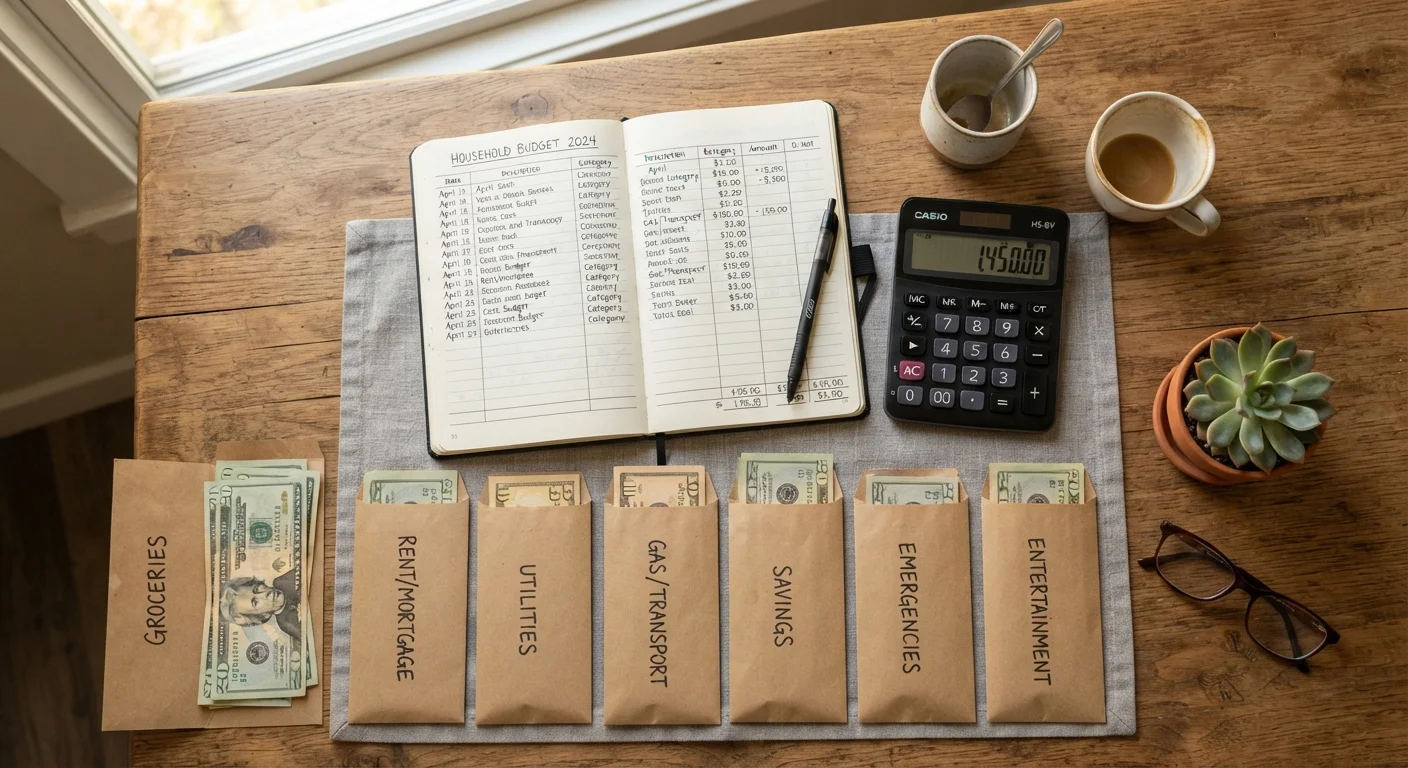
The Envelope Method
The tactile, cash-in-hand spending control system.
Best for: Families who overspend in specific categories and want a physical, hard-stop mechanism to break the habit.
How Each Method Actually Works
Both approaches share the same core goal — making sure your spending doesn't outrun your income — but they get there differently.
Zero-based budgeting starts with your total monthly income and works downward. You assign every dollar to a category: rent, groceries, utilities, savings, debt payments, entertainment, and so on. The budget is done when income minus all assigned categories equals zero. Nothing is left floating. If you earn $4,500 a month, every one of those dollars has a named job before the month begins. This doesn't mean you spend it all — savings and emergency fund contributions count as categories too.
If you're starting from scratch and aren't sure how to set up those categories, our guide for first-time budgeters walks through the groundwork.
The envelope method is more physical. After deciding how much to spend in each variable category — groceries, gas, eating out, clothing — you put that exact amount of cash into a labeled envelope. Throughout the month, you spend from the envelope. When the cash runs out, spending in that category stops until next month. Fixed bills like rent or utilities are typically paid normally; envelopes focus on the discretionary categories where overspending tends to happen.
For a closer look at how this plays out day-to-day for modern families with digital payments and subscriptions, see what envelope budgeting actually looks like in practice.
| Criterion | Zero-Based Budgeting | The Envelope Method |
|---|---|---|
| Core mechanism | Assign every dollar to a named category | Load cash into labeled spending envelopes |
| Best for | Detail-oriented planners, digital households | Cash spenders, tactile learners, overspenders |
| Handles fixed bills (rent, utilities) | Yes — included as budget categories | Usually paid separately outside envelopes |
| Handles savings goals | Yes — savings is a named category | Requires a separate savings envelope or account |
| Works with digital/card payments | Yes — tracks all payment types | Limited — designed around physical cash |
| Setup time per month | Moderate — full budget rebuild required | Low — load envelopes and spend |
| Flexibility mid-month | High — reallocate between categories | Low — cash in envelope is the limit |
| Works with irregular income | Possible but requires extra planning | Possible — load envelopes based on what arrived |
Where Each Method Struggles
Neither system is perfect. Zero-based budgeting demands time upfront each month — you need to build the entire budget before spending begins. Families with irregular income (freelancers, tipped workers, seasonal employees) may find it frustrating to assign every dollar when the income number itself changes. It also requires honest record-keeping throughout the month; without tracking actual spending against the plan, the budget exists only on paper.
The envelope method runs into real friction in a cashless world. If most of your spending happens on a debit card, credit card, or mobile payment app, physically withdrawing and sorting cash each month adds a layer of inconvenience many households won't sustain. It also doesn't naturally account for savings goals or fixed recurring costs — you have to layer those in separately.
Digital Envelope Workarounds Exist
Several budgeting apps and bank accounts let you create virtual "envelopes" or spending buckets that mimic the cash envelope system without requiring physical cash. These can bridge the gap for households that want the behavioral stop of the envelope method but rely primarily on card or digital payments. Evaluate any app on its own merits and verify fees or privacy terms before signing up.
For households that want to combine the structure of zero-based budgeting with digital tracking tools, our comparison of budgeting tools can help you pick the right format.
Choosing — or Blending — Both
The honest answer for many families is that neither method is used in pure form. A practical middle ground: use zero-based budgeting to plan the full month and account for savings, fixed bills, and debt payoff — then use cash envelopes for the two or three categories where your household consistently overspends. You get the big-picture discipline of a zero-based plan with the hard-stop control of physical cash where it matters most.
~33%
US adults with a detailed monthly budget
Gallup polling has consistently found that fewer than half of American adults maintain a detailed household budget, suggesting most families operate without a formal spending plan.
$1,000+
Median monthly discretionary spending per household
The U.S. Bureau of Labor Statistics Consumer Expenditure Survey shows significant household spending on food away from home, entertainment, and apparel — categories where both methods target control.
Whatever you choose, both methods share one requirement: you need to know your monthly income and your typical expenses before building any budget. If that foundation isn't solid yet, the complete household budgeting guide covers the full setup from tracking income to sustaining the habit long-term.
More everyday money habits that support either method are collected in Everyday Money Tips.
This article is for general informational and educational purposes only and does not constitute personalized financial advice. Consider consulting a qualified financial professional for guidance specific to your household's situation.
The content provided on our blog site traverses numerous categories, offering readers valuable and practical information. Readers can use the editorial team’s research and data to gain more insights into their topics of interest. However, they are requested not to treat the articles as conclusive. The website team cannot be held responsible for differences in data or inaccuracies found across other platforms. Please also note that the site might also miss out on various schemes and offers available that the readers may find more beneficial than the ones we cover.