

Our Verdict
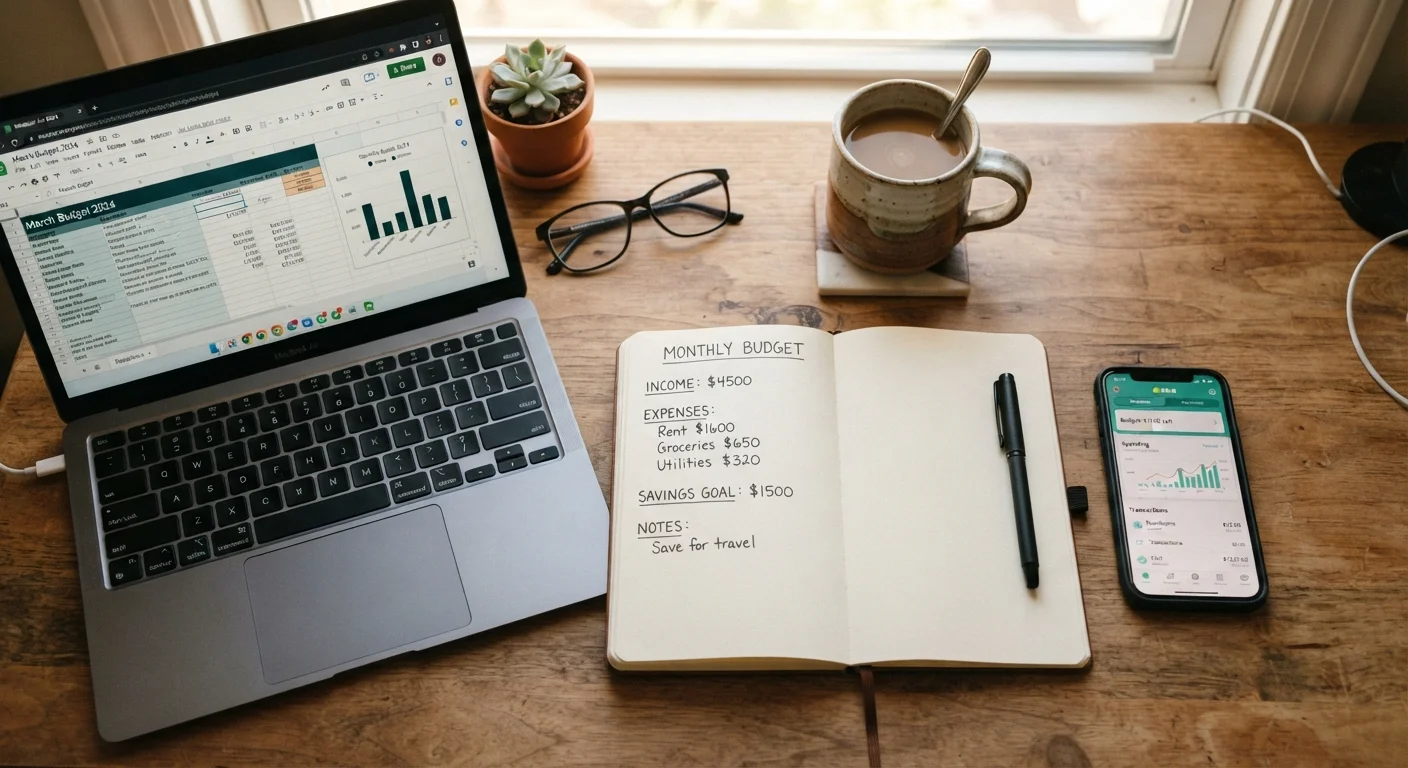
No single tracking method outperforms the others in every situation. Manual notebooks build spending awareness from scratch, spreadsheets offer flexible control, and apps make daily logging nearly effortless. The right choice comes down to how you naturally operate — and whether a method fits your real life, not an idealized version of it.
| Best for | Recommended |
|---|---|
| Hands-on learners who want to build awareness from the ground up | Pen-and-paper notebook |
| Detail-oriented households who want custom categories and full control | Spreadsheet |
| Busy households who want low-friction, automatic tracking | Budgeting app |
| Those who want accountability without technology | Envelope or cash-based system |
Why Your Tracking Method Matters More Than Your Budget Plan
Most people know they should track their spending. Fewer actually stick with it — and the usual culprit isn't willpower, it's mismatch. A method that doesn't fit your habits will get abandoned inside a month, no matter how good the system looks on paper.
Before choosing a tool, it helps to know yourself. Are you someone who enjoys writing things down by hand? Do you prefer set-it-and-forget-it automation? Does looking at a spreadsheet energize you or make you close the laptop? Your answers shape which approach will last. For a broader look at how tracking connects to your overall budget setup, see the complete household budgeting guide.
Four Common Tracking Approaches — and Who They Suit
Here's a plain-language breakdown of the four methods most households actually use:
1. Pen-and-Paper Notebook
Writing every purchase by hand is slow by design — and that's the point. The friction forces you to notice what you're spending, which builds awareness fast. This approach works well for people who are just starting out, who distrust apps with bank credentials, or who simply prefer analog habits. The downside: totaling categories at month-end takes real time, and it's easy to miss cash transactions you forget to log.
2. Spreadsheet
A spreadsheet gives you the structure of a budget without handing your data to a third party. You decide the categories, the formulas, and the layout. This suits detail-oriented people who enjoy customizing systems and don't mind a bit of regular upkeep. If you share finances with a partner, a shared cloud spreadsheet can keep both of you on the same page. Compare pen-and-paper, spreadsheets, and apps side by side for a deeper trade-off breakdown.
3. Budgeting App
Apps that connect to your bank and credit card accounts log transactions automatically, categorize spending, and surface summaries without much daily effort. This suits busy households who won't remember to enter expenses manually. The trade-offs: you're granting account access to a third party, and automatic categorization isn't always accurate — you'll still need periodic review.
4. Cash Envelope System
You allocate a fixed amount of physical cash to each spending category each month. When the envelope is empty, spending in that category stops. This method is highly visual and tactile, making it effective for people who overspend on cards but respond to real money running out. It's less practical for online purchases or households with many recurring digital bills.
| Pen & Paper | Spreadsheet | Budgeting App | Cash Envelopes | |
|---|---|---|---|---|
| Setup effort | Minimal | Moderate | Low | Low |
| Daily time required | 5–10 minutes | 5–15 minutes | 1–2 minutes | Minimal after setup |
| Automation | None | Partial (formulas) | High | None |
| Privacy / data sharing | Full privacy | Full privacy | Account access required | Full privacy |
| Works for online spending | Yes, if logged | Yes, if logged | Yes, automatic | Limited |
| Best for | Beginners, analog learners | Detail-oriented, customizers | Busy households | Overspenders, visual thinkers |
| Biggest risk | Forgotten entries | Inconsistent upkeep | False sense of control | Impractical for digital bills |
Matching the Method to Your Personality
Think about where your spending problems actually live. If you lose track of small, frequent purchases — coffee, lunches, impulse buys — a method with low friction (like an app) catches those automatically. If you tend to overspend in one or two specific categories, the cash envelope system creates a hard ceiling right where you need it.
If you're starting from zero and genuinely don't know where your money goes, begin with the first household spending snapshot process before committing to any tool. Seeing your actual numbers — even roughly — makes choosing a method much easier.
You Don't Have to Pick Just One
Many households use a hybrid approach: an app for automatic daily logging and a paper notebook or spreadsheet for a monthly review. The app catches what you'd otherwise forget; the manual review forces you to actually read the numbers. If one method isn't sticking after 30 days, it's worth adjusting rather than abandoning tracking altogether.
For households that want tracking to reinforce saving, pairing any of these methods with automated transfers can be powerful. The automated savings approaches guide explains how to make saving the default rather than an afterthought.
This article is for general informational purposes only and does not constitute personalized financial advice. Consult a qualified financial professional for guidance specific to your situation.
The content provided on our blog site traverses numerous categories, offering readers valuable and practical information. Readers can use the editorial team’s research and data to gain more insights into their topics of interest. However, they are requested not to treat the articles as conclusive. The website team cannot be held responsible for differences in data or inaccuracies found across other platforms. Please also note that the site might also miss out on various schemes and offers available that the readers may find more beneficial than the ones we cover.