

Our Verdict
Dry food, wet food, and raw diets each offer distinct advantages and limitations. There is no one-size-fits-all answer, and the right choice depends on your individual pet's health needs, your household's capacity for food handling, and your budget. A veterinarian or veterinary nutritionist is the best resource for tailoring a feeding plan.
| Best for | Recommended |
|---|---|
| Owners prioritizing convenience and cost | Dry kibble |
| Pets who need extra hydration or have dental sensitivities | Wet food |
| Owners able to manage strict food safety protocols with vet guidance | Raw diet |
| Pets with complex or transitional health needs | Mixed feeding (vet-directed) |
What Each Format Actually Is
Before comparing these three feeding approaches, it helps to understand what each one involves at a basic level.
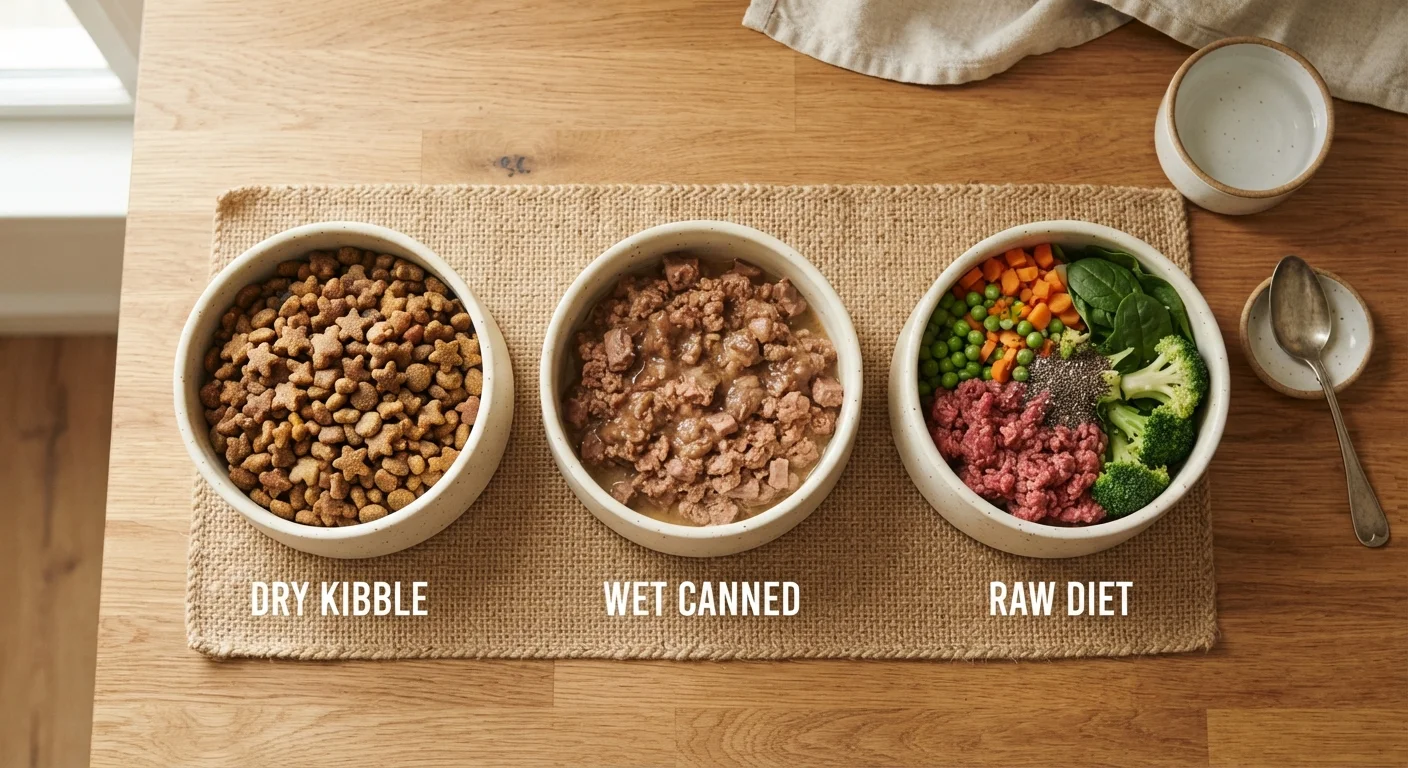
Dry food (kibble) is the most widely used pet food format in the United States. It's manufactured through a process called extrusion — ingredients are mixed, cooked under high heat and pressure, and shaped into small pellets. The result is a product with very low moisture content, typically around 10%, and a long shelf life.
Wet food comes in cans or pouches and contains significantly more moisture — usually 70–80%. Ingredients are cooked inside a sealed container, which sterilizes the product and locks in flavor. The higher water content makes it more palatable for many animals and easier to eat for those with dental issues.
Raw diets involve feeding uncooked animal proteins — typically muscle meat, organ meat, and sometimes raw bones — along with fruits, vegetables, and supplements. Raw feeding may be commercially prepared (frozen or freeze-dried) or home-prepared. Unlike kibble or canned food, raw diets are not heat-processed, which is a key point of both appeal and concern.
Understanding how these foods are made sets the stage for a more informed conversation with your vet about what might work for your pet. You can also learn more about how to read and interpret the labels on any of these products in our guide to decoding pet food nutrition facts.
Nutritional Profiles and Regulatory Standards
All three diet types can — in principle — meet a pet's nutritional needs, but they differ in how reliably they do so and how that's verified.
In the U.S., the Association of American Feed Control Officials (AAFCO) sets nutritional standards for commercial pet foods. Most commercially produced dry and wet foods carry an AAFCO statement indicating that the product meets minimum nutritional requirements, either through formulation or feeding trials. This provides a baseline level of confidence that the product is nutritionally complete and balanced.
Raw diets, particularly home-prepared ones, often lack this verification. Without careful planning — ideally with input from a board-certified veterinary nutritionist — homemade raw meals can be deficient in calcium, essential fatty acids, or specific vitamins. Commercial raw foods may carry AAFCO statements, but this varies widely by product.
| Dry Kibble | Wet Food | Raw Diet | |
|---|---|---|---|
| Moisture content | ~10% | 70–80% | Varies (60–70% fresh) |
| AAFCO compliance | Widely available | Widely available | Variable by product |
| Food safety risk | Low | Low | Higher — requires strict handling |
| Shelf life | Long (months sealed) | Moderate (sealed); days once opened | Short; requires freezing |
| Typical cost | Lower | Moderate to higher | Higher |
| Palatability | Moderate | High | High for many pets |
| Preparation effort | Minimal | Low | Moderate to high |
It's also worth noting that popular beliefs about diet formats sometimes outpace the available evidence. Our article on common myths about pet nutrition addresses some of the claims that frequently circulate about raw feeding and grain-free diets.
Food Safety: The Key Difference With Raw Feeding
The most significant practical concern with raw diets is food safety — for both pets and the people in the household.
Raw meat can harbor pathogens including Salmonella, Listeria, and E. coli. The U.S. Centers for Disease Control and Prevention (CDC) and the U.S. Food and Drug Administration (FDA) have both issued guidance noting that raw pet food poses contamination risks to humans, particularly in households with young children, elderly individuals, or immunocompromised people.
Raw Diets and Household Safety Risks
Raw pet food can carry bacteria such as Salmonella and Listeria that may affect both pets and the people handling the food. The FDA and CDC advise particular caution in homes with young children, elderly individuals, or anyone with a compromised immune system. Wash hands and surfaces thoroughly after handling raw meat, and keep raw pet food separate from human food preparation areas.
Dry and wet commercial foods, by contrast, are heat-processed during manufacturing, which eliminates most bacterial pathogens. This makes them substantially lower risk from a food-handling standpoint, though proper storage still matters — wet food left at room temperature for more than two hours, for example, should be discarded.
Households considering raw feeding should research safe handling protocols thoroughly and discuss the decision with a veterinarian who can weigh in on the specific health profile of their pet.
Practical Considerations: Cost, Convenience, and Palatability
Beyond nutrition and safety, day-to-day logistics play a real role in which diet format works for a given household.
Cost: Dry kibble is generally the least expensive option per serving, particularly for larger dogs. High-quality wet food costs more due to its packaging and moisture content. Raw diets — especially commercially prepared ones — tend to be the most expensive format, and home-prepared raw diets require significant time investment on top of ingredient costs.
Convenience: Kibble is easy to measure, store, and serve. It doesn't require refrigeration after opening (though it should be stored in a sealed container). Wet food requires refrigeration after opening and has a shorter use window. Raw food, whether frozen or fresh, demands consistent thawing, handling hygiene, and more careful portioning.
Palatability: Wet food is frequently preferred by picky eaters or animals recovering from illness, due to its stronger aroma and softer texture. Kibble can sometimes be enhanced with a small amount of wet food for animals who resist eating it plain.
Mixed feeding — combining dry and wet food — is a common and practical middle ground that many veterinarians consider acceptable for healthy pets. For a broader look at your pet's overall wellness, visit our Pet Health & Wellness hub.
This article is for general informational and educational purposes only and does not constitute veterinary or medical advice. Always consult a licensed veterinarian before making significant changes to your pet's diet.
The content provided on our blog site traverses numerous categories, offering readers valuable and practical information. Readers can use the editorial team’s research and data to gain more insights into their topics of interest. However, they are requested not to treat the articles as conclusive. The website team cannot be held responsible for differences in data or inaccuracies found across other platforms. Please also note that the site might also miss out on various schemes and offers available that the readers may find more beneficial than the ones we cover.