

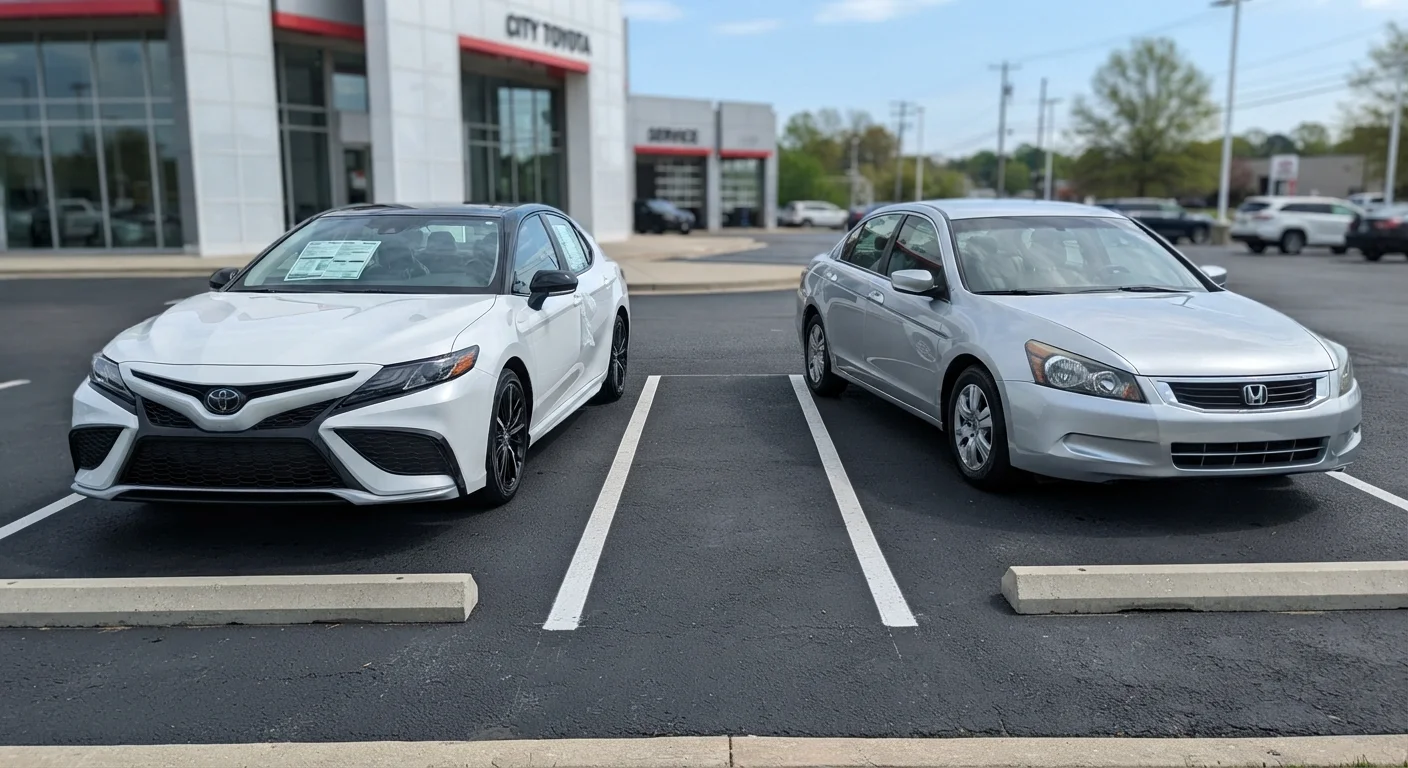
Option A
New Car
The factory-fresh choice with full manufacturer backing.
Best for: Buyers who prioritize warranty coverage, latest safety features, and predictable ownership costs and can absorb higher upfront expense.
Option B
Used Car
The value-oriented alternative with a proven track record.
Best for: Buyers who want to reduce purchase price and first-year depreciation, and are comfortable doing more upfront research on vehicle history.
Depreciation: The Number That Changes Everything
Depreciation is the single biggest financial variable in the new-versus-used decision. A new vehicle can lose roughly 15-25% of its value within the first year alone, according to widely cited industry estimates - and the steepest drop typically occurs the moment it leaves the lot. By year three, cumulative depreciation often reaches 40-50% of the original purchase price.
When you buy a used vehicle that is already two to four years old, that initial value cliff has already been absorbed by the previous owner. You effectively step onto a flatter depreciation curve, which means the car retains a greater share of its purchase price over the years you own it.
That said, depreciation isn't uniformly bad for new-car buyers. If you plan to keep a vehicle for eight or more years, the annual depreciation cost averages out and the warranty and reliability benefits of buying new can justify the initial hit. Understanding the true cost of owning a car - not just the sticker price - is essential before deciding which route makes sense for your household.
| Criterion | New Car | Used Car |
|---|---|---|
| Purchase price | Higher (full retail value) | Lower (depreciation already absorbed) |
| First-year depreciation | Steepest - 15-25% typical | Flatter curve on older vehicles |
| Manufacturer warranty | Full coverage from day one | Partial, expired, or none |
| Financing APR | Typically lower | Typically higher |
| Vehicle history | Fully known - zero miles | Requires research and inspection |
| Insurance cost | Generally higher premiums | Generally lower premiums |
| Feature availability | Latest safety & tech standard | Varies by model year |
| Customization options | Factory-order possible | Limited to available inventory |
Warranty, Reliability, and the Unknown History Problem
New cars come with a manufacturer's warranty - typically a 3-year/36,000-mile bumper-to-bumper policy and a 5-year/60,000-mile powertrain warranty, though these terms vary by manufacturer. That coverage means most repair costs in the early ownership period fall on the manufacturer, not you.
Used cars present a more complex picture. A vehicle with, say, 45,000 miles on the clock may still have powertrain warranty remaining, or it may have none at all. Equally important: you don't always know how the previous owner drove or maintained it. That's why a pre-purchase inspection by an independent, qualified mechanic is widely recommended before buying any used vehicle - it's a modest upfront cost that can surface issues costing thousands later.
Get an Independent Inspection Before Buying Used
A pre-purchase inspection by a qualified, independent mechanic is one of the most practical steps a used-car buyer can take. Most mechanics offer this service for a modest flat fee, and it can reveal hidden issues - worn brakes, oil leaks, suspension wear - that aren't obvious on a test drive. Don't skip it even on a vehicle that looks clean or comes with a history report.
If some warranty coverage matters to you but a new-car price doesn't fit the budget, a certified pre-owned vehicle is worth examining. CPO programs vary significantly, so understanding exactly what each one covers is important before treating it as equivalent to a new-car warranty.
Financing Rates and the Real Monthly Payment
Many buyers compare new and used cars purely on sticker price and stop there. But financing terms often shift that comparison materially. Lenders - including banks, credit unions, and captive finance arms - generally offer lower annual percentage rates (APRs) on new vehicles than on used ones, reflecting lower collateral risk on a vehicle with no wear history.
For example, a new car financed at a notably lower rate over 60 months may carry a similar or only moderately higher monthly payment than a used car financed at a higher rate, even if the used vehicle's purchase price is several thousand dollars less. Run the full loan math - total interest paid over the loan term, not just the monthly figure - before concluding which option costs less to finance.
~20%
Average new-car value lost in year one
Industry analysts broadly estimate new vehicles depreciate 15-25% in the first 12 months, with the exact figure depending on segment and demand.
1-2%+
Typical APR gap: new vs. used loans
Federal Reserve consumer credit data consistently shows used-car loan rates running higher than new-car rates, though the spread varies by lender and credit profile.
3 yrs / 36k mi
Common bumper-to-bumper warranty on new cars
Many manufacturers offer at least this baseline coverage, though terms differ - always verify the specific warranty for any vehicle you are considering.
Also factor in insurance. New vehicles, especially those with higher replacement values, typically cost more to insure than older ones. Your overall car-buying budget should account for insurance, registration, and ongoing maintenance from day one, not just the loan payment.
Making the Call: Practical Questions to Ask Before You Decide
Neither option is universally better. The right choice depends on your financial situation, how long you plan to keep the vehicle, how many miles you drive annually, and your tolerance for uncertainty. A few practical questions can help clarify the decision:
- How long will you keep it? Longer ownership generally favors new cars, where warranty coverage and lower initial maintenance offset the depreciation cost over time.
- What's your risk tolerance for repairs? Used cars carry more uncertainty. A vehicle history report and mechanic inspection reduce - but don't eliminate - that risk.
- What do the total ownership numbers say? Look beyond the purchase price to projected insurance, fuel, maintenance, and depreciation across your expected ownership period.
- Where are you buying the used car? Buying from a private seller versus a dealership introduces different levels of consumer protection and price negotiation dynamics.
If you end up trading in a vehicle as part of the transaction, be prepared for the valuation to come in lower than expected - our guide on why trade-in offers are often lower than expected explains the factors dealers use to set that number.
Finally, watch what gets added at signing. Extended warranties, gap insurance, and paint protection are commonly presented at the finance desk for both new and used purchases - understanding those add-ons before you sit down puts you in a stronger position to evaluate each one clearly.
The content provided on our blog site traverses numerous categories, offering readers valuable and practical information. Readers can use the editorial team’s research and data to gain more insights into their topics of interest. However, they are requested not to treat the articles as conclusive. The website team cannot be held responsible for differences in data or inaccuracies found across other platforms. Please also note that the site might also miss out on various schemes and offers available that the readers may find more beneficial than the ones we cover.