

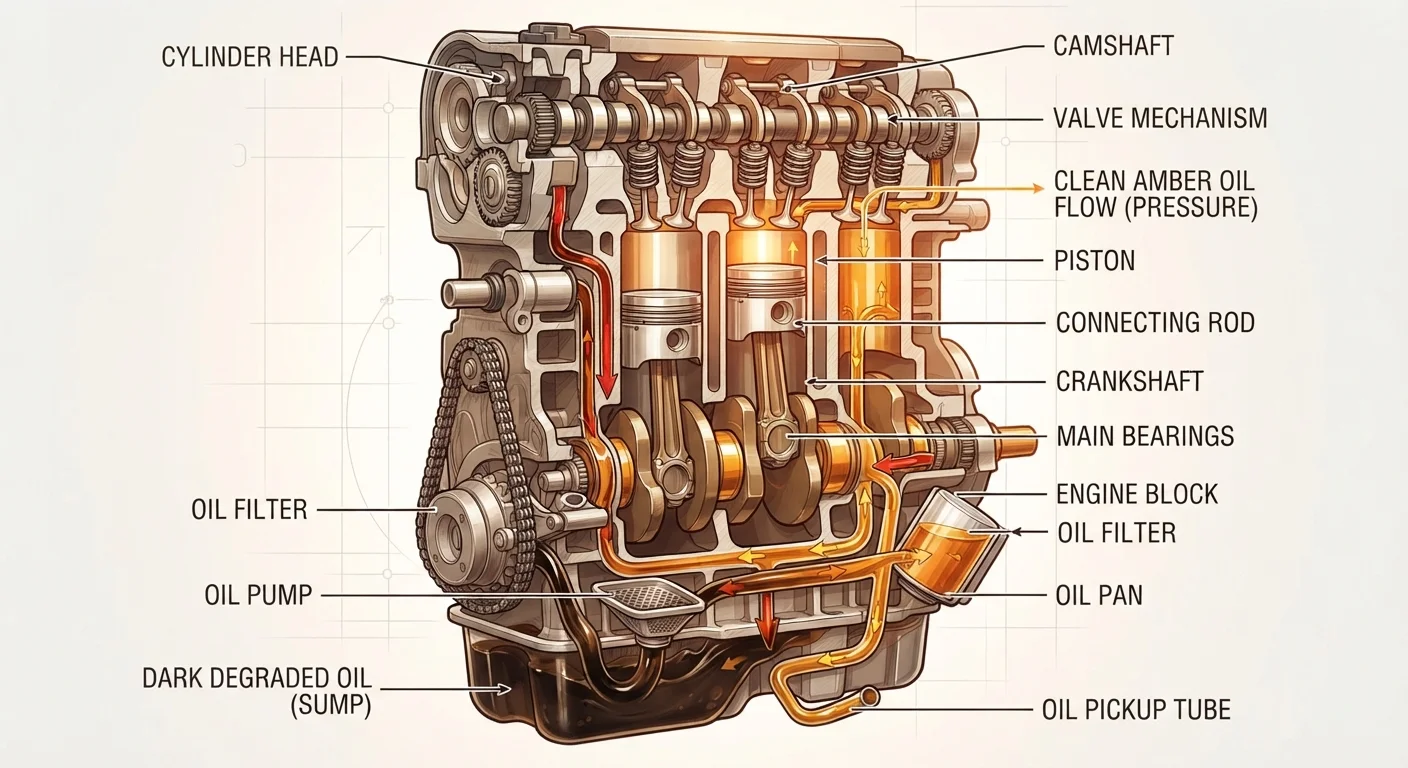
What Engine Oil Actually Does
Think of engine oil as the lifeblood of your vehicle. Inside a running engine, hundreds of metal components move at high speed with extraordinarily tight tolerances - some gaps measured in thousandths of an inch. Without a continuous film of oil separating those surfaces, metal would grind against metal, generating destructive heat within seconds.
But lubrication is only one job. Engine oil also:
- Cleans: Detergent additives suspend microscopic particles - metal shavings, soot, combustion residue - and carry them to the oil filter, preventing buildup on engine surfaces.
- Cools: Oil absorbs heat from components the cooling system can't directly reach, including pistons, camshafts, and bearings, then dissipates it back to the oil pan.
- Protects against corrosion: Additive packages neutralize the mild acids that form as combustion byproducts accumulate in oil over time.
- Seals: Oil fills microscopic gaps between piston rings and cylinder walls, improving compression and efficiency.
Understanding these functions makes it clear why degraded oil is so harmful - it's not just a lubrication failure, it's the loss of an entire protective system.
Why Oil Degrades - and What That Means
Fresh motor oil is engineered with a precise balance of base oil and chemical additives. Every mile driven chips away at that balance through three main processes:
- Thermal breakdown: High engine temperatures cause oil molecules to oxidize and break apart, reducing viscosity stability - the oil's ability to maintain the right thickness across temperature extremes.
- Additive depletion: The detergents, anti-wear agents, and corrosion inhibitors in oil are consumed as they do their jobs. Once depleted, they can't be replenished by simply topping off the oil level.
- Contamination: Combustion gases that slip past piston rings (called blow-by) introduce water vapor, soot, and unburned fuel into the oil. Short trips that don't fully warm the engine are especially problematic because moisture doesn't fully evaporate.
The result, if oil goes unchanged too long, is engine sludge - a thick, gel-like deposit that forms when heavily contaminated oil oxidizes. Sludge coats internal surfaces, restricts oil passages, and can cause components to run without adequate lubrication. Once sludge sets in, cleaning it out is difficult and expensive, and in severe cases, engine damage is permanent.
Engine Sludge: A Costly but Preventable Problem
Some engines built in the early-to-mid 2000s developed reputations for sludge buildup under normal use - an issue that led to investigations and extended warranties in some cases. While modern engine and oil chemistry has improved significantly, the underlying mechanism hasn't changed: infrequent oil changes combined with severe driving conditions remain the primary cause of sludge in any engine. Staying on your recommended service schedule is the most effective prevention.
The 3,000-Mile Rule: Where It Came From and Why It's Outdated
For decades, the advice to change your oil every 3,000 miles was near-universal. It wasn't bad advice for its time - older engine designs had looser tolerances, conventional oil of that era degraded faster, and driving patterns often involved more severe conditions.
Today, that blanket recommendation no longer reflects how modern vehicles and oils are engineered. Many automakers now specify intervals of 5,000 to 10,000 miles, and some vehicles using full synthetic oil in normal driving conditions are rated for up to 15,000 miles between changes. The quick-lube industry's sticker on your windshield often reflects older conventions rather than your car's actual requirements.
The authoritative source is your owner's manual. It accounts for your specific engine design, oil specification, and whether your vehicle has an oil life monitoring system - a sensor-based algorithm that tracks driving conditions in real time and alerts you when oil actually needs changing. These systems are standard on many vehicles built in the last decade. See our guide to reading your owner's manual maintenance schedule to make sense of what's in yours.
It's also worth knowing that using the wrong interval costs money in both directions: too frequent changes waste money unnecessarily, while going too long risks expensive engine damage. Our look at common maintenance myths explores how outdated advice like this affects drivers' wallets.
Trust Your Owner's Manual, Not the Sticker
The oil-change reminder sticker placed on your windshield by a quick-lube shop often reflects a generic interval - commonly 3,000 miles - that may not match your vehicle's actual requirements. Your owner's manual is the only document written specifically for your engine, oil type, and expected driving conditions. Make it your first stop when setting a service interval.
Oil Type, Driving Conditions, and Choosing the Right Interval
Two variables matter most when determining how long you can safely go between changes: the type of oil in your engine and your driving conditions.
Full synthetic oil resists thermal breakdown and oxidation far better than conventional oil, which is the primary reason synthetic-compatible vehicles carry longer intervals. For a deeper look at the chemistry and trade-offs involved, see our breakdown of synthetic vs. conventional motor oil.
Driving conditions matter just as much as oil type. Manufacturers typically define two service regimes:
- Normal service: Steady highway driving, moderate temperatures, longer trips that fully warm the engine.
- Severe service: Frequent short trips under 5 miles, stop-and-go city driving, extreme heat or cold, towing or hauling heavy loads, dusty environments.
Severe-service driving stresses oil faster, so many owner's manuals specify a shorter interval for those conditions. Honest self-assessment of how you actually drive - not how you'd like to drive - is important here.
Keeping a record of your oil changes and other maintenance helps you stay on schedule and can also matter when selling the vehicle. Our guide to keeping a vehicle maintenance log explains a simple approach that works for most drivers.
5,000-10,000 mi
Typical modern oil change interval
Most major automakers now specify intervals well beyond the old 3,000-mile standard for vehicles using current-generation oils.
~$4,500
Average engine replacement cost
Engine repairs or replacements from neglected oil maintenance routinely run into thousands of dollars, according to automotive repair industry estimates.
Up to 15,000 mi
Some synthetic oil intervals
Certain vehicles using full synthetic oil under normal driving conditions carry manufacturer-specified intervals of up to 15,000 miles between changes.
Frequently Asked Questions
It depends on your vehicle, driving conditions, and oil type. Most modern vehicles with synthetic oil can go 7,500 to 10,000 miles or more between changes. Check your owner's manual for the manufacturer's specific recommendation rather than relying on generic guidelines.
For most modern vehicles, no. The 3,000-mile interval was appropriate for older engines and conventional oil. Advances in engine design and oil chemistry have extended recommended intervals significantly. Following the 3,000-mile rule today often means changing oil more frequently than necessary.
Degraded oil loses its ability to lubricate and clean effectively, allowing sludge - a thick, tar-like deposit - to form inside the engine. Sludge can block oil passages, starve components of lubrication, and cause costly engine damage that is often irreversible.
Yes. Stop-and-go city driving, frequent short trips, towing, and extreme temperatures are all considered 'severe' driving conditions that stress oil faster. If your driving matches these patterns, check whether your owner's manual recommends a shorter interval for severe service.
You can monitor oil level using the dipstick and look for obvious signs of trouble - very dark or gritty oil, a milky appearance (which can indicate coolant contamination), or a low level. However, dipstick checks alone won't tell you whether the oil's additive package has depleted; follow your service schedule for that.
Generally, yes. Full synthetic oil resists thermal breakdown longer than conventional oil, which is why vehicles using synthetics typically have longer recommended intervals. Your owner's manual specifies both the oil type and the corresponding service interval for your engine.
The content provided on our blog site traverses numerous categories, offering readers valuable and practical information. Readers can use the editorial team’s research and data to gain more insights into their topics of interest. However, they are requested not to treat the articles as conclusive. The website team cannot be held responsible for differences in data or inaccuracies found across other platforms. Please also note that the site might also miss out on various schemes and offers available that the readers may find more beneficial than the ones we cover.