

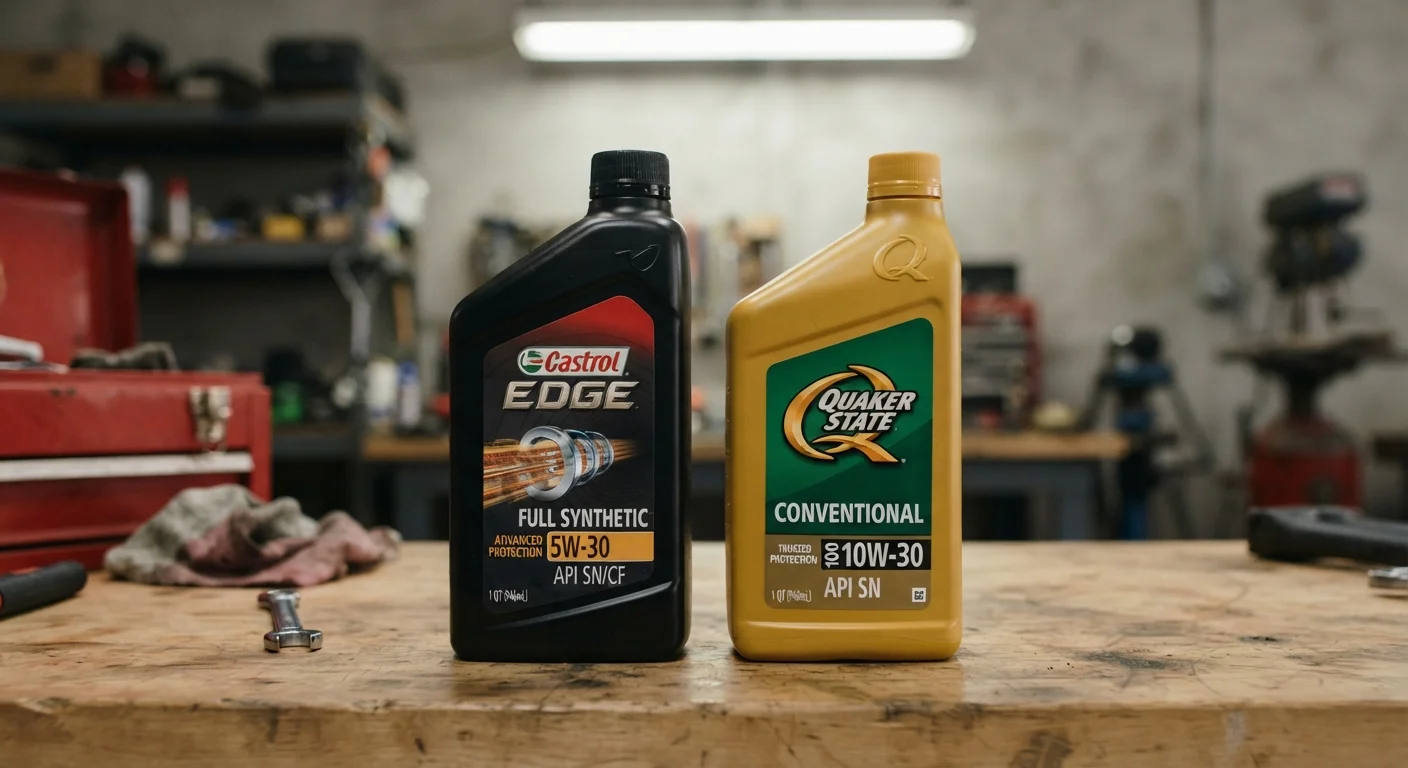
Option A
Synthetic Motor Oil
The engineered, high-performance option.
Best for: Drivers with newer vehicles, turbocharged engines, extreme climates, or long intervals between oil changes.
Option B
Conventional Motor Oil
The time-tested, straightforward choice.
Best for: Drivers with older, simpler engines operating in moderate climates and following frequent change schedules.
What Actually Separates These Two Oils
Motor oil has one core job: reduce friction between moving metal parts inside your engine. Both synthetic and conventional oil do this, but the way they're made is fundamentally different-and that difference matters in real-world driving.
Conventional motor oil is refined from crude oil. During refining, impurities are removed and additives are blended in to improve performance. The result is a functional lubricant, but one that retains some molecular irregularity from its natural origins. Those inconsistencies affect how the oil behaves under stress.
Synthetic motor oil is chemically built from the ground up. Engineers design the molecules for uniformity and stability, which translates to more predictable viscosity across temperature swings, greater resistance to oxidation (breakdown), and better flow in cold starts. A synthetic blend-sometimes called a semi-synthetic-mixes both types, offering a middle-ground option some manufacturers recommend.
For a deeper look at what happens inside your engine during an oil change, see Oil Changes: What's Really Happening Inside Your Engine.
| Criterion | Synthetic Motor Oil | Conventional Motor Oil |
|---|---|---|
| Base material | Chemically engineered molecules | Refined crude oil |
| Cold-weather flow | Excellent - flows quickly at low temps | Slower - can thicken in freezing cold |
| High-heat stability | Strong resistance to breakdown | Degrades faster under high heat |
| Typical change interval | Often 7,500-10,000+ miles (per manual) | Typically 3,000-5,000 miles (per manual) |
| Cost per quart | Higher upfront cost | Lower upfront cost |
| Best engine fit | Modern, turbocharged, or high-performance | Older, simpler, lower-stress engines |
| Molecular consistency | Uniform - engineered for predictability | Variable - natural impurities remain |
Performance Differences That Matter to Everyday Drivers
The engineering gap between the two oils shows up most clearly in specific driving conditions:
- Cold starts: Synthetic oil flows faster when temperatures drop, which means engine components get lubricated almost immediately. Conventional oil can be sluggish in freezing weather, leaving parts momentarily unprotected.
- High heat: Turbocharged engines and stop-and-go city driving push oil temperatures higher. Synthetic holds up better under that heat without breaking down as quickly.
- Long-haul intervals: Conventional oil degrades faster, which is part of why older guidance suggested changes every 3,000 miles. Many modern vehicles using full synthetic can go significantly longer between changes-but follow your owner's manual, not assumptions.
- Older, high-mileage engines: Some drivers report that switching a high-mileage engine to synthetic oil can expose minor leaks, because synthetic flows through small gaps more readily than conventional. This isn't universal, but it's worth knowing.
Viscosity Grade: Don't Skip This Step
Oil type (synthetic vs. conventional) and oil viscosity grade are two separate specifications. Even if you choose the right type, using the wrong viscosity-say, 10W-40 when your engine calls for 5W-20-can reduce fuel economy and increase wear. Always cross-check both the type and the grade against your owner's manual before every oil change.
Choosing oil type is only half the equation. The viscosity grade-those numbers like 5W-30 or 0W-20-must match your manufacturer's specification. Using the wrong viscosity can cause real harm regardless of whether the oil is synthetic or conventional. Check the oil cap, the owner's manual, or your maintenance schedule guide for the correct grade.
Cost, Intervals, and the Real-World Math
Synthetic oil typically costs more per quart than conventional-sometimes two to four times as much. However, that upfront cost doesn't tell the whole story.
~2-4×
Synthetic oil cost vs. conventional per quart
Industry estimates vary by product tier, but full synthetic typically costs significantly more per quart than standard conventional oil.
5,000-10,000 mi
Typical synthetic change interval range
Many modern vehicle manufacturers specify intervals in this range for full synthetic, compared to shorter intervals common with conventional oil.
~22%
U.S. vehicles now factory-filled with synthetic
Industry analysts estimate a growing share of new vehicles ship from the factory with full synthetic, reflecting tighter engine tolerances in modern designs.
If your vehicle's manufacturer approves extended oil change intervals with full synthetic, the cost-per-mile difference narrows considerably. A higher-cost oil changed every 7,500-10,000 miles (per manufacturer guidance) can come close to the total cost of conventional oil changed every 3,000-5,000 miles. That said, the 3,000-mile rule is largely outdated for most modern vehicles-a point covered in depth in our piece on car maintenance myths that cost drivers money.
The safest financial decision is to follow your owner's manual change interval precisely, regardless of which oil type you use. Skipping or stretching changes beyond spec to save money tends to cost significantly more in engine repairs over time.
If you're weighing maintenance costs as part of a broader vehicle decision, New Car vs. Used Car: What the Trade-Offs Actually Look Like is worth a read.
How to Choose-and When to Ask a Mechanic
The decision tree is simpler than most oil-change marketing makes it seem:
- Open your owner's manual. If it specifies synthetic, use synthetic. If it allows conventional, you have a genuine choice.
- Consider your driving conditions. Extreme cold, high-heat climates, towing, or performance driving all favor synthetic.
- Check your vehicle's age and mileage. Many older vehicles with high mileage and no manufacturer synthetic requirement do fine on conventional, provided the correct viscosity is used.
- Don't assume switching is always fine. While switching between oil types mid-life is generally safe, consult a qualified mechanic if your vehicle has high mileage, known leaks, or a turbocharged engine.
For tasks like an oil change itself, DIY Car Maintenance: Where It Makes Sense-and Where It Doesn't can help you decide whether to do it yourself or hand it to a professional. Either way, using the right oil type and viscosity for your engine is non-negotiable.
The content provided on our blog site traverses numerous categories, offering readers valuable and practical information. Readers can use the editorial team’s research and data to gain more insights into their topics of interest. However, they are requested not to treat the articles as conclusive. The website team cannot be held responsible for differences in data or inaccuracies found across other platforms. Please also note that the site might also miss out on various schemes and offers available that the readers may find more beneficial than the ones we cover.