

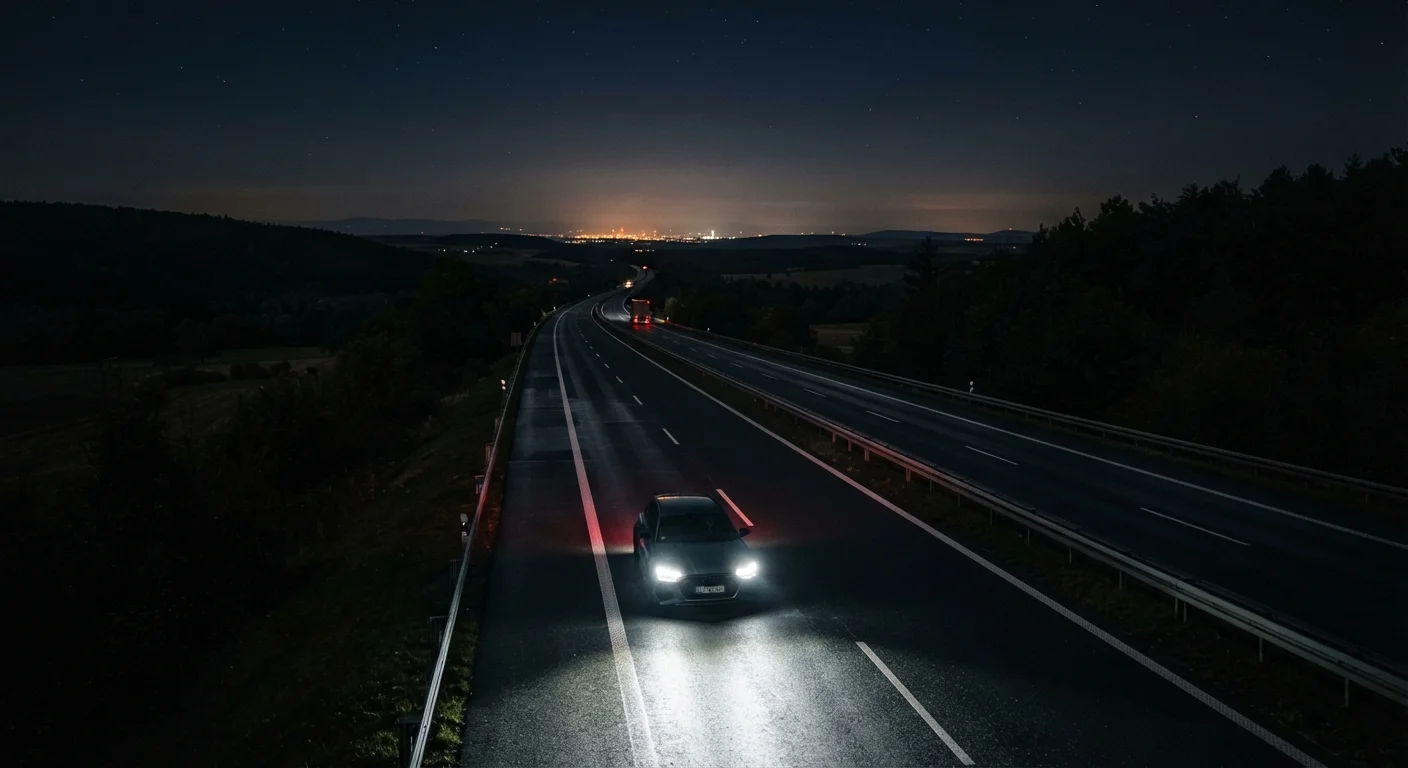
Why Night Driving Is Genuinely More Dangerous
According to the National Safety Council, traffic fatality rates per mile driven are roughly three times higher at night than during the day. That gap isn't explained by volume alone - nighttime conditions fundamentally change what a driver can see and how quickly they can respond.
The human eye relies on rod and cone cells to process light. In low-light conditions, peripheral vision narrows, depth perception weakens, and the ability to distinguish color and contrast degrades. At highway speeds, headlights typically illuminate about 160 to 250 feet ahead - but stopping distances at 65 mph can exceed 300 feet. That gap between what you can see and how far it takes to stop is sometimes called overdriving your headlights, and it's a core night-driving hazard.
Combine reduced visibility with higher rates of impaired and fatigued driving after dark, and the result is a significantly elevated risk environment - one that deserves deliberate preparation rather than assumption that daylight habits will carry over.
Best Practices for Driving Safely After Dark
The following practices address the specific conditions that make night driving more demanding. Each is grounded in how darkness affects perception, reaction, and hazard exposure.
Use high beams on unlit roads and dim them for oncoming traffic.
High beams can nearly double your effective sight distance on dark rural roads, giving more time to identify hazards like animals or road debris. Failing to dim for oncoming drivers, however, creates glare that temporarily blinds both parties.
Increase your following distance beyond the standard three-second rule.
Reduced visibility shortens the time available to identify a hazard and react. A larger cushion between you and the vehicle ahead compensates for slower hazard recognition after dark. See our breakdown of safe following distance for how to apply this in varying conditions.
Keep your windshield and mirrors clean inside and out.
Even a light film of grime on the interior windshield creates significant glare from oncoming headlights and streetlights, reducing clarity and increasing eye strain. Dirty mirrors have the same effect.
Scan the road edges actively for pedestrians and wildlife.
Both pedestrians and large animals are disproportionately involved in nighttime crashes because they're harder to detect and may appear suddenly at the road's edge. Reflective eyeshine from animals can provide early warning if you know what to look for.
Recognize fatigue early and stop driving before it becomes critical.
Drowsy driving impairs judgment and reaction time in ways comparable to alcohol intoxication. Fatigue risk is highest between midnight and 6 a.m. due to the body's natural circadian rhythm. Pushing through fatigue is a common but serious miscalculation.
Dim your dashboard and instrument cluster lighting appropriately.
Bright interior lighting reduces the eye's adaptation to the dark road ahead, a process called dark adaptation. Lower instrument brightness helps maintain better night vision.
For strategies on managing fatigue specifically, see our article on driving fatigue vs. distraction - two impairment types that look alike but require different responses.
Quick Actions You Can Take Tonight
Not every improvement requires a major habit change. Several of the most effective adjustments take less than five minutes and cost nothing.
Night driving shares some challenges with adverse weather. If you're navigating both conditions together, our guide on driving in rain, snow, and fog covers how to layer those adjustments safely.
New and Young Drivers: Extra Caution After Dark
Inexperience and darkness are a compounding combination. The visual scanning habits that experienced drivers develop over years - constantly reading lane edges, watching for peripheral movement, anticipating hazard zones - are still forming in new drivers. Graduated licensing systems in most states restrict nighttime driving for this reason: the learning curve is steepest precisely when conditions are hardest.
New drivers should treat night driving as a separate skill to practice deliberately, ideally starting on familiar, lower-traffic routes before attempting unfamiliar roads or highways after dark. The foundational visual skills described in scanning the road ahead become even more critical when contrast and peripheral information are reduced.
The content provided on our blog site traverses numerous categories, offering readers valuable and practical information. Readers can use the editorial team’s research and data to gain more insights into their topics of interest. However, they are requested not to treat the articles as conclusive. The website team cannot be held responsible for differences in data or inaccuracies found across other platforms. Please also note that the site might also miss out on various schemes and offers available that the readers may find more beneficial than the ones we cover.