

Two Distances Hidden Inside One Number
When drivers think about stopping, they usually picture the moment the brake pedal hits the floor. But the vehicle has already been traveling - sometimes for several car lengths - before that happens. Total stopping distance is made up of two separate phases, and understanding each one changes how you think about speed and space.
Reaction distance is the ground covered between the moment your eyes register a hazard and the moment your foot actually engages the brake. At highway speeds, this phase alone can consume more distance than most drivers expect. Braking distance is what happens after the brakes engage - the measurable physics of friction slowing a moving vehicle to zero.
Both numbers grow with speed, but not at the same rate. Reaction distance increases in a straight line: drive twice as fast, cover twice the ground during reaction. Braking distance, however, grows with the square of speed. At 20 mph, braking distance on dry pavement is roughly 20 feet. At 40 mph - twice the speed - it's not 40 feet, it's closer to 80. This is why speed limits and following distances exist in the specific form they do.
~130 ft
Reaction distance at 60 mph
Based on an average reaction time of approximately 1.5 seconds, before braking even begins, according to commonly cited driver safety guidelines.
4x
Braking distance increase when speed doubles
Because kinetic energy scales with the square of velocity, doubling speed quadruples the braking distance needed on the same road surface.
2x+
Stopping distance increase on wet pavement
Road safety authorities commonly estimate that wet roads can double stopping distances compared to dry conditions due to reduced tire traction.
The Role of Reaction Time
The average alert driver takes somewhere between 1.5 and 2 seconds to perceive a hazard, decide to brake, and move their foot to the pedal. At 60 mph, 1.5 seconds of travel equals roughly 130 feet - nearly half a football field - before a single pound of brake pressure has been applied.
That baseline assumes optimal conditions: a driver who is rested, undistracted, and fully alert. Real-world conditions routinely degrade reaction time. Fatigue, distraction from a phone or conversation, and any level of alcohol impairment all extend the reaction window. Even a half-second increase - going from 1.5 to 2.0 seconds - adds roughly 44 feet to your stopping distance at 60 mph.
This is why experienced drivers scan ahead rather than fixating on the vehicle directly in front. A driver who spots a hazard two seconds earlier effectively builds in a buffer that physics alone cannot provide.
Build Reaction Time Into Your Following Distance
A practical way to account for your reaction time is to add it to your following distance calculation. The three-second rule already builds in a reaction buffer, but in adverse conditions - rain, fatigue, or heavy traffic - extend that to four or five seconds. More space equals more time, and more time equals a real chance to stop safely.
How Road Surface and Conditions Change the Equation
Braking distance figures published by safety organizations typically assume a dry, paved surface with adequate tire traction. The real road is rarely that cooperative. Surface friction - the grip between tire and pavement - is the variable that changes most dramatically with conditions.
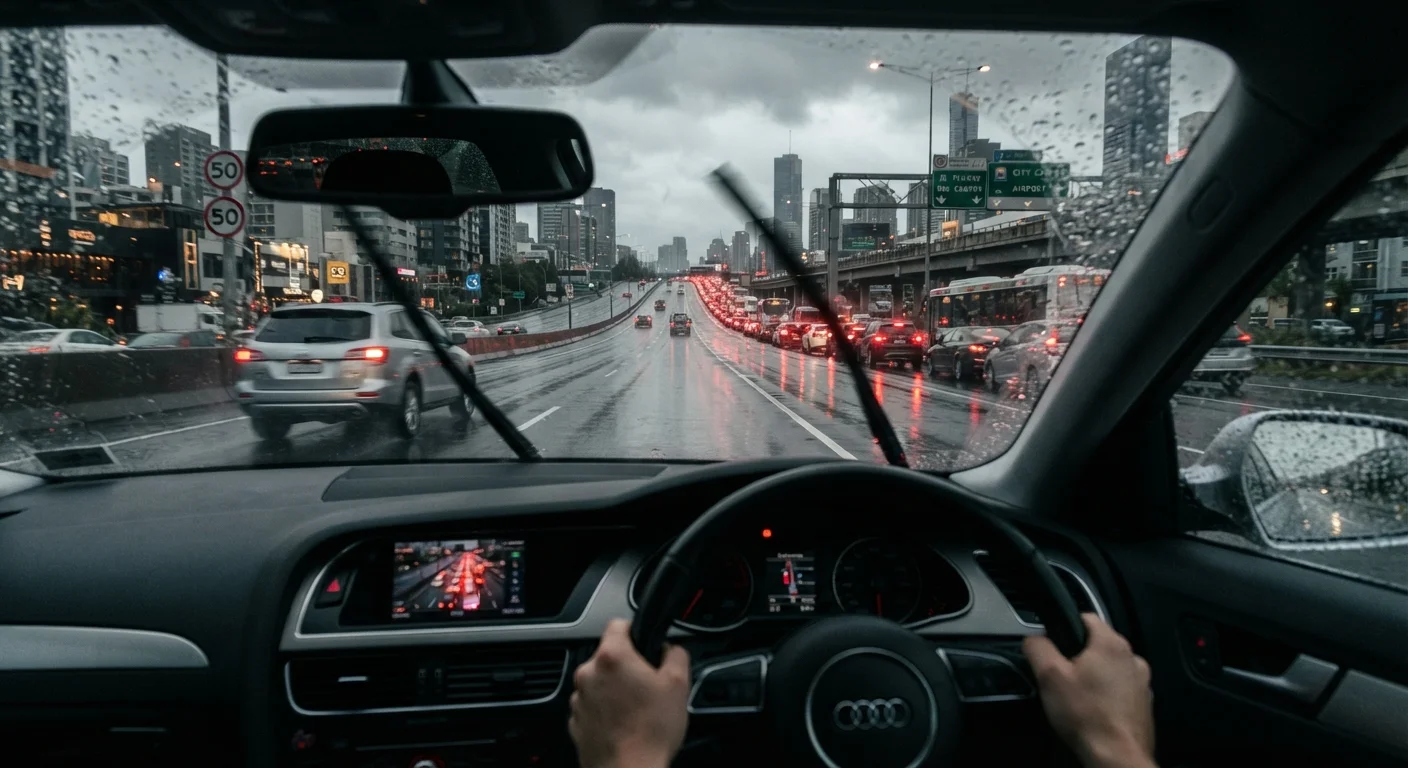
On wet pavement, tire traction drops noticeably, and stopping distances can roughly double compared to dry conditions. Loose gravel, oil patches, and painted road markings create localized low-friction zones. Ice is the extreme end: traction can fall to a fraction of dry-road values, pushing stopping distances to many times what drivers expect.
This is why the guidance in adapting to rain, snow, and fog centers on speed reduction and increased following distance - not just technique. The physics of braking don't change; the surface underneath changes what those physics can accomplish.
Speed Limits Are Set for Ideal Conditions
Posted speed limits generally reflect safe speeds for dry pavement with good visibility. In rain, snow, or fog, driving at the posted limit can still be too fast for conditions. Traffic law in most US states includes provisions for driving at a speed appropriate to conditions - not just within the posted maximum. See what drivers get wrong about speed limits for more context.
What Your Vehicle Contributes
Stopping distance is also shaped by the mechanical state of your car. Tire tread depth is particularly important: worn tires have less rubber contacting the road and reduced channels for displacing water, which compromises grip in both dry and wet conditions. Underinflated tires can also affect braking performance by altering the contact patch between tire and road.
Brake pad condition matters as well. Pads that are worn thin generate less friction and can fade under sustained heavy braking. Vehicle weight plays a role too - a heavily loaded truck or SUV carries more kinetic energy than a compact car at the same speed, requiring greater braking force to stop in the same distance.
Understanding stopping distance connects directly to the habit of following distance. The gap between your car and the vehicle ahead is, in effect, your buffer of stopping distance. When that gap shrinks, you're borrowing against physics. And as the numbers above show, the physics don't negotiate.
This article is for general informational purposes. Always follow the traffic laws and posted speed limits applicable in your jurisdiction, and consult a qualified mechanic for vehicle safety inspections.
Frequently Asked Questions
On a dry road with good tires and an alert driver, total stopping distance at 60 mph is generally estimated at around 240-300 feet. This includes both reaction distance (approximately 130 feet) and braking distance. Wet or degraded road conditions will increase this figure substantially.
A wet road significantly reduces tire traction, which means brakes take longer to slow the vehicle. Stopping distances on wet pavement can be roughly double those on dry pavement. On ice or snow, distances can extend even further - sometimes to ten times the dry-road equivalent.
Yes - significantly. At 60 mph, a 1.5-second reaction time means your car travels about 130 feet before you even press the brake pedal. Fatigue, distraction, and impairment can all lengthen reaction time, which directly increases the total distance needed to stop.
A common guideline is the three-second rule: pick a fixed point ahead, and ensure at least three seconds pass between the car in front passing it and your car reaching it. In adverse conditions, extend that gap to four or more seconds to account for longer stopping distances.
Anti-lock braking systems (ABS) are designed to prevent wheel lockup during hard braking, which helps maintain steering control rather than always reducing stopping distance. On dry pavement, stopping distance may be similar with or without ABS. On loose or slippery surfaces, ABS can improve both control and, in some cases, distance.
Tire tread depth and inflation pressure, brake pad condition, and overall vehicle weight are the primary mechanical factors. Worn tires or degraded brakes can meaningfully extend braking distance even on dry roads. Regular maintenance checks help ensure your vehicle performs as expected in an emergency.
The content provided on our blog site traverses numerous categories, offering readers valuable and practical information. Readers can use the editorial team’s research and data to gain more insights into their topics of interest. However, they are requested not to treat the articles as conclusive. The website team cannot be held responsible for differences in data or inaccuracies found across other platforms. Please also note that the site might also miss out on various schemes and offers available that the readers may find more beneficial than the ones we cover.