

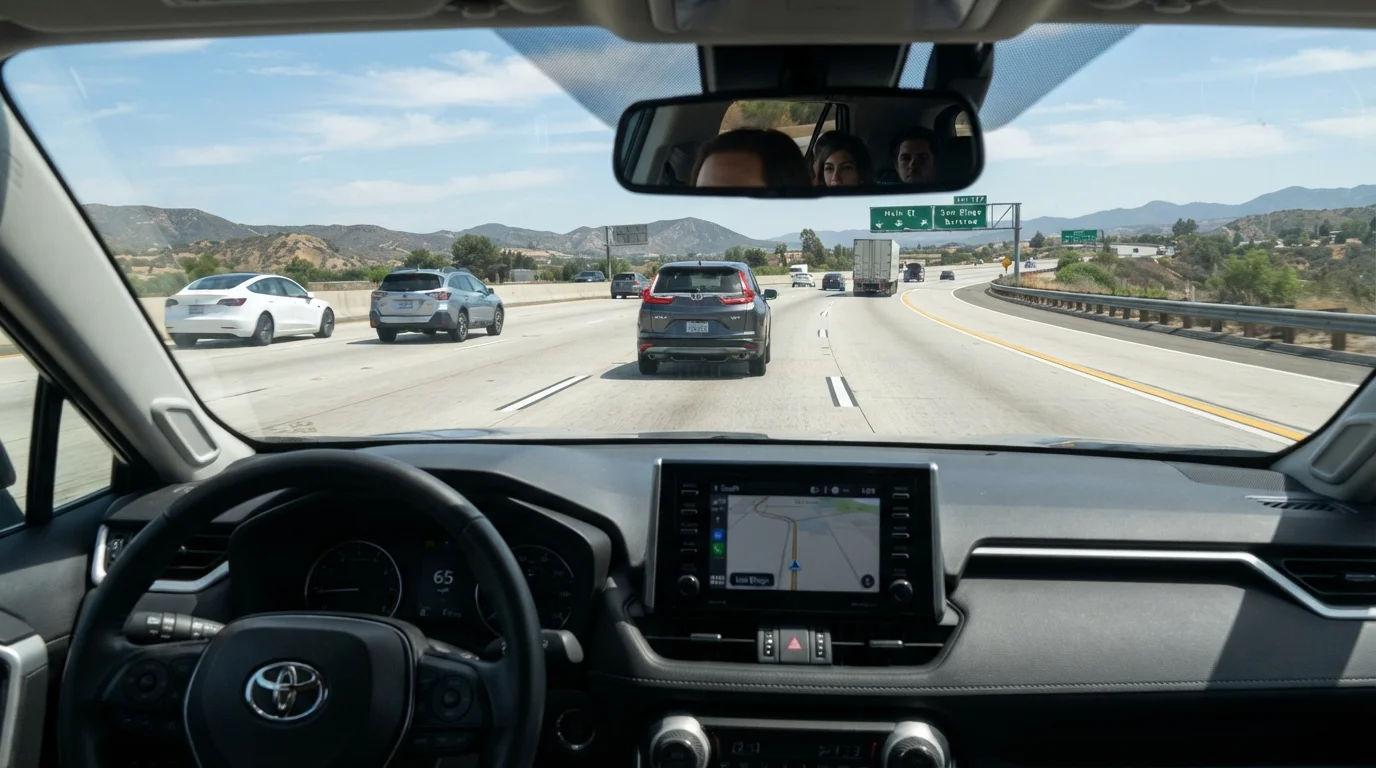
Why the Gap Between Cars Is a Safety Margin, Not Wasted Space
Most drivers underestimate how much distance a vehicle actually needs to stop. At 60 mph, your car travels 88 feet every second - roughly six car lengths. Factor in the roughly 1.5 seconds it typically takes the average driver to perceive a hazard and move a foot to the brake pedal, and you've already covered more than 130 feet before braking even begins.
That's the core problem with tailgating: it eliminates the buffer that makes emergency braking physically possible. When you follow closely, you're not saving time - highway studies consistently show that aggressive following provides negligible travel-time benefit. You're simply transferring the risk of any sudden stop entirely onto yourself and the driver behind you.
Rear-end crashes are among the most frequently occurring collision types in the US. According to the National Highway Traffic Safety Administration (NHTSA), following too closely is consistently identified as a contributing factor in a significant share of these crashes. Understanding and applying a safe following gap is one of the highest-impact habits a driver can develop - and it pairs directly with the broader approach described in our guide to defensive driving vs. aggressive driving.
How the Three-Second Rule Works - and When to Extend It
The three-second rule is straightforward. As the vehicle ahead passes a stationary reference point - a road sign, shadow, or overpass - begin counting: one-thousand-one, one-thousand-two, one-thousand-three. If you reach that same point before finishing the count, close the gap by easing off the accelerator.
The strength of this method is that it scales automatically with speed. A three-second gap at 30 mph is about 132 feet; at 65 mph it extends to roughly 286 feet. No mental math required.
Extend Your Gap in Adverse Conditions
Three seconds is the minimum for dry roads in daylight. Add at least one second for rain, one more for darkness, and double the entire gap on snow or ice. When you're towing or driving a large vehicle, add an extra second on top of whatever the base conditions require.
Three seconds is the minimum. Experienced drivers treat it as a floor and extend based on conditions:
- Rain or wet roads: Add at least one second. Wet pavement can more than double stopping distance.
- Snow or ice: Double or triple the gap. Braking distances on ice can be ten times those on dry pavement.
- Fog or low visibility: Slow down and extend your gap until you can stop within your sight distance.
- Night driving: See our guide on night driving safety for why darkness changes everything about reaction time.
- Towing or carrying heavy loads: Add at least one second - heavier vehicles take significantly longer to stop.
- Following a large truck or motorcycle: Trucks block your forward sightlines; motorcycles can stop faster than cars.
What Tailgating Looks Like - and What Drivers Tell Themselves
Most tailgating isn't intentional aggression - it's inattention or a misread of what 'close' actually means. Drivers who grew up watching others follow at two car lengths often internalize that as normal. Urban traffic can also compress gaps until everyone moves together in a slow convoy, normalizing the behavior.
Some drivers follow closely to pressure slower drivers to move over - a tactic that lane discipline guidance addresses more safely. Others simply aren't looking far enough ahead to notice the gap has shrunk. That forward-scanning habit is something experienced drivers do deliberately - and it's a learnable skill.
Building the Habit: Practical Steps for Every Drive
88 ft/sec
Distance traveled per second at 60 mph
At highway speeds, your vehicle covers the length of about six average cars every single second before braking begins.
~1.5 sec
Typical driver perception-reaction time
Research from the transportation safety field cites approximately 1.5 seconds as a general estimate for perceiving a hazard and initiating braking - though this varies by individual and conditions.
Top 3
Ranking of rear-end crashes among US collision types
NHTSA data consistently shows rear-end collisions are among the most common crash types in the US, with following too closely cited as a key contributing factor.
Changing following distance is less about willpower and more about redirecting attention. Here's how to make it stick:
- Pick your reference point early. As soon as you're on an open road, identify a fixed object ahead and check your gap at regular intervals - not just after near-misses.
- Use cruise control on highways. Maintaining a constant speed reduces the unconscious tendency to creep closer when traffic slows.
- Check your mirrors before braking. A quick rearward glance before slowing tells you whether the driver behind has left enough room - and helps you brake gradually rather than abruptly when possible.
- Don't fill the gap on reflex. When a vehicle merges in front of you, ease off the accelerator rather than braking hard to restore the three-second buffer.
If you're introducing a new driver - a teen or a household member returning after a license gap - this habit is worth practicing explicitly during supervised drives. Our overview of the graduated license system covers why early habits have outsized long-term impact.
This article provides general road safety information for educational purposes. Always follow your state's traffic laws and consult a certified driving instructor for personalized guidance.
Frequently Asked Questions
Pick a fixed point on the road - a sign or overpass. When the vehicle ahead passes it, count 'one-thousand-one, one-thousand-two, one-thousand-three.' If you reach that point before finishing the count, you're following too closely. This rule applies under normal conditions at any speed.
Yes. Every US state has traffic laws requiring drivers to maintain a 'reasonable and prudent' following distance. While specific measurements vary by state, police can issue citations for following too closely, and at-fault rear-end collisions typically place legal liability on the following driver.
The faster you travel, the more distance your vehicle covers during your reaction time and braking. At 30 mph you cover about 44 feet per second; at 60 mph that doubles to 88 feet. A three-second gap automatically scales with speed, which is why time-based rules are more reliable than fixed car-length estimates.
Add at least one additional second for each adverse condition: rain, snow or ice, fog, darkness, towing a trailer, driving a large vehicle, or following a motorcycle. When multiple conditions apply, extend your gap accordingly.
Avoid sudden braking. Gradually reduce your speed to encourage the tailgater to pass, or merge to another lane if safe. Do not brake-check another driver - that escalates danger for everyone on the road.
Yes, though the consequences of a low-speed rear-end impact are generally less severe. In stop-and-go traffic, a gap of two to three seconds helps prevent chain-reaction collisions and reduces stress for all drivers nearby.
The content provided on our blog site traverses numerous categories, offering readers valuable and practical information. Readers can use the editorial team’s research and data to gain more insights into their topics of interest. However, they are requested not to treat the articles as conclusive. The website team cannot be held responsible for differences in data or inaccuracies found across other platforms. Please also note that the site might also miss out on various schemes and offers available that the readers may find more beneficial than the ones we cover.