

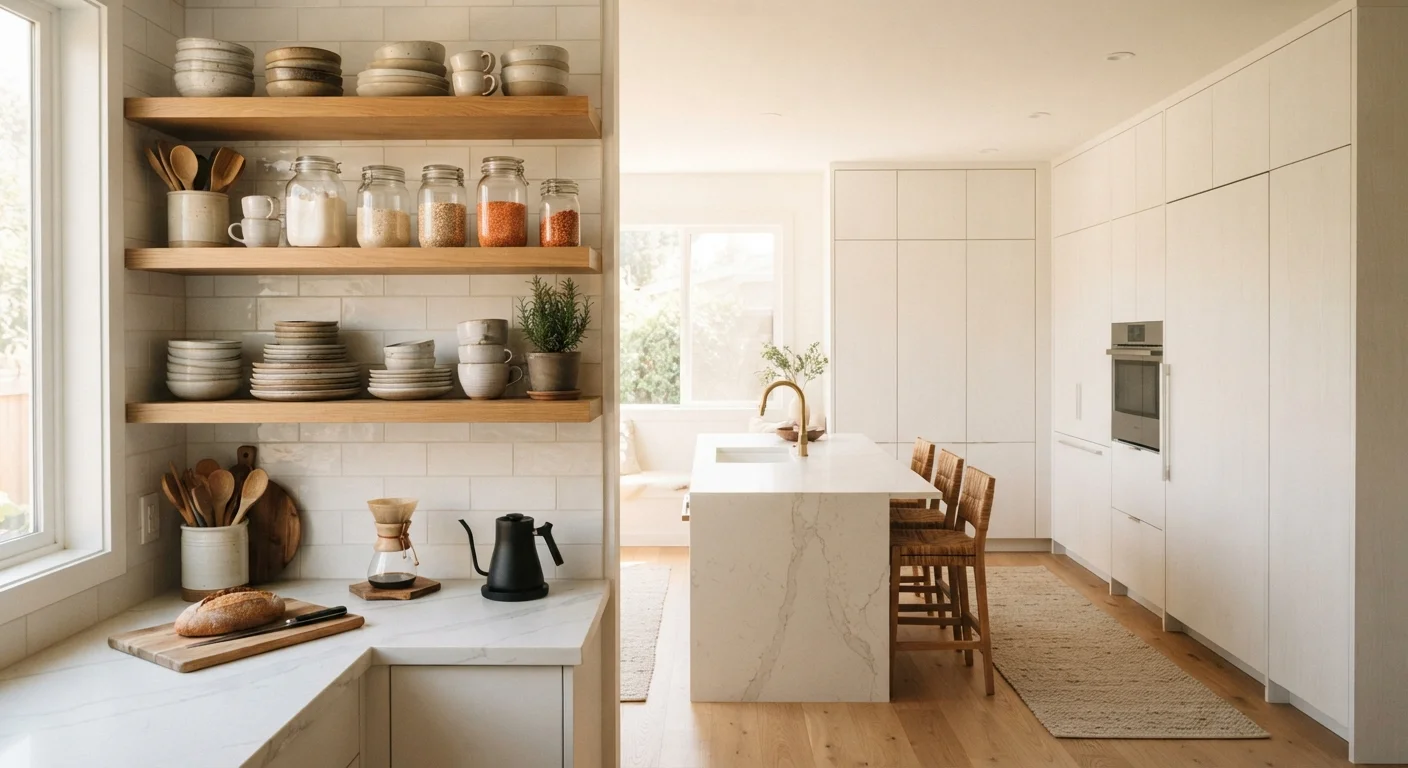
Option A
Open Shelving
The visible, access-first approach to kitchen storage.
Best for: Households that maintain tidy countertops, use items frequently, and want quick visual access to everyday essentials.
Option B
Closed Cabinets
The contained, clutter-concealing workhorse of kitchen organization.
Best for: Households with varied storage needs, young children, or anyone who prefers a streamlined, low-maintenance visual environment.
How Each System Actually Handles Day-to-Day Organization
The central question isn't which storage type looks better in a showroom - it's which one holds up under real household pressure. Open shelving and closed cabinets impose different organizational demands, and matching those demands to your actual habits is what determines whether your kitchen stays functional.
Open shelves operate on a display logic: everything is visible at all times, which makes retrieval fast but requires that every item be consistently returned to a precise spot. A single misplaced mug is immediately apparent. This visibility creates accountability - some households thrive on it - but it also means the shelf's appearance reflects your organization at every moment, not just when guests arrive.
Closed cabinets operate on a containment logic: visual order is maintained behind doors regardless of what's inside. This lowers the daily visual maintenance burden significantly, but it can allow interior disorganization to compound unnoticed. A cabinet that starts orderly can devolve into a jumbled stack of mismatched containers within weeks if the household doesn't periodically audit it. See our guide to dedicated storage zones vs. distributed tidying for a deeper look at how these organizational mindsets play out across the whole home.
| Criterion | Open Shelving | Closed Cabinets |
|---|---|---|
| Visual clutter management | Everything always visible | Clutter concealed behind doors |
| Daily maintenance demand | High - precision required | Lower - interior can be imperfect |
| Dust and grease exposure | High - items exposed to air | Low - items protected |
| Retrieval speed | Fast - no doors to open | Moderate - doors add a step |
| Child and pet safety | Low - items fully accessible | High - latches available |
| Interior organization visibility | Fully visible at a glance | Requires opening to inspect |
| Installation complexity | Generally simpler | More complex; more hardware |
Practical Trade-Offs: Dust, Grease, and Accessibility
One factor that rarely appears in kitchen inspiration photos is grease and dust accumulation. Open shelves near a stovetop collect airborne cooking grease and fine dust continuously. Dishes and glasses stored in the open require more frequent washing before use - not because they're dirty from use, but because kitchen air deposits a film over time. In kitchens with inadequate ventilation, this is a genuine hygiene consideration, not just an aesthetic one.
Closed cabinets protect stored items almost entirely from ambient grease and dust, which is a meaningful practical advantage in working kitchens. The trade-off is reduced ventilation inside the cabinet itself; in humid climates or poorly ventilated kitchens, closed storage can trap moisture if items are stored damp.
Accessibility is the area where open shelving most clearly wins. Grab-and-go retrieval is faster, and for people with limited grip strength or mobility challenges, not having to manage cabinet doors can meaningfully reduce physical effort. That said, cabinet design has evolved - full-extension drawers, pull-out shelves, and soft-close hinges have substantially improved interior accessibility over older fixed-shelf configurations.
60%+
Kitchen remodels that include cabinet changes
According to the National Kitchen and Bath Association, cabinet replacement or refacing is among the most common scopes in kitchen renovation projects.
3-5 min
Average time saved per day with open-shelf retrieval
Kitchen organization researchers estimate that eliminating door-opening steps can reduce meal-prep friction noticeably for households that cook frequently.
If you're evaluating whether to install more vertical storage in either format, vertical space strategies for small homes offers guidance on maximizing wall height in compact kitchens regardless of which system you choose.
Making a Hybrid Layout Work
Most kitchens don't have to be all-or-nothing. A hybrid layout - open shelving for a defined category of items, closed cabinets for everything else - is a practical middle ground that many households find performs better than either system alone.
A workable rule of thumb: use open shelves for items you reach for daily and that you genuinely don't mind keeping in deliberate order. Everyday glasses, a small collection of frequently used cookbooks, or a tray of cooking oils near the stove are reasonable candidates. Reserve closed cabinets for anything you use less frequently, anything that comes in mismatched packaging, and anything you'd prefer to keep out of sight.
Clear labeling helps both systems perform more consistently, especially in shared households. Labeling systems for home storage covers which labeling methods hold up in kitchen environments specifically. For households managing multiple people's preferences across shared spaces, the same negotiation principles apply in the kitchen as in any shared room - balancing two people's storage needs offers transferable frameworks.
If you're planning a larger kitchen update, it's worth thinking through the storage layout before committing to cabinetry. Kitchen renovation planning walks through how storage decisions fit into the broader sequencing of a remodel.
When Open Shelving Near a Stove Is a Risk
Open shelves installed directly above or beside a gas or electric cooktop are subject to higher grease and heat exposure than shelves elsewhere in the kitchen. Storing items made of wood, paper, or porous ceramic in those zones can lead to staining, warping, or odor absorption over time. If open shelving is part of your plan, consider positioning it away from the primary cooking zone and using non-porous, easy-to-clean materials for items stored nearby.
The content provided on our blog site traverses numerous categories, offering readers valuable and practical information. Readers can use the editorial team’s research and data to gain more insights into their topics of interest. However, they are requested not to treat the articles as conclusive. The website team cannot be held responsible for differences in data or inaccuracies found across other platforms. Please also note that the site might also miss out on various schemes and offers available that the readers may find more beneficial than the ones we cover.