

Why Category-Based Tidying Is Fundamentally Different
Most people organize their homes the same instinctive way: they walk into the bedroom and tidy it, then move to the kitchen, then a closet. The problem is that belongings don't actually live in just one room. A household's books might be spread across a living room shelf, a nightstand, a home office, and three boxes in storage. Tidying room by room means you never see the full picture of what you own.
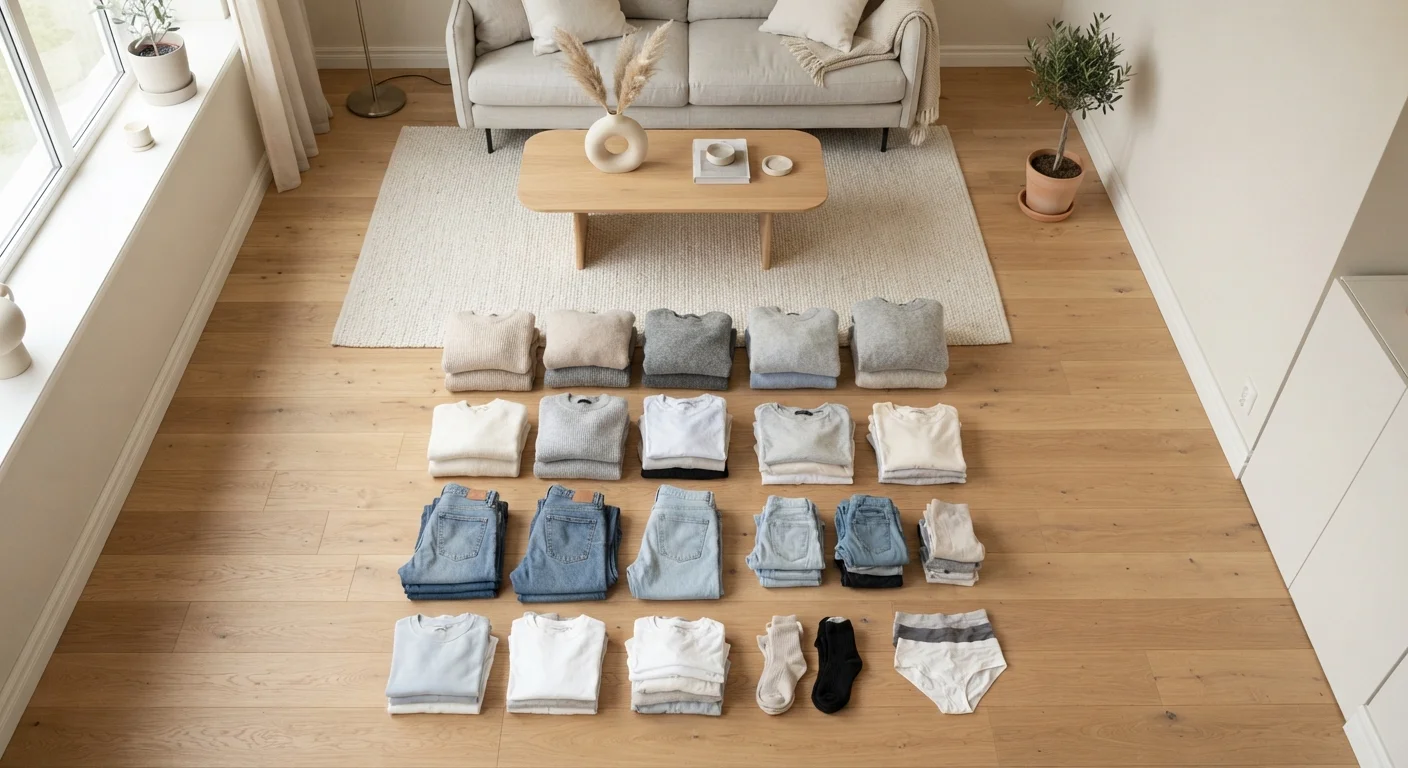
The KonMari Method solves this by requiring you to gather every item in a category from your entire home before touching anything else. All clothing from every closet, drawer, and storage bin goes into one pile. All books come off every shelf in the house. Only once everything is physically assembled do you begin making decisions.
This simple shift has a significant psychological effect. Seeing 200 items of clothing in one pile - versus a manageable-looking closet - makes the actual volume of your possessions undeniable. It is also the mechanism that surfaces true duplicates: four pairs of kitchen scissors, three copies of the same novel, a dozen half-empty notebooks scattered across different rooms.
KonMari Is a Reset, Not a Routine
The method is designed as a single intensive effort that fundamentally resets what you own and how it is stored - not as a recurring seasonal cleanout. Once complete, day-to-day tidying is meant to become simpler because everything has a designated home and excess has been removed. Treating it as an annual spring-cleaning routine misses the point of the approach.
If you're new to decluttering entirely, consider reading our first-timer's guide to decluttering before starting a full KonMari session. Building a basic comfort level with letting go makes the category process more manageable.
The Five Categories and Why the Order Matters
KonMari assigns a specific sequence to categories, and following it is considered important to the method's effectiveness:
- Clothing - the largest category for most households and the least emotionally loaded
- Books - forces early practice with the "sparks joy" standard on objects that feel intellectual or obligatory
- Papers - documents, mail, manuals, and printed material; the default rule is to discard almost everything unless actively needed
- Komono - a broad Japanese term for miscellaneous items, covering kitchen tools, hobby supplies, toiletries, electronics, and more
- Sentimental items - photos, gifts, and inherited objects; saved for last because emotional attachment is highest
The sequence is intentional. Clothing is a low-stakes category for practicing decision-making. Sentimental items require the most emotional maturity, so they come after you have spent weeks sharpening your judgment on easier categories. Attempting sentimental items first is a common reason people stall.
25%
Of household items used regularly
Research on household clutter patterns suggests most people regularly use only around a quarter of what they own, with the rest stored, forgotten, or duplicated across rooms.
~1 hour/day
Time spent searching for misplaced items
Studies on household productivity estimate that Americans spend significant time each week searching for misplaced belongings, a problem category-based storage directly addresses.
40%
Reduction in household cleaning time reported
Organizing consultants and user surveys frequently report that decluttered homes with designated storage can reduce routine cleaning and tidying time substantially, though results vary by household.
What "Sparks Joy" Is - and Isn't
The phrase "sparks joy" has become a cultural shorthand, but it is often misunderstood as a mandate to live with almost nothing. In practice, it functions as a decision-making standard that shifts your default question. Instead of asking "should I throw this out?" - which puts the burden on finding a reason to discard - you ask "do I genuinely want to keep this?"
You pick each item up physically, hold it, and pay attention to your immediate response. Items that feel light, welcome, or genuinely useful tend to stay. Items that produce guilt, obligation, or indifference are candidates for letting go. The physical act of holding the object matters; looking at it from across the room is not the same exercise.
Importantly, joy is not limited to decorative or sentimental objects. A colander that works well every week sparks joy in the sense that it is genuinely wanted and used. A duplicate that has been in a cabinet for three years probably does not.
This is also where KonMari diverges most clearly from minimalism. The method does not prescribe a target number of possessions or a visual aesthetic. For a comparison of these two often-confused philosophies, see our piece on minimalism myths that make decluttering harder.
After the Tidy: Making It Last
One reason the KonMari Method emphasizes doing the full process intensively - rather than a drawer at a time - is that partial completion tends not to stick. When only some categories have been assessed, the remaining clutter continues to expand into the tidied space.
Once the full category sequence is complete, the next challenge is maintaining the result. Every item that passed your assessment should now have a designated home. The method's storage guidance focuses on vertical folding for clothing, grouping like items together, and ensuring that everything can be returned to its place quickly after use.
If you find organization reverting after a few months, the issue is usually systemic rather than motivational. Our article on why organized homes don't stay that way explores the structural habits that support lasting results.
For households weighing KonMari against other approaches - such as dedicated storage zones or distributed tidying - a side-by-side comparison of organization philosophies may help clarify which framework fits your home and lifestyle best.
This article is intended for general informational and educational purposes. Organizational outcomes vary by household size, layout, and individual circumstances.
Frequently Asked Questions
It means asking honestly whether you want an item in your life going forward - not just whether it was expensive or useful once. You pick each object up physically and notice your gut response. Items that feel neutral, burdensome, or forgotten are candidates for letting go, regardless of sentimental guilt or original cost.
Room-by-room tidying addresses one space at a time, which means identical categories of items get assessed separately and never compared. KonMari pulls all items in a category from every room before any decisions are made. This makes it much harder to underestimate how much you own and easier to spot true redundancy.
No. The KonMari Method is about intentional keeping, not radical reduction. Many people who follow it retain the majority of their belongings - they simply become more deliberate about what they choose to keep and where it lives. It is not a minimalist prescription.
Most households take several weeks to complete the full process when working in focused sessions. It is designed as a one-time intensive effort rather than an ongoing maintenance routine. The idea is that once done thoroughly, daily tidying becomes much easier to sustain.
It works best when each person applies the method to their own belongings independently. Shared items - like kitchen tools or furniture - can be addressed collaboratively after individual categories are complete. Imposing the process on others without their agreement is not part of the method and is unlikely to be effective.
The method always starts with clothing, which tends to be the largest and most emotionally uncomplicated category. Starting there lets you practice the decision-making process before reaching harder categories like sentimental items. Skipping ahead or starting with paperwork is specifically discouraged.
The content provided on our blog site traverses numerous categories, offering readers valuable and practical information. Readers can use the editorial team’s research and data to gain more insights into their topics of interest. However, they are requested not to treat the articles as conclusive. The website team cannot be held responsible for differences in data or inaccuracies found across other platforms. Please also note that the site might also miss out on various schemes and offers available that the readers may find more beneficial than the ones we cover.