

How Clutter Creep Takes Hold
Most households do not decide to become disorganized. Instead, disorganization arrives quietly - one battery on the counter, one bag left by the door, one stack of mail that never quite gets sorted. Each act is harmless in isolation. The pattern they form over weeks and months is not.
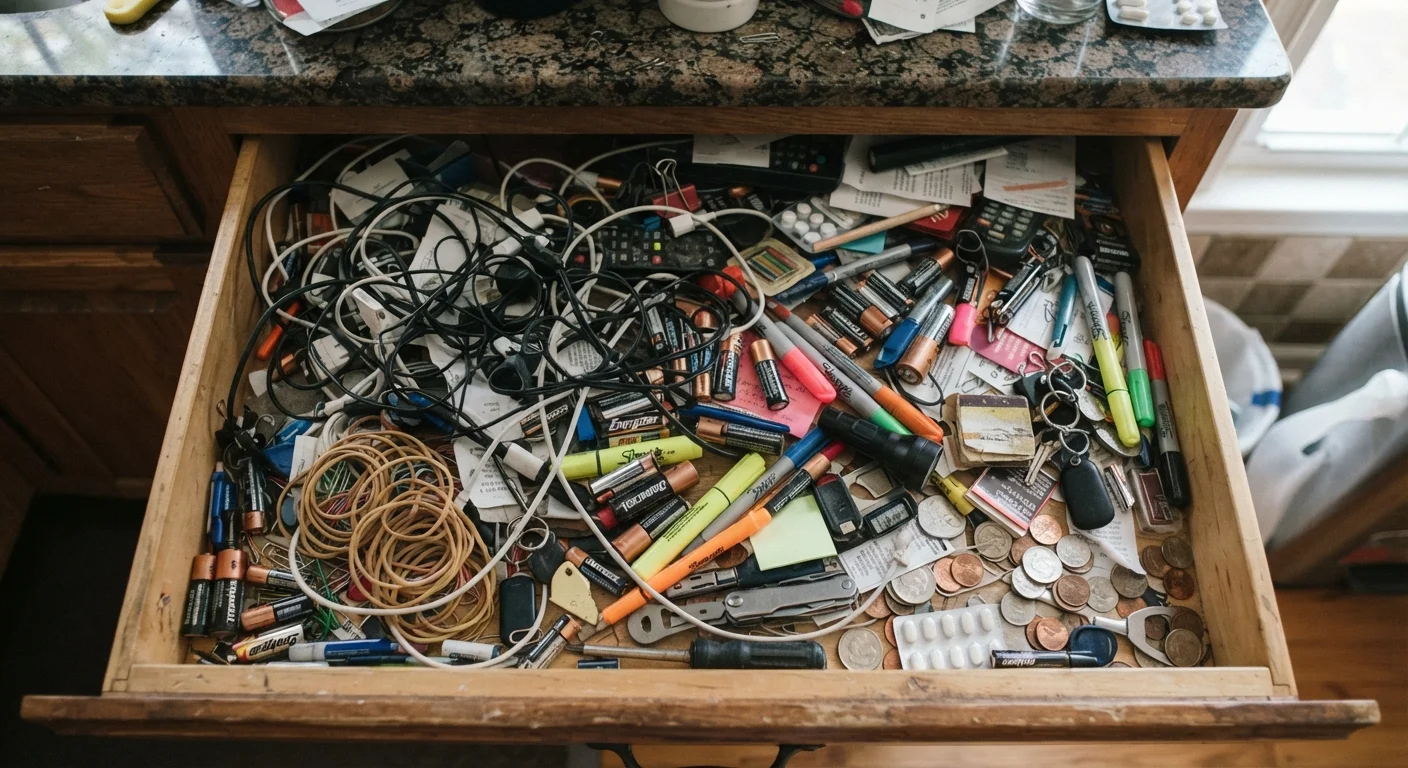
This is the defining characteristic of clutter creep: it is cumulative, not catastrophic. A junk drawer that started with a single tape measure slowly absorbs rubber bands, expired coupons, mystery keys, and phone chargers for devices that no longer exist. A kitchen counter intended for meal prep becomes a landing zone for school permission slips, charging cables, and reusable bags waiting to be returned to the car.
The reason this happens is partly behavioral. When a space has no clear rule about what belongs in it, the path of least resistance is to place new items wherever there is room. That default behavior, repeated daily, gradually redefines what the space is for. Once a surface becomes associated with dropping things off, its function as clutter storage becomes self-reinforcing.
Clutter Creep Is Not a Character Flaw
Accumulation is a predictable response to modern household life: more purchases, more incoming mail, more packaging, and less time to process it all. Recognizing the pattern is about understanding a behavioral dynamic, not assigning blame. Most households experience some version of this regardless of how organized they consider themselves.
For a broader look at why even well-organized homes eventually revert to disorder, see our article on why organized homes don't stay that way.
The Spaces Most Vulnerable to Accumulation
Clutter creep does not distribute itself evenly across a home. It concentrates in transitional zones - spaces that people pass through frequently but rarely stop to maintain deliberately.
- Entryways and mudrooms: Items carried in from outside (bags, shoes, mail, packages) land here and often stay. Without a clear system for processing incoming items, the entryway becomes a holding area without an exit.
- Kitchen counters and islands: High daily traffic and proximity to cooking, eating, and household administration make these surfaces magnets for objects that don't have an obvious home elsewhere.
- Junk drawers: Originally conceived as a practical catch-all, the junk drawer expands to meet whatever is placed in it. When it can no longer close, items migrate to a second drawer - or a box, or a shelf.
- Bedroom surfaces: Nightstands, dressers, and chairs accumulate clothing, chargers, books, and items emptied from pockets. These areas are often tidied last, if at all.
- Garages and basement corners: Out-of-sight storage spaces absorb items that households are not ready to discard but cannot find a place for indoors. These zones often hold the oldest, most forgotten clutter.
Understanding which spaces are most vulnerable in your home is the first step toward interrupting the pattern. Our room-by-room organization audit checklist offers a structured way to assess each area systematically.
1 in 4
US households with clutter-related garage issues
According to a survey by the National Association of Professional Organizers, roughly one in four Americans report that their garage is too cluttered to fit a car inside.
~40%
Of household items rarely or never used
Professional organizers commonly cite estimates suggesting a significant proportion of items kept in most homes are used infrequently or not at all, contributing to chronic storage pressure.
2.5 hours
Average time lost weekly searching for misplaced items
Research on household time management suggests Americans spend a substantial amount of time each week looking for lost items - a direct consequence of objects lacking consistent, defined homes.
Recognizing the Early Warning Signs
Because clutter creep is gradual, the clearest signals tend to be behavioral rather than visual - the way a household interacts with a space reveals more than a quick glance at it.
Signs clutter creep is underway:
- You can't fully clear a surface without effort. If counters, tables, or shelves are never entirely clear - if tidying means consolidating rather than putting things away - accumulation is already embedded in the space.
- Storage areas resist closing. Drawers that stick, cabinet doors that won't latch, and closets that require strategic maneuvering all signal that capacity has been exceeded.
- Items live on top of other items. Stacking is a reliable indicator that defined storage has run out and overflow has begun.
- You regularly can't find something you own. When locating a household object requires searching multiple spots, it indicates that items lack consistent, designated homes.
- New containers keep appearing. Purchasing bins, baskets, or organizers to manage existing clutter - without removing anything - often signals that the problem is growing faster than the solutions.
Paper clutter is one of the most reliable early indicators: mail stacks, unfiled documents, and loose receipts tend to appear before other clutter categories become visible.
The 'Last Place You Looked' Test
Walk through your home and note every category of item where you regularly search more than one location before finding it. Each category represents a storage system that isn't working - and a likely contributor to ongoing clutter creep. Addressing these specific categories, rather than doing a whole-home overhaul, is a more targeted and sustainable starting point.
Breaking the Accumulation Cycle
Recognizing clutter creep is a meaningful first step, but interrupting it requires addressing the underlying behaviors that allow accumulation to continue. The goal is not a perfectly curated home - it is a home where items have logical, consistently used homes and where new additions are consciously evaluated rather than reflexively placed.
A few practical principles tend to be effective across households:
- Define what every transitional zone is actually for and remove anything in it that doesn't serve that purpose. A counter cleared of non-cooking items immediately becomes easier to maintain.
- Apply a one-in, one-out rule to categories prone to accumulation - especially items like chargers, batteries, tools, and containers.
- Schedule brief, regular reviews of high-traffic zones rather than waiting for visible overflow. Fifteen minutes per week is far less disruptive than a full-day decluttering effort every few months.
- Treat storage additions skeptically. Before buying a new bin or shelf, ask whether the underlying accumulation problem will persist - and consider whether the real issue is too many items, not too little storage.
If you are addressing clutter for the first time and feel uncertain where to begin, our guide to decluttering a home for the first time offers a grounded, step-by-step approach. For households that have organized before but found results don't last, exploring dedicated storage zones versus distributed tidying can help identify which organizational philosophy fits how your household actually moves through space.
Frequently Asked Questions
Clutter creep is the slow buildup of disorganization that happens when items are repeatedly placed without a defined home. It occurs because each small decision - setting something down 'just for now' - feels inconsequential in the moment. Over time, these micro-decisions compound into a visibly cluttered space.
High-traffic transitional zones are the most common origin points: kitchen countertops, entryway surfaces, the top of dressers, and junk drawers. These spaces receive constant daily traffic and often lack clearly defined storage rules, making them easy targets for accumulation.
Watch for specific signals: surfaces that are rarely fully clear, storage areas that can no longer close properly, items routinely placed on the floor or on top of other items, and difficulty locating everyday objects. If tidying the same area feels perpetually temporary, clutter creep is likely at work.
Not on its own - and it can make things worse. Adding storage capacity without addressing what goes in it and why tends to give clutter a more organized appearance without reducing it. Effective storage works best when paired with clear rules about what belongs where and regular reassessment.
Most households benefit from a light check of high-traffic zones every few weeks and a more thorough room-by-room review every few months. A <a href="/home-garden/home-organization/room-by-room-organization-audit-a-household-checklist">room-by-room organization audit</a> can provide a structured framework for this process.
Yes. General messiness is often temporary and situational - dishes after a meal, laundry mid-wash cycle. Clutter creep describes a structural pattern where items accumulate in spaces without ever being properly resolved or relocated, creating a persistent baseline of disorder that worsens over time.
The content provided on our blog site traverses numerous categories, offering readers valuable and practical information. Readers can use the editorial team’s research and data to gain more insights into their topics of interest. However, they are requested not to treat the articles as conclusive. The website team cannot be held responsible for differences in data or inaccuracies found across other platforms. Please also note that the site might also miss out on various schemes and offers available that the readers may find more beneficial than the ones we cover.