

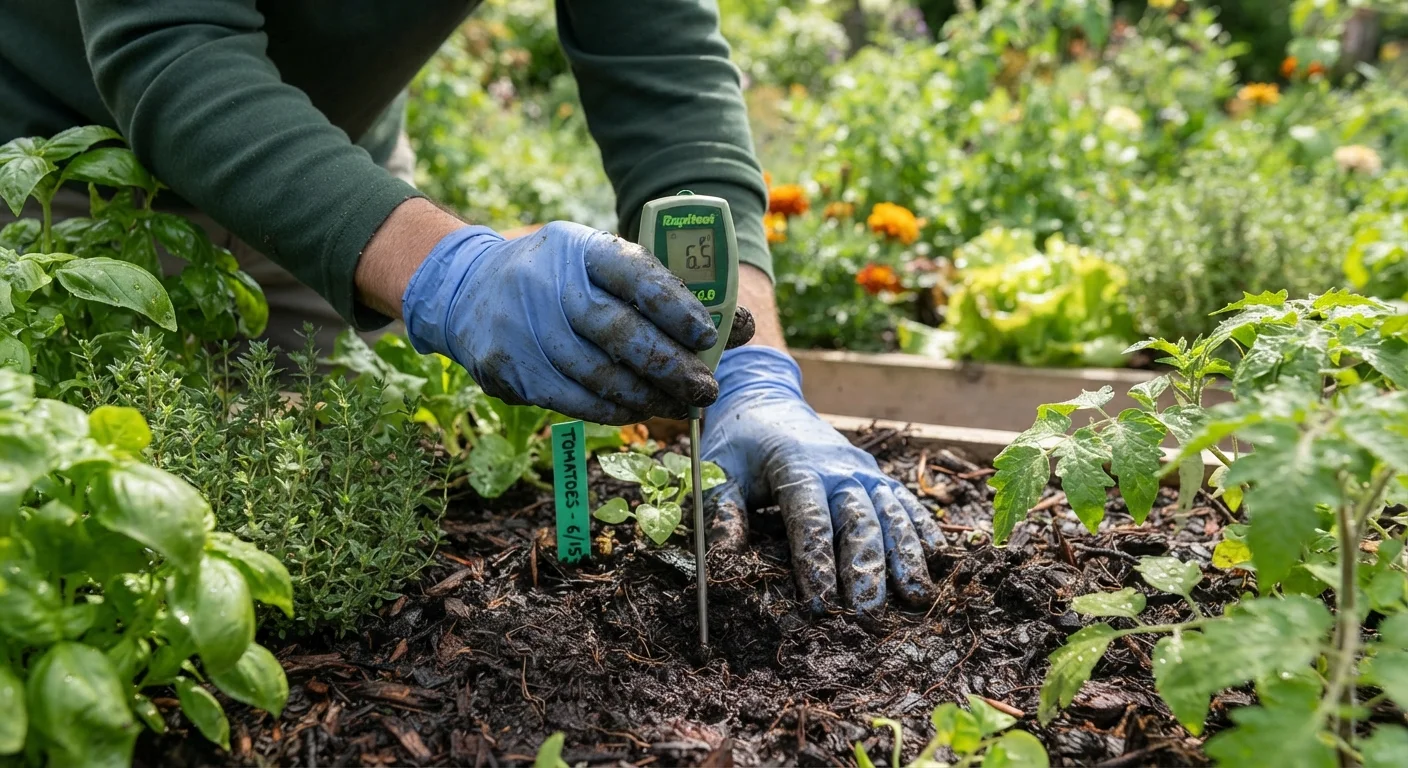
Why pH Is the Hidden Variable in Your Garden
You water consistently, you fertilize on schedule, and yet your tomatoes look pale and your lawn has stubborn yellow patches. The culprit may not be what you're adding to the soil - it may be the soil itself. Specifically, the pH level determines whether the nutrients you apply are actually accessible to your plants.
Think of soil pH as a gate. When the gate is open - meaning pH is in the right range - water carries dissolved nutrients directly into plant roots. When the gate is partially closed due to extreme acidity or alkalinity, those same nutrients become chemically bound to soil particles and stay out of reach, no matter how much fertilizer you apply. This phenomenon is called nutrient lockout.
Understanding pH is foundational to good soil management, and it connects directly to other practices like fertilizing and watering. Our guide on what lawn fertilizer labels actually mean explains how N-P-K ratios work - but those nutrients only deliver results when pH is in a workable range.
6.0-7.0
Optimal pH range for most garden plants
According to University Extension soil science resources, the majority of vegetables, ornamentals, and turf grasses achieve best nutrient uptake in this slightly acidic range.
10×
Change in acidity per pH unit on the scale
The pH scale is logarithmic, meaning a soil at pH 5.0 is ten times more acidic than one at pH 6.0 - a difference that significantly impacts nutrient chemistry.
~3-6 months
Typical time for lime to raise soil pH
Cooperative extension guidelines generally suggest retesting soil three to six months after applying amendments to assess the full effect before applying more.
How pH Affects Specific Nutrients
Different nutrients become available or locked out at different pH levels. Here's what happens at the extremes:
- Too acidic (below 6.0): Phosphorus becomes difficult for roots to absorb. Manganese and aluminum can reach toxic concentrations. Iron and zinc may be available in excess, causing their own problems.
- Too alkaline (above 7.5): Iron, manganese, copper, and zinc all become less soluble. This commonly causes chlorosis - a yellowing between leaf veins - even in well-fertilized soil.
Nitrogen, the nutrient most associated with lush green growth, is particularly sensitive to pH because it depends on soil microbes to convert it into a plant-usable form. Those microbes function best in a near-neutral pH range.
Testing Your Soil: Where to Start
Never adjust your soil pH without testing first. Applying lime or sulfur blindly can push pH further in the wrong direction. There are two practical testing routes:
- Home test kits and meters: Widely available and easy to use, these provide a reasonable ballpark reading. Collect samples from several spots in the garden, mix them, and test the blend for a representative result.
- Cooperative extension lab testing: Most US land-grant universities run cooperative extension programs that offer soil testing for a modest fee. These lab reports include pH, nutrient levels, and specific amendment recommendations calibrated to your region and intended crops - far more actionable than a home kit alone.
Take samples from the root zone - typically the top 4 to 6 inches of soil. Avoid sampling right after fertilizing or heavy rain, which can skew readings.
Test Before You Amend
Always get a soil test result in hand before purchasing lime or sulfur. Your local cooperative extension service can provide region-specific lab testing - often for under $20 - with amendment recommendations tailored to your crop goals. Applying amendments without test data is one of the most common and costly garden mistakes.
Adjusting pH: Raising and Lowering
Once you have your test results, correction is straightforward - though not instant. Soil chemistry changes slowly, and most amendments need several months to work fully.
Raising pH (Reducing Acidity)
Ground limestone is the standard tool. Calcitic lime is the most common form; dolomitic lime is preferred when your soil is also low in magnesium. Application rates depend on your current pH, your target pH, and your soil texture - clay soils require more amendment than sandy soils. Work lime into the soil before planting when possible, and retest after three to six months.
Lowering pH (Reducing Alkalinity)
Elemental sulfur is the most effective long-term option. Soil bacteria convert it to sulfuric acid over time, which requires warm, moist conditions. Results typically take two to three months to appear. Acidifying fertilizers (those containing ammonium-based nitrogen) can help sustain lower pH over time. Incorporating organic matter such as compost also tends to nudge pH toward a more neutral range in both acidic and alkaline soils.
If your soil feels dense or compacted alongside a pH problem, address both together. Our guide on why your garden soil feels like concrete explains how structure and chemistry interact.
Plants With Specific pH Preferences
Most common garden plants are flexible within the 6.0-7.0 range, but some have distinct preferences worth knowing:
| Plant Type | Preferred pH Range |
|---|---|
| Most lawn grasses | 6.0-7.0 |
| Vegetables (general) | 6.0-6.8 |
| Blueberries | 4.5-5.5 |
| Azaleas and rhododendrons | 4.5-6.0 |
| Roses | 6.0-6.5 |
| Lavender | 6.5-7.5 |
If you're growing blueberries or acid-loving ornamentals in a naturally alkaline yard, consider raised beds with custom soil blends rather than trying to lower the pH of a large area - it's more practical and gives you direct control.
Good soil chemistry also works alongside other healthy garden habits. For example, the right pH paired with proper deep, infrequent watering encourages roots to grow deeper into the corrected soil zone, amplifying the benefits of your pH work.
Frequently Asked Questions
Most vegetables, flowers, and lawn grasses thrive in a pH range of 6.0 to 7.0. This slightly acidic zone keeps the broadest range of nutrients available at the root zone. Some plants - like blueberries and azaleas - prefer more acidic conditions around 4.5 to 5.5.
Inexpensive pH test kits and digital meters are widely available at garden centers. Collect small soil samples from several spots in your garden, mix them together, and follow the kit instructions. For the most accurate results, send samples to your local cooperative extension service.
Ground limestone (lime) is the standard amendment for raising soil pH. Calcitic lime works quickly; dolomitic lime also adds magnesium. Apply according to your soil test results and work it into the top several inches of soil. Retest in three to six months.
Elemental sulfur is the most common amendment for lowering pH. Soil microbes convert it into sulfuric acid over time, which takes several months. Acidifying fertilizers can also help maintain lower pH over the long term.
Most pH adjustments are gradual processes that take months, not days. Soil type, organic matter content, and the degree of imbalance all affect how fast amendments work. Avoid large, rapid corrections, which can shock plants and disrupt soil biology.
Yellowing despite fertilization is a classic sign of a pH problem. When pH is out of range, nutrients in the soil become chemically locked and unavailable to roots - a condition called nutrient lockout. Testing and correcting pH often resolves the issue without adding more fertilizer.
The content provided on our blog site traverses numerous categories, offering readers valuable and practical information. Readers can use the editorial team’s research and data to gain more insights into their topics of interest. However, they are requested not to treat the articles as conclusive. The website team cannot be held responsible for differences in data or inaccuracies found across other platforms. Please also note that the site might also miss out on various schemes and offers available that the readers may find more beneficial than the ones we cover.