

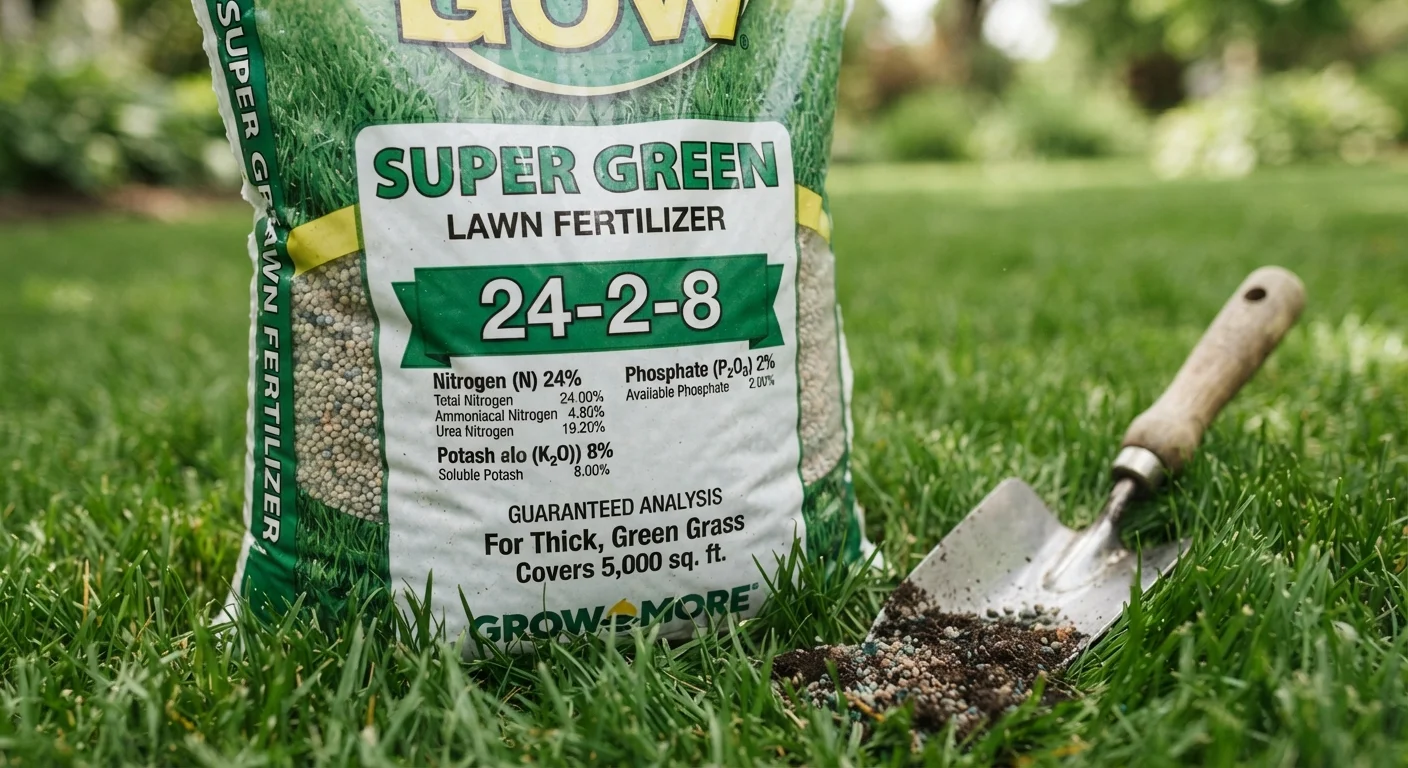
The Three Numbers: What N-P-K Actually Tells You
Every fertilizer bag sold in the US must display a guaranteed analysis - a regulated section that leads with three bold numbers. Those numbers are the N-P-K ratio, and they always appear in the same order: nitrogen first, phosphorus second, potassium third.
Here is what each nutrient does for your lawn:
- Nitrogen (N) - Fuels leafy, green blade growth. It is the nutrient most responsible for that rich, dense color homeowners want. Lawns typically need more nitrogen than any other nutrient.
- Phosphorus (P) - Supports root development and seedling establishment. Many established lawns already have adequate phosphorus, and excess applications can run off into waterways. Some states restrict or ban phosphorus fertilizers for this reason.
- Potassium (K) - Strengthens the grass plant's overall resilience - helping it tolerate drought, cold, foot traffic, and disease pressure.
If a bag reads 28-0-6, it contains 28% nitrogen, 0% phosphorus, and 6% potassium by weight. The remaining 66% is carrier material - typically sand, clay, or other filler that helps spread the nutrients evenly across your lawn.
3
Primary nutrients listed on every fertilizer label
US federal law (the FIFRA framework) requires all fertilizer products to display guaranteed analysis of N, P, and K as the core label elements.
~50%
Of bag weight is typically inert carrier material
In a typical granular fertilizer, roughly half or more of the bag weight is filler - the actual nutrient percentages add up to far less than 100%, as shown by the N-P-K numbers.
16+
US states restrict phosphorus lawn fertilizer
As of widely reported state-level legislation, more than a dozen states have enacted restrictions or bans on phosphorus in lawn fertilizers to protect local water quality.
Beyond N-P-K: Other Label Information That Matters
The guaranteed analysis section often lists more than just N-P-K. Look for secondary nutrients - calcium, magnesium, and sulfur - and micronutrients like iron, manganese, and zinc. Iron, for example, can deepen green color without pushing excess growth, which is why iron-containing fertilizers are popular in late season.
Pay close attention to the release type, which is often noted near the ingredient list:
- Quick-release (water-soluble) fertilizers act within days. They produce fast results but increase the risk of burning grass if applied too heavily or during heat stress. They also leach out of the soil faster, requiring more frequent reapplication.
- Slow-release (controlled-release) fertilizers - often labeled with terms like sulfur-coated urea, polymer-coated, or IBDU - feed your lawn gradually over weeks or months. They are generally safer to apply and require fewer treatments per season.
Many products use a blend of both types for an initial green-up followed by sustained feeding. The label will specify the ratio if a blend is used.
Understanding soil pH is closely tied to fertilizer effectiveness. Even a perfectly chosen N-P-K ratio will underperform if your soil's pH prevents nutrient uptake. See our guide on soil pH and nutrient availability for how to test and correct your soil before fertilizing.
Get a Soil Test Before You Buy
Many homeowners choose fertilizers based on the bag's marketing claims rather than what their soil actually needs. A soil test - available through most state cooperative extension offices, often for a modest fee - takes the guesswork out of the process. It will tell you your nitrogen, phosphorus, and potassium levels as well as your soil pH, so you can buy a product that genuinely targets your lawn's deficiencies.
How to Use the Label to Choose the Right Product
The label gives you the data - but applying it well requires knowing what your lawn currently needs. A soil test from your local cooperative extension office is the most reliable starting point. It will tell you your existing nutrient levels and pH, so you are not guessing.
Once you have test results in hand, match your fertilizer choice to the gaps:
- If nitrogen is low and roots are established, choose a high-N formula with slow-release nitrogen for most of the season.
- If you are seeding or reseeding, a modest phosphorus level may benefit germination - check whether your state permits phosphorus fertilizers first.
- If potassium is deficient - common in sandy soils - look for a higher K number to improve drought and stress tolerance.
Always check the application rate printed on the bag. This will tell you how many square feet the bag covers and how much to apply per 1,000 square feet. Applying more than directed does not speed up results - it raises the risk of burn and waste.
For a month-by-month view of when to apply fertilizer based on your region and grass type, the Complete Lawn Care Calendar for US Homeowners breaks down timing across cool-season and warm-season grasses. Reading fertilizer labels is a skill that works a lot like decoding tire sidewall numbers - once you understand the system, the information becomes immediately useful rather than overwhelming.
Frequently Asked Questions
They represent the percentages of nitrogen (N), phosphorus (P), and potassium (K) by weight, always listed in that order. A bag labeled 24-6-12 contains 24% nitrogen, 6% phosphorus, and 12% potassium. The rest of the bag weight is filler material that helps distribute the nutrients evenly.
There is no single best ratio - it depends on your soil's existing nutrient levels and your grass type. A soil test reveals what your lawn is actually missing. Most established lawns benefit from higher nitrogen, but applying excess phosphorus without need can harm local waterways and is restricted in some states.
Quick-release fertilizers deliver nutrients rapidly, producing fast green-up but requiring more frequent applications and carrying a higher risk of burning grass if over-applied. Slow-release formulas break down gradually over weeks or months, providing steadier feeding with lower burn risk and fewer applications needed overall.
A soil test is strongly recommended before choosing a fertilizer. It tells you which nutrients are deficient, your soil's pH level, and whether you risk over-applying something already present in adequate amounts. Many cooperative extension offices offer low-cost testing kits.
The guaranteed analysis is a legally required section that lists the minimum percentages of each nutrient the product must contain. It ensures you are getting what the label promises and allows meaningful comparison between products.
Yes. Over-fertilizing - especially with high-nitrogen products - can burn grass blades, damage roots, and contribute to nutrient runoff that harms local water quality. Always follow label rate instructions and apply only as directed.
The content provided on our blog site traverses numerous categories, offering readers valuable and practical information. Readers can use the editorial team’s research and data to gain more insights into their topics of interest. However, they are requested not to treat the articles as conclusive. The website team cannot be held responsible for differences in data or inaccuracies found across other platforms. Please also note that the site might also miss out on various schemes and offers available that the readers may find more beneficial than the ones we cover.