

Our Verdict
Cash-only spending is a genuinely effective tool for reining in impulsive or habitual overspending in day-to-day categories. It creates a visceral budget boundary that digital payments simply cannot replicate. That said, it's not a complete financial system — it sidesteps modern conveniences, safety nets, and the credit-building that most households also need.
Households that consistently overspend in a few specific categories (groceries, dining out, entertainment) and want a low-tech, high-accountability method to get those habits under control.
What Cash-Only Spending Actually Means
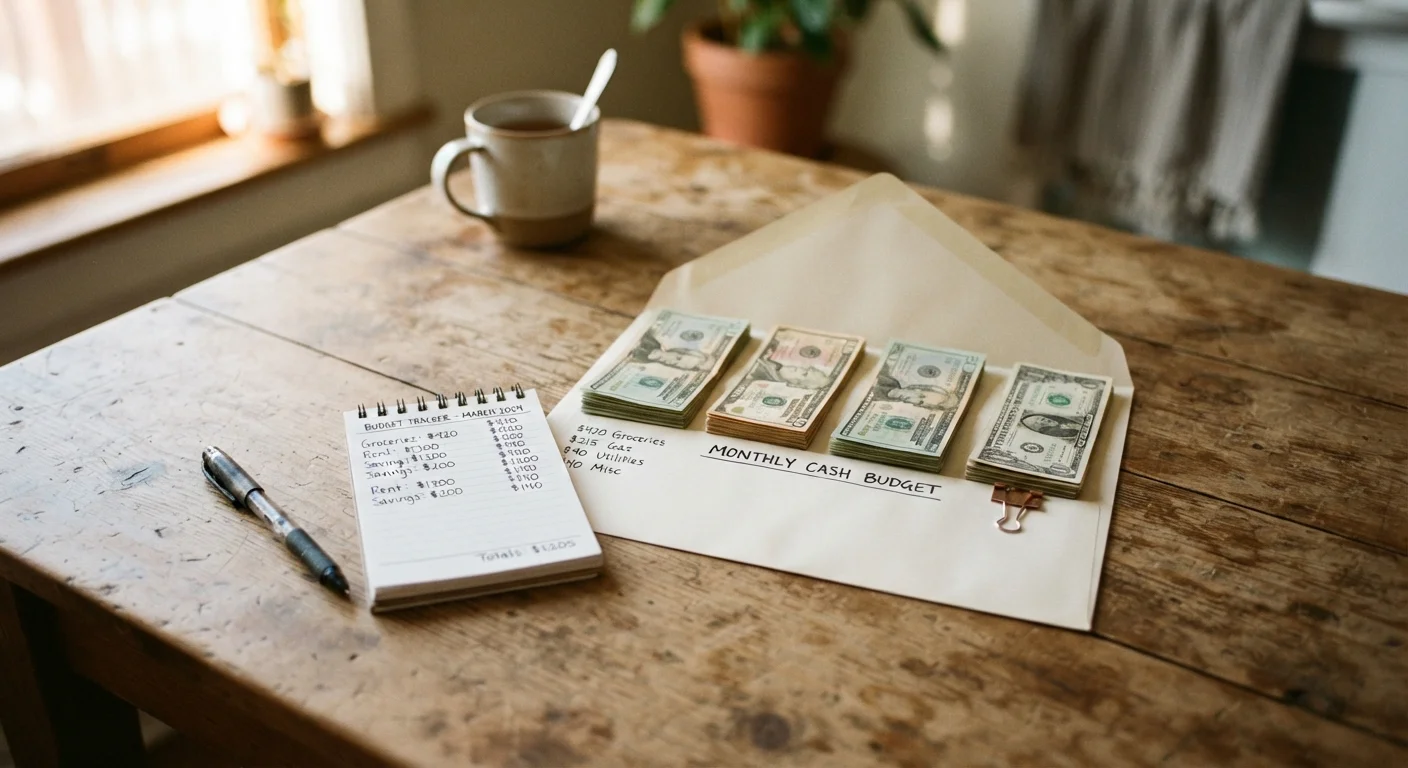
Cash-only budgeting means withdrawing physical money at the start of each budget period and using only that cash for designated spending categories. Once the cash runs out, spending in that category stops — no exceptions. The approach is closely linked to the envelope method, where separate envelopes hold cash earmarked for groceries, gas, dining, and similar variable expenses. For a deeper look at how that system works in practice, see what envelope budgeting actually looks like in a modern household.
Most people who use this method don't go fully cashless in every corner of their life. Fixed bills — rent, utilities, insurance — typically stay on autopay or card. The cash discipline is focused where spending tends to slip: the everyday, discretionary purchases that quietly drain a budget month after month.
The Real Advantages of Paying in Cash
There's a reason financial educators have recommended this approach for decades — it works for a lot of people.
Creates a hard spending limit that's impossible to ignore
When the cash in an envelope is spent, there's nothing left to spend. This physical boundary is far harder to rationalize past than a credit card limit.
Reduces impulse purchases through payment "pain"
Studies in consumer behavior find that physically handing over cash registers more acutely in the brain than a card swipe, making discretionary purchases feel more deliberate.
No app or tracking required — balance is always visible
The remaining cash in your wallet or envelope is an instant, accurate snapshot of where you stand, with zero data entry needed.
Works well for irregular or variable spending categories
Groceries, dining, entertainment, and personal care are notoriously hard to track digitally in real time — cash makes the limit tangible and immediate.
Removes temptation to "float" spending on credit
Without a card to fall back on, there's no opportunity to tell yourself you'll pay it off later — a habit that frequently leads to revolving credit card balances.
The psychological friction of handing over physical bills is the biggest driver. Research in consumer behavior consistently finds that paying with cash registers as more "painful" than swiping a card, which tends to reduce the size and frequency of purchases. That's not a bug — it's the feature.
Cash also delivers instant clarity. You don't need an app, a spreadsheet, or an end-of-month reconciliation to know how much you have left. The envelope in your wallet tells you exactly where you stand. If you're weighing different tools for tracking this kind of spending, our comparison of budgeting tools breaks down what each option offers.
Where the Cash-Only Method Falls Short
This approach has genuine limitations that are worth understanding before committing to it.
Lost or stolen cash is unrecoverable
Unlike debit or credit cards, physical cash has no fraud protection. If your wallet is lost or stolen, that money is gone — period.
Incompatible with online shopping and subscriptions
A significant share of everyday household spending now happens online or through automatic billing, which requires a card or bank account — cash doesn't reach these transactions.
Forfeits credit card rewards and purchase protections
Many credit cards offer cash back, travel points, extended warranties, or dispute resolution on purchases — all of which disappear when you pay exclusively in cash.
Does nothing to build or maintain credit history
Credit scores depend on active credit use and repayment history. A household that stops using credit entirely may see their score stagnate or decline over time.
Carrying large amounts of cash can be impractical or risky
For weekly grocery runs or a full month of discretionary spending, the cash amounts involved can be bulky and uncomfortable to carry safely.
Requires frequent ATM trips and potential withdrawal fees
Regularly withdrawing cash — especially from out-of-network ATMs — can add up in fees and time, partially offsetting the budgeting benefit.
The friction that makes cash effective also makes it inconvenient. Online shopping, subscription services, and many bill payment systems simply don't accept cash. A household that goes fully cash-only would need workarounds — prepaid cards, money orders — that add friction and potential fees.
There's also the security issue. Lost or stolen cash is gone. A stolen debit or credit card typically comes with fraud liability protections under federal law; a stolen wallet full of your grocery budget does not. That's a meaningful real-world risk, particularly for anyone who commutes or travels regularly.
Cash and Credit-Building Don't Mix
If building or repairing a credit score is a household priority, going fully cash-only works against that goal. Credit scores are built through the responsible use and repayment of credit accounts. Completely abandoning card use can cause an established score to drift downward over time as accounts go inactive. A hybrid approach — using a card for one or two fixed, predictable expenses and paying it in full each month — preserves credit health while still applying cash discipline where it counts most.
Making the Method Work Without Going All-In
The most practical version of cash-only budgeting for most households is a hybrid: use cash for the categories where you consistently overspend, and keep cards or autopay for fixed, predictable expenses. This captures the behavioral benefit where it matters most without the logistical headaches.
A few practical steps to make it stick:
- Identify your two or three highest-drift categories from last month's spending — those are the best candidates for cash.
- Withdraw the budgeted amount at the start of each week or month, not as-needed (which tends to undercut the discipline).
- When cash runs out in a category, treat it as a hard stop rather than a signal to withdraw more.
Pair this with a regular end-of-month check-in. Our monthly budget reset checklist walks through exactly how to review what worked and adjust category limits before the next month starts.
If you're deciding between cash-based approaches and more structured systems, zero-based budgeting vs. envelope budgeting offers a direct comparison worth reading.
This article is for general informational purposes only and does not constitute personalized financial advice. Consider consulting a qualified financial professional for guidance specific to your household's situation.
The content provided on our blog site traverses numerous categories, offering readers valuable and practical information. Readers can use the editorial team’s research and data to gain more insights into their topics of interest. However, they are requested not to treat the articles as conclusive. The website team cannot be held responsible for differences in data or inaccuracies found across other platforms. Please also note that the site might also miss out on various schemes and offers available that the readers may find more beneficial than the ones we cover.