

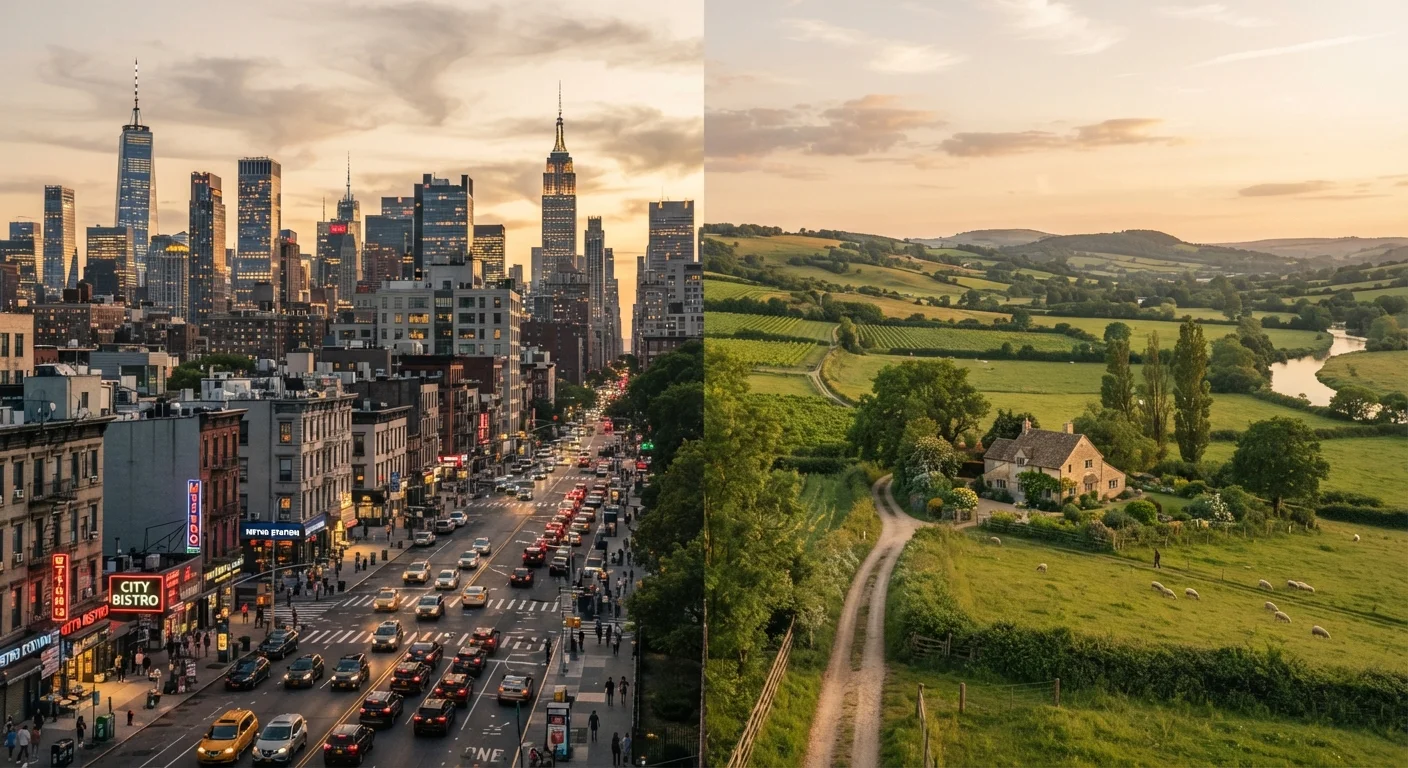
Option A
City Breaks
The high-energy, culture-packed urban escape.
Best for: Households craving museums, dining variety, nightlife, and efficient access to multiple attractions in a compact trip.
Option B
Rural Retreats
The slow-paced, restorative nature-focused getaway.
Best for: Travelers seeking quiet landscapes, outdoor activities, and a deliberate break from the noise and pace of everyday urban life.
What Actually Separates These Two Travel Styles
The city-versus-rural question isn't really about geography — it's about pace, priorities, and what kind of experience you want to carry home. A city break is typically a short, activity-dense trip to an urban center where the draw is density: art, food, architecture, and nightlife compressed into walkable neighborhoods. A rural retreat, by contrast, trades variety for depth — fewer things to do, but more space and quietude to actually experience them.
Both formats exist across a wide range of US destinations. Cities like New Orleans, Chicago, and San Diego each offer distinct cultural identities that reward even a weekend visit. Rural options span from Appalachian mountain cabins and Great Plains farmsteads to coastal Maine villages and high-desert New Mexico. The setting shapes everything: how you move around, what you spend, and how rested you feel at the end.
If you're still identifying which travel style resonates with your household, matching your interests to a destination type is a useful starting framework before comparing environments.
| Criterion | City Breaks | Rural Retreats |
|---|---|---|
| Typical pace | Fast, activity-dense | Slow, open-ended |
| Accommodation cost | Higher on average | Often lower |
| Transportation needed | Transit usually available | Car typically required |
| Dining options | Wide range, eat out often | Limited; self-catering common |
| Best trip length | 2–5 days | 3–7+ days |
| Crowds & noise | Higher, especially weekends | Low; seasonal variation |
| Outdoor access | Parks and waterfronts | Trails, lakes, open land |
| Cell/Wi-Fi coverage | Reliable throughout | Patchy; verify in advance |
Costs, Logistics, and Planning Realities
Urban travel typically concentrates its expenses: hotel rates in city centers are usually higher than comparable rural lodging, and dining out in cities adds up quickly. That said, cities also offer free or low-cost attractions — public parks, free museum days, historic neighborhoods — that can offset some expenses. Public transit means you may not need a rental car, which is itself a significant saving.
Rural trips invert this pattern. Nightly rates for cabins, farm stays, or country inns are often lower, and cooking your own meals in a rented cottage can cut food costs substantially. The trade-off is transportation: most rural destinations in the US require a car, and fuel and rental costs can close the gap quickly. It's worth mapping the full logistics before assuming one is cheaper than the other.
~60%
US leisure trips under 300 miles from home
US Travel Association research consistently shows the majority of American leisure trips are short-distance, making both urban and rural options highly accessible for most households.
2–3x
City hotel rates vs. rural lodging
Industry lodging data from sources including STR and AAA regularly show urban hotel averages running two to three times higher than comparable rural or small-town accommodation nightly rates.
49 of 50
US states with national forest or park land
According to the USDA Forest Service and National Park Service, nearly every US state contains federally managed public land, making rural nature access geographically broad.
Planning complexity also differs. Cities tend to have robust infrastructure for visitors — booking platforms, clear transit maps, tourist offices. Rural areas may require more self-directed research: road conditions, cell coverage, nearest emergency services, and whether your accommodation has reliable utilities. A destination research checklist can help you cover those bases before committing to either type of destination.
Matching the Environment to Your Household's Goals
The most useful question isn't "which is better" but "what does our household actually need right now?" Families with toddlers who nap on schedules often find rural retreats far less stressful than navigating city crowds and transit with a stroller. Couples celebrating a milestone anniversary might prefer the restaurant scene and cultural richness of a city. Adult friend groups with wildly different interests frequently do well in cities, where everyone can split off and regroup for dinner.
Energy level matters enormously. City breaks reward people who are ready to be on — moving, deciding, queuing, navigating. Rural retreats reward people who are ready to decompress. Neither is inherently more valuable, but choosing the wrong one for your current state of mind can leave you feeling more worn down than when you left. Slow travel principles offer an interesting middle path if your group leans toward depth over breadth regardless of environment.
For groups with genuinely competing preferences, choosing a destination that works for everyone outlines practical strategies for bridging different needs — useful whether you ultimately land on a city or the countryside. And if the question of how you'll get there is still open, comparing road trips versus flying can sharpen that side of the decision too.
The content provided on our blog site traverses numerous categories, offering readers valuable and practical information. Readers can use the editorial team’s research and data to gain more insights into their topics of interest. However, they are requested not to treat the articles as conclusive. The website team cannot be held responsible for differences in data or inaccuracies found across other platforms. Please also note that the site might also miss out on various schemes and offers available that the readers may find more beneficial than the ones we cover.