

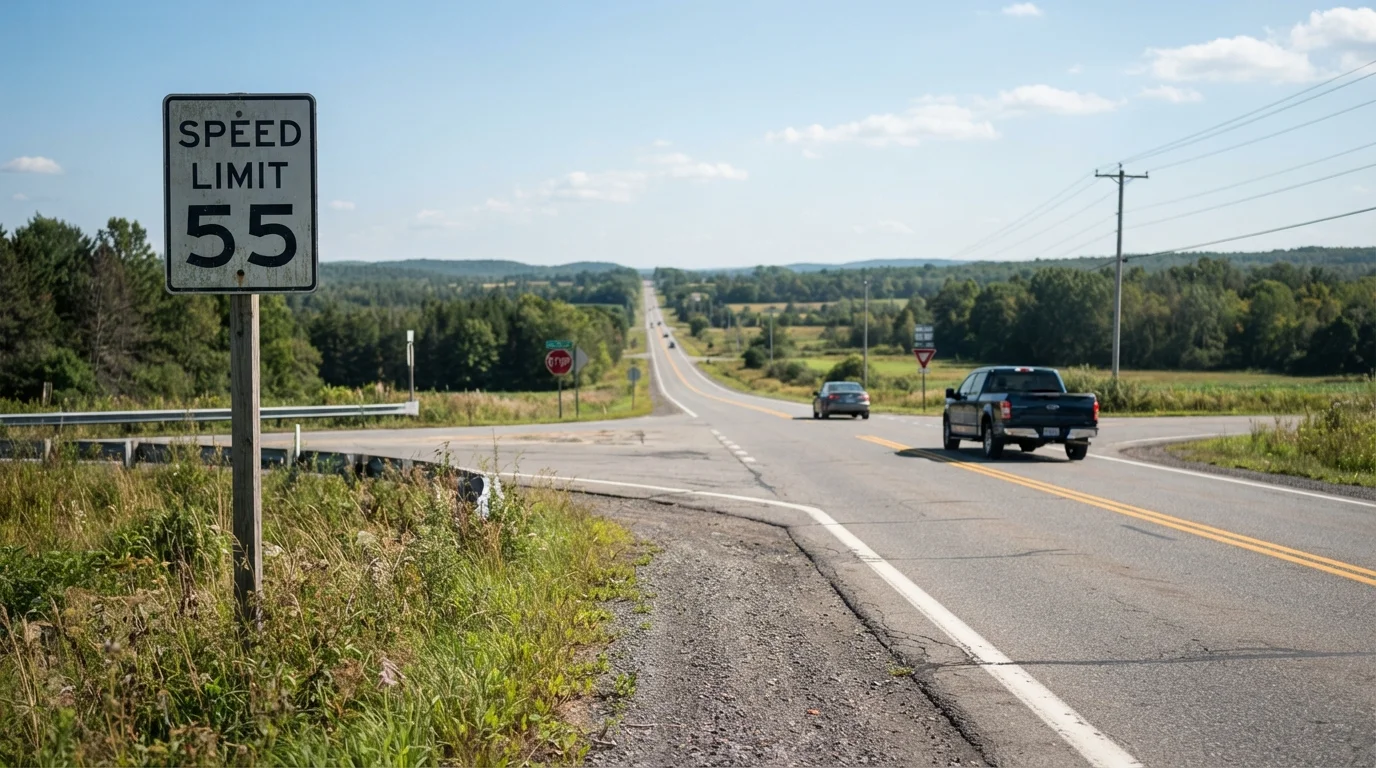
Why Speed Limits Confuse Even Experienced Drivers
Most drivers treat speed limits as straightforward: see a sign, obey it. But a significant share of US roads - particularly rural highways, residential streets, and newly opened construction areas - carry no posted limit at all. When there's no sign, many drivers guess, assume, or simply follow traffic flow. All three approaches can land them with a ticket or, worse, contribute to a crash.
Speed limit law in the US operates on two parallel tracks. Statutory limits (also called prima facie limits) are the default numbers set by each state for specific road types. Posted limits are signs that either confirm or override those defaults for a specific stretch of road. Understanding the difference matters because ignorance of the default isn't a legal defense.
Add to this the concept of "reasonable and prudent" speed - a legal standard used in many states that means you can technically be cited for driving at the posted limit if conditions (rain, fog, heavy pedestrian traffic) make that speed unsafe. The sign is a ceiling, not a blanket permission slip.
Assuming no sign means no limit.
Why it happens: Drivers learn from posted signs and rarely read the statutory default tables in driver handbooks. When a sign is absent, many assume there's no enforceable limit.
Treating the posted limit as safe in any conditions.
Why it happens: The number on the sign feels like official permission to drive that speed regardless of rain, fog, or heavy traffic. Most drivers don't connect the posted number to the underlying "reasonable and prudent" standard.
Missing school zone and work zone temporary limit changes.
Why it happens: School zone limits are often time-restricted (e.g., 20 mph when children are present), and work zones may have reduced limits only when workers are actively on-site. Drivers on familiar routes go on autopilot and miss these fluctuating conditions.
Driving well below the flow of traffic and thinking it's the safest choice.
Why it happens: Many drivers believe slower always means safer. While reducing speed for conditions is appropriate, driving significantly below the posted or statutory limit on a high-speed road creates a speed differential that increases crash risk.
Applying home-state defaults while driving in a different state.
Why it happens: Drivers naturally use the rules they know. Rural two-lane highways that are 55 mph at home may be 65 mph - or 45 mph - in another state, with no visible sign to prompt a correction.
Default Speed Limits by Road Type: The Basics
While exact numbers vary by state, common statutory defaults across the US follow a recognizable pattern:
- Residential streets: typically 25 mph, though some states set this at 30 mph
- Urban arterial roads: commonly 30-35 mph unless posted otherwise
- Rural two-lane highways: often 55 mph as a baseline
- Interstate highways: minimums and maximums vary widely by state - from 65 mph to 85 mph in some rural stretches of Texas
When crossing state lines, these defaults shift. A rural highway that's 55 mph in one state may carry a 65 mph default just over the border. Checking your state's driver handbook - or the handbook for states you're driving through - is the only reliable way to know the correct number. The Highway Driving for New Drivers guide covers this context well for anyone newer to long-distance driving.
Speed Limits Change at State Lines
Default statutory speed limits are set independently by each state. A rural highway that carries a 55 mph default in one state may have a 65 mph or even 45 mph default just across the border. Never assume the same rules apply. Check the official driver handbook for any state you plan to drive through, and pay close attention to posted signs near state borders where defaults may shift without warning.
Speed and Stopping Distance: The Physical Reality
One reason speed limit rules exist isn't arbitrary - it's physics. The faster you travel, the exponentially longer your stopping distance becomes. Reaction time is relatively constant for most drivers, but the distance your vehicle covers during that reaction window grows with every mile per hour. At 40 mph you need roughly twice the stopping distance you'd need at 25 mph, not just 60% more.
This is why residential default limits are low. Streets with parked cars, driveways, children, and cross-traffic demand a margin of error that higher speeds don't allow. For a deeper look at the numbers, the Science Behind Stopping Distances breaks down how speed, road surface, and reaction time interact in practical terms.
The same logic applies to following distance. Speed and gap are inseparable - see Tailgating: The Gap Between Cars That Changes Everything for how to manage both together.
~29%
Of traffic fatalities linked to speeding
According to the National Highway Traffic Safety Administration (NHTSA), speeding is a factor in roughly 29% of all traffic fatalities in the US annually.
Double
Work zone speeding fines in most states
The majority of US states impose doubled or enhanced fines for speed violations in active work zones, though exact amounts vary by jurisdiction.
Driving Confidently Within the Rules
Understanding speed limits isn't about fear of tickets - it's about building the kind of situational awareness that keeps you and others safe. Experienced drivers constantly read road conditions, adjust speed accordingly, and treat posted limits as context, not just commands. The Scanning the Road Ahead guide explains how skilled drivers process the full road environment rather than reacting to what's immediately in front of them.
If you're unsure of the default limit on an unfamiliar road, the conservative approach is always safer: slow down, look for context clues (road width, land use, signage for cross streets), and leave extra margin. Speed limits represent a minimum level of care, not an optimal driving target in all conditions.
Lane discipline also plays into speed management - What the Left Lane Is Actually For clarifies how lane choice and speed interact on multi-lane roads, and Merging, Yielding, and Right-of-Way addresses the speed-related decisions drivers face at intersections and on-ramps.
This article provides general driver education and is not a substitute for your state's official driver handbook or legal advice. Traffic laws vary by state; always verify local regulations before driving in an unfamiliar jurisdiction.
The content provided on our blog site traverses numerous categories, offering readers valuable and practical information. Readers can use the editorial team’s research and data to gain more insights into their topics of interest. However, they are requested not to treat the articles as conclusive. The website team cannot be held responsible for differences in data or inaccuracies found across other platforms. Please also note that the site might also miss out on various schemes and offers available that the readers may find more beneficial than the ones we cover.